Bio-based Construction Polymer Market Snapshot

Key Players

  • BASF SE (Germany)
  • Dupont de Nemours Inc. (US)
  • Arkema SA (France)
  • Evonik Industries AG (Germany)
  • Mitsui Chemicals Inc. (Japan)
  • PolyOne Corporation (US)
  • Royal DSM N.V. (Netherlands)
  • Covestro AG (Germany)
  • NatureWorks LLC (US)
  • Novamont S.p.A (Italy)

Market Size

Base Year 2024
$13.68 Bn
CAGR
14.4%
Forecast 2034
$52.52 Bn

Market Segments

By Product
  • Polyurethane
  • PolyethyleneTterephthalate
  • Epoxies
  • Cellulose Acetate
  • Others
By Application
  • Pipe
  • Profile
  • Insulation
  • Others

Market Dynamics

Drivers
  • Rising eco-consciousness
  • Advancements in bio-technology
Restraints
  • High production costs
  • Regulatory compliance issues
Opportunities
  • Growing sustainability trends
  • Emerging green building mandates

Market Size

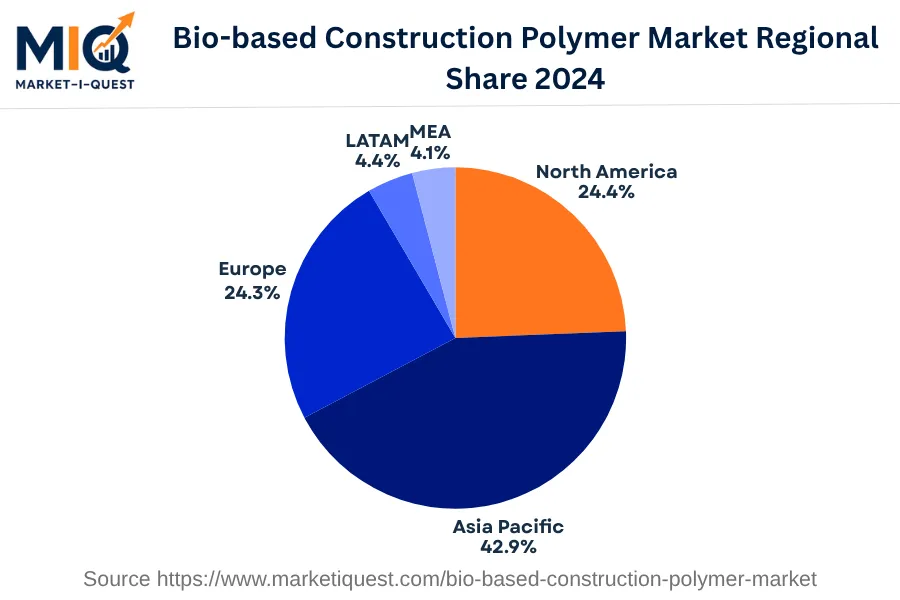
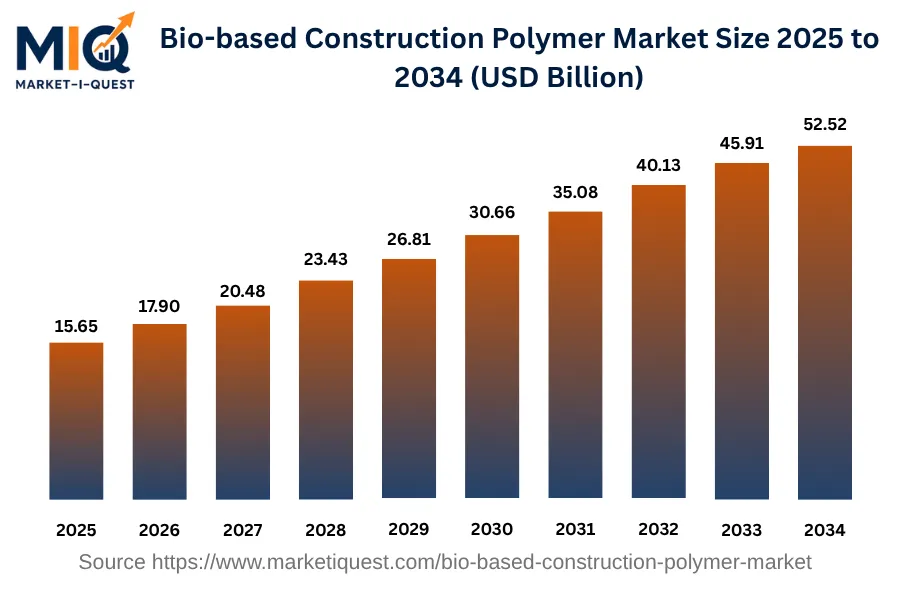
The Bio-based Construction Polymer Market size is projected to increase from USD 15.65 billion in 2025 to USD 52.52 billion in 2034, growing at a CAGR of 14.4%. From 2024, when the market size was estimated to be USD 13.68 billion, a constant rise in the value is foreseen. In 10 years, from 2025 to 2034, the market size is projected to rise by about USD 36.87 billion. This consistent growth over the years is anticipated primarily due to the increasing demand and adoption of bio-based polymers in construction. Regionally in 2024, the Asia-Pacific held the most substantial share of the market at 42.91%. North America and Europe closely followed, holding virtually even shares at 24.36% and 24.28%, respectively. Meanwhile, the remaining market share was divided between LATAM at 4.37% and the MEA at 4.08%.

Key Takeaways

  • By Product - Polyurethane held the major share in the Bio-based Construction Polymer Market.
  • By Application - Pipe led the Bio-based Construction Polymer Market accounting for a significant share.
bio-based-construction-polymer-market market size

Key Driving Factors

Implementation of Strict Environmental Regulations

The enforcement of stringent environmental guidelines globally is a key factor driving the Bio-based Construction Polymer Market. Governments, especially in regions like Europe and North America, are progressively tighter requirements on carbon emissions and waste production, pushing constructors towards more environmentally sound materials. Bio-based construction polymers are derived from renewable resources and exhibit lower carbon footprints, aligning with these regulations. For example, the EU's Renewable Energy Directive and the Paris Agreement have set clear targets for reducing greenhouse gas emissions, encouraging industries to adopt greener alternatives––such as bio-based construction polymers.

Emergence of Bio-Based Construction as Part of the Circular Economy

The shift towards a circular economy, which emphasizes resource efficiency and waste reduction, is another prominent driver of the Bio-based Construction Polymer Market. Bio-based construction polymers support this model due to their renewable nature and potential for recycling. For instance, construction firms and architects are increasingly exploring the 'cradle to cradle' approach which encompasses the use, recycling, and reuse of materials in the building process. In this framework, bio-based polymers can be repurposed after a building's end of life, deterring the waste that typically comes from demolitions. This aligns with the circular economy concept, reinforcing the market demand for bio-based construction polymers.

Market Evolution by Timeline

2019-2023
During 2019-2023, the bio-based construction polymer market saw increased adoption particularly in the European and North American regions due to growing sustainable construction practices. The most demanded products were polyurethane, epoxy resins, and cellulose. A technological milestone included the development of advanced bio-polymer structures integrated with conventional construction materials. A notable constraint during this period was the challenge in producing high performance bio-based polymers at a competitive cost. Policy-wise, the EU's Bioeconomy Strategy encouraged the use of bio-based polymers. Commercially, there was a trend of manufacturers forming strategic alliances with material research institutes to enhance R&D capabilities. The major risk during this period was the price volatility of feedstock.
2024
In 2024, we saw that the Asian market, particularly China and India, had begun showing an increased interest in bio-based construction polymers. The primary demand drivers included infrastructural development projects and an increase in green building certifications. The supply side saw significant advances in the formulation of bio-based resins for superior curing properties. `Building Regulation 2020` was a significant legislation that influenced adoption in the Indian market by specifying standards for sustainable construction materials. There was a shift towards partnership models with construction companies and architects. This phase also had challenges, wherein acceptance and trust in bio-based materials were a barrier, prompting companies to provide extensive material certifications.
2025-2029
The 2025-2029 period witnessed a paradigm shift in the demand with a move towards functionally graded bio-based construction polymers. Now, the supply side had developed the capability to manufacture these bio-polymer composites. The 'Green Building Incentive Program' by the U.S. federal government promoted the adoption of these green materials. A common contract type included long term agreements with leading construction firms that ensured a steady supply of bio-based polymers. However, the increased demand for functionally graded polymers posed a challenge in maintaining quality standards, driving new partnerships and certification programs.
2030-2034
By 2030-2034, there was a surge in global demand for bio-based construction polymers, stimulated by carbon neutral construction trends. These polymers were now integrated into smart and sustainable housing solutions. Commercially, BioBased-NanoTech, a major player, led in perfecting mass production of advanced nanocomposite polymers while complying with the EU's revised Bioeconomy Strategy guidelines. Supply contracts typically included clauses that factored in pricing adjustments against feedstock price fluctuations. The ongoing challenge was meeting the global demand while adhering to evolving green construction standards and regulations.

Future Market Outlook

Future Opportunities

The future opportunities within the bio-based construction polymer sector are influenced by current regulatory frameworks, technological advancements, and evolving consumer preferences towards sustainability. As of recent updates in 2023, countries like Germany and Sweden have implemented stringent building regulations favoring materials that have a lower carbon footprint. These regulations create a pathway for manufacturers to innovate and commercialize new bio-based products that fulfill these requirements. Companies such as Dow are exploring partnerships with start-ups focused on bioplastics to expand their product offerings. The increasing consumer demand for sustainable buildings will likely lead to a decline in traditional petrochemical-based polymers, with regional markets, particularly in North America and Europe, positioned to advance in bio-based alternatives. In addition, the establishment of organizations like the BioMaterials Impact Group in 2022 serves to facilitate collaboration and best practices among industry players. Research grants from institutions such as the National Science Foundation encourage academia-industry partnerships to explore bio-based alternatives for various construction applications, leading to enhanced material properties such as durability and energy efficiency. As market participants respond to both regulatory incentives and consumer behavior shifting toward environmental consciousness, the bio-based construction polymer sector is likely to experience expansive growth and increased integration into mainstream construction practices worldwide.

Segmentation Analysis

By Product

The market is divided into subsegments including Polyurethane, PolyethyleneTterephthalate, Epoxies, Cellulose Acetate, and Others. Polyurethane accounted for the largest revenue share while Epoxies are expected to grow at the fastest CAGR during the forecast period.

Largest Revenue Share

Polyurethane

Market Share Leader

Polyurethane, which comprises the largest revenue share segment, shows its dominance due to its versatility, durability, and cost-effectiveness. Polyurethane's applications extend across various industries, including automotive, furniture, and construction, offering a myriad of uses such as insulation, adhesives, sealants, and even protective coatings. As industries grow, so does the demand for polyurethane. It is particularly prominent in the construction and automotive sectors, where its light weight and strong insulating properties make it a desirable choice for manufacturers. Its consumption is increased in regions with robust industrial and commercial infrastructural developments like Asia, and North America. Furthermore, increasing regulation on energy conservation and carbon emissions also contributes to the growth of this subsegment as using polyurethane reduces energy usage and CO2 emissions. The purchasing decision for polyurethane-based products is largely driven by its lifetime value, durability and cost-effectiveness which makes it popular among the end users.

Fastest CAGR

Epoxies

Forecast Period Growth Leader

With a different story, Epoxies present the fastest CAGR outlook. Epoxy Resins are popular for their superior properties, including excellent chemical resistance, superb adhesion, and high heat resistance. Their growing acceptance in sectors such as electronics, aerospace, marine, and especially the automotive industry, which is moving towards electric vehicles where heat resistance is critical, is contributing to this subsegment's growth. Moreover, technological advancements like UV-curable Epoxy Resins are opening up new possibilities and increasing adoption. However, the high production cost and the increasing availability of alternative resins can hinder their growth trajectory. In terms of catalysts, the continuing R&D investments and the emergence of bio-based epoxy resins will spur the market further. Meanwhile, potential risks include the propensity for volatility of raw material prices and strict environmental regulations. As with any market segment, it's essential to carefully monitor these progress levers and potential obstacles.

By Application

The market is divided into subsegments including Pipe, Profile, Insulation, and Others. In 2024, Pipe accounted for the largest revenue share while Insulation is expected to grow at the fastest CAGR during the forecast period.

Largest Revenue Share

Pipe

Market Share Leader

The pipe application subsegment holds the largest share in the market revenue due to its wide implementation across multiple industries such as oil and gas, housing and construction, water supply, among others. With increasing urbanization and growing residential and commercial infrastructure development activities, the demand for pipes is driving market revenue growth significantly. Furthermore, the introduction of stringent regulations regarding the safety and efficiency of pipeline systems is also playing an essential role in the surge of pipe application share in market revenues. Lean manufacturing strategies focusing on reducing waste and inefficiency, while enhancing quality and productivity, have further boosted the pipe application's market dominance in 2024.

Fastest CAGR

Insulation

Forecast Period Growth Leader

The insulation application subsegment is predicted to exhibit the fastest growth during the forecast period. The rapid adoption of this technology is driven by increasing residential and commercial retrofitting activities, which demand energy-efficient insulation solutions. Also, due to persistent regulatory pressure for reducing energy consumption and curbing greenhouse gas emissions, the insulation application subsegment has registered positive growth trends. This transformation, coupled with significant capital investment in research and development activities, is acting as a catalyst for this subsegment's growth. However, the market may face near-term challenges pertaining to the flammability of insulation materials and adherence to stringent fire and safety regulations.

Competitive Analysis: Bio-based Construction Polymer Market

Key Market Players

Manufacturers / OEMs

BASF
Germany
Covestro
Germany
Arkema
France

Key Suppliers & Raw Materials

Mitsui Chemicals
Japan
DuPont
US
Evonik Industries
Germany

Distributors, Integrators & Channel Partners

Grand View Research
US
Emerald Performance Materials
US
TechSci Research
US

Porter’s Five Forces Analysis

The analysis provides insights into the competitive landscape of the Bio-based Construction Polymer Market.

Supplier Bargaining Power

High

Due to scarce resources and advanced technology requirements, suppliers have significant bargaining power.

Buyer Bargaining Power

Medium

Limited number of suppliers and increasing environmental concerns strengthen buyer bargaining power.

Threat of Substitutes

Low

High performance and environment-friendly nature of bio-based polymers limit threat of substitutes.

Threat of New Entrants

High

Increasing demand for eco-friendly solutions in construction encourages new entrants.

Competitive Rivalry

High

Existing players compete aggressively on innovation, affordability, and quality.

Regional Analysis

Geographic market dynamics and growth opportunities across key regions

Global Market Outlook

bio-based-construction-polymer-market market regional share

North America

In 2024, the North American Bio-based Construction Polymer market was characterized by steady growth, supported by robust demand & strategic investments. Sustainability concerns drove up demand for these environmentally friendly polymers, especially in the US, where stringent governmental regulations increased the appeal of bio-based alternatives to conventional synthetic materials. In Canada, significant investments in advanced technologies facilitated increased production and supply of these polymers, easing the pricing pressure for consumers.

A notable trend in 2024 was the shift in buyer behavior towards eco-friendly construction materials. Manufacturers saw opportunities in this shift and responded by optimizing their supply chains, particularly in Mexico, leading to greater availability of bio-based construction polymers. Concurrently, mergers and acquisitions intensified as firms sought to augment their market standing and capitalize on the increasing demand for green construction materials. Policy enforcement in sectors like manufacturing and retail dictated the adherence to sustainability standards, encouraging the adoption of bio-based construction polymers.

One noteworthy regulatory driver was the US government's revision of building standards to include a greater focus on sustainability, intensifying the shift towards bio-based materials. Moreover, enterprise customers, attracted by the cost-effectiveness and eco-friendliness of these polymers, increasingly integrated them into their operations, further propelling the market growth. As a result, bio-based construction polymers emerged as a key commodity within the North American green economy in 2024.

Asia Pacific

In 2024, the bio-based construction polymer market in the Asia Pacific experienced significant momentum. The market was principally driven by escalating demand for sustainable products, favorable regulatory frameworks, and strategic investments in green tech advancements. China spearheaded this drive, with strong anti-pollution policies and domestic industry support propelling demand for bio-based polymers. In India, unprecedented investment in sustainable technologies spurred growth, while Japan focused on advanced bio-technology adaptation to reduce traditional polymer reliance.

The market trends were shaped by shifting buyer behaviors toward environmentally friendly products and increasing emphasis on green building standards. Japan led the technological shifts with its adoption of cellulose-based polymers in construction. A surge in strategic partnerships occurred, particularly with South Korea's Lotte Chemicals and Australia's Plantic Technologies, aimed at enhancing the product portfolio of bio-based polymers. Government policy enforcement, especially in key ASEAN markets, also reinforced the green agenda, affecting market dynamics positively. The main customer sectors attributing to the demands were government-led infrastructure projects, manufacturing, utilities, and enterprise sectors all favoring eco-sensitive options. Consequently, 2024 saw an upsurge in the Asia Pacific bio-based construction polymer market, underpinned by sustainability preferences, green policy inclinations, and technological advancements.

Europe

In 2024, the Bio-based Construction Polymer Market in Europe exhibited significant growth driven by various factors and trends. The shift towards 'green' construction due to stringent environmental regulations fuelled the demand for bio-based construction polymers, especially in heavily industrialized nations like Germany, UK, and France. Investment in innovation and technology adoption, particularly in the Nordics, has boosted the supply dynamics, with a notable increase in bio-polymer production. The cost competitiveness of bio-based polymers, particularly in Spain and Italy, further escalated the market growth. Policy enforcement in favor of sustainable materials in the construction sector hugely impacted buyer behavior, driving trends towards eco-friendly alternatives. The transition from petroleum-based to bio-based polymers due to technological advances was conspicuous in 2024, with a shift in channel dynamics leaning towards digital platforms, enabling wider reach and accessibility.

Partnerships and M&A activities, predominantly in the UK and Benelux, aimed at enhancing bio-polymer production capabilities, indicated the pivotal role of collaboration in the industry. Central & Eastern Europe saw stricter enforcement of EU standards promoting the use of bio-based construction polymers. The significant sectors positively influenced included government building projects, healthcare facilities, utilities, manufacturing, and retail construction, demonstrating a broad acceptance of bio-based construction polymers across industries.

Latin America

The Bio-based Construction Polymer Market in Latin America ended the base year 2024 on an optimistic note, impressing especially Brazilian, Mexican, Argentinean, Colombian, Chilean, and Peruvian stakeholders. The market saw a driving force in an escalating demand for eco-friendly building solutions, fueled by stringent environmental regulations propelling an increasing number of construction companies to pursue sustainable alternatives. Innovations in the renewable sources technology alongside significant investments in biodegradable products resulted in robust supply dynamics. Furthermore, competitive pricing strategies among market players favored the commodification of bio-based polymers.

Consequently, a distinct trend of buyers pursuing bio-based construction materials rather than traditional, carbon-intensive options has surfaced in LATAM’s construction sector. Accelerated product development, notably in Brazil and Mexico, exhibited a prominent shift towards plant-based polymer technology. Additionally, several strategic partnerships formed in 2024 across Argentina, Chile, and Peru showcased the growing corporate emphasis on collaboration in this arena. In terms of industrial policy, consistent enforcement of international green building standards created a conducive environment for the further penetration of bio-polymers in the construction industry. The growth of bio-based construction polymer applications was particularly noticeable in government-sponsored housing projects, healthcare facilities, and large-scale retail complexes, solidifying its market presence in 2024.

Middle East & Africa

In 2024, the bio-based construction polymer market in the Middle East and Africa demonstrated noteworthy dynamism.
Regulatory efforts to offset embodied carbon in the construction sector was a primary driver for bio-based polymer adoption, particularly in environmentally conscious nations like Kenya and Israel. Nigerian oil companies also saw reduced cost and improved yields through the deployment of bio-polymers in enhanced oil recovery. Moreover, the Saudi government's ambitious Vision 2030 catalyzed investments in sustainable infrastructure, bolstering bio-polymer demand in construction.

In terms of trends, buyer behavior shifted towards environmentally friendly building materials, stimulating the bio-based construction polymer market particularly in South Africa's housing sector. Technological shifts were evident too with Egypt's building sector embracing bio-polymer sealant technologies. On the corporate front, significant mergers and acquisitions occurred amongst UAE polymer-manufacturing firms aiming for market consolidation and cost synergies.
Regulation came into play with Qatar's proactive enforcement of green building standards, which further accelerated the shift towards bio-based polymers. Meanwhile, a growing focus on sustainability across sectors such as telecom, healthcare, and retail in countries like the UAE and Saudi Arabia amplified bio-polymer uptake for construction-related applications. Overall, diverse market drivers and evolving trends contributed to heightened engagement with bio-based construction polymers across the region in 2024.

Recent Industry Developments

Latest market innovations, product launches, and strategic initiatives

June 2026

The market for eco-friendly infrastructure polymers expanded to hit a projected $17.2 billion globally, propelled by strict green-building codes. Civil engineering projects are increasingly utilizing bio-based soil stabilizers and polyurethane binders over traditional bitumen to construct climate-resilient highways.

September 2025

Solvay announced its global circularity strategy to convert highly dispersible silica (HDS) production in Asia to alternative raw materials by 2026. The move expands upon its localized bio-circular supply chains, establishing a template to scale renewable plant-based resins and biopolymers across industrial applications.

Frequently Asked Questions