Barcode Printers Market Snapshot

Key Players

  • Zebra Technologies (United States)
  • SATO Holdings Corporation (Japan)
  • Honeywell International Inc. (United States)
  • TSC Auto ID Technology Co. Ltd. (Taiwan)
  • Brother Industries Ltd. (Japan)
  • Avery Dennison Corporation (United States)
  • Epson America Inc. (Japan)
  • Novexx Solutions GmbH (Germany)
  • Printronix Inc. (United States)
  • Seiko Epson Corporation (Japan)

Market Size

Base Year 2024
$5.93 Bn
CAGR
7.38%
Forecast 2034
$12.09 Bn

Market Segments

By Printer Type
  • Label Printers
  • Mobile Printers
  • Industrial Printers
  • Card Printers
By Technology
  • Thermal Transfer
  • Direct Transfer
  • Laser
  • Impact
  • Inkjet
By Application
  • Asset Management
  • Inventory Management
  • Package Labeling
  • Patient Identification
  • Product Identification
  • Shipping Labels
  • Wristband Printing
  • Ticketing
  • Merchandising
  • Pallet Labels
  • Compliance Labelling
  • Others

Market Dynamics

Drivers
  • Rising e-commerce activities
  • Technological advancements in barcode printers
Restraints
  • High equipment cost
  • Rapid digitization trend
Opportunities
  • Emerging e-commerce trends
  • Advancements in printing technology

Market Size

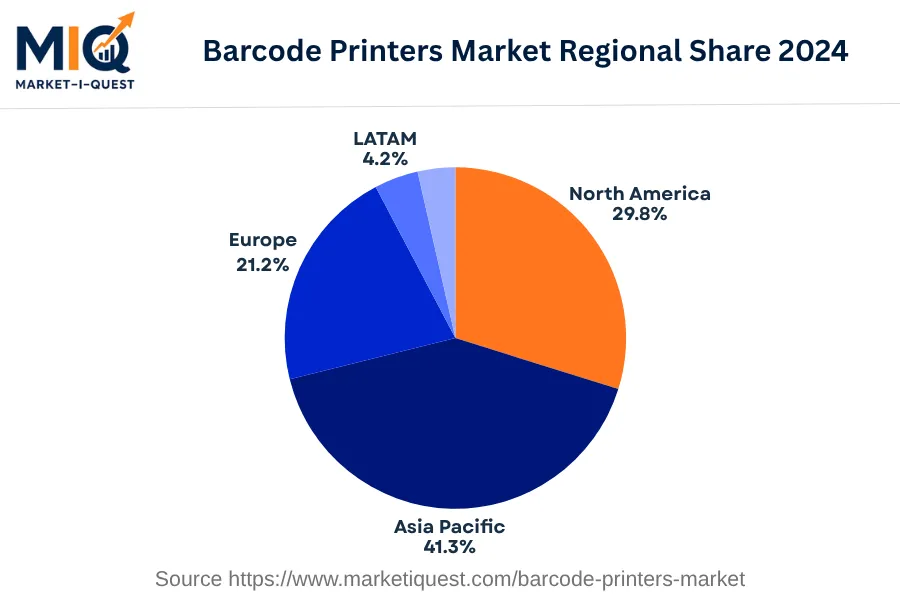
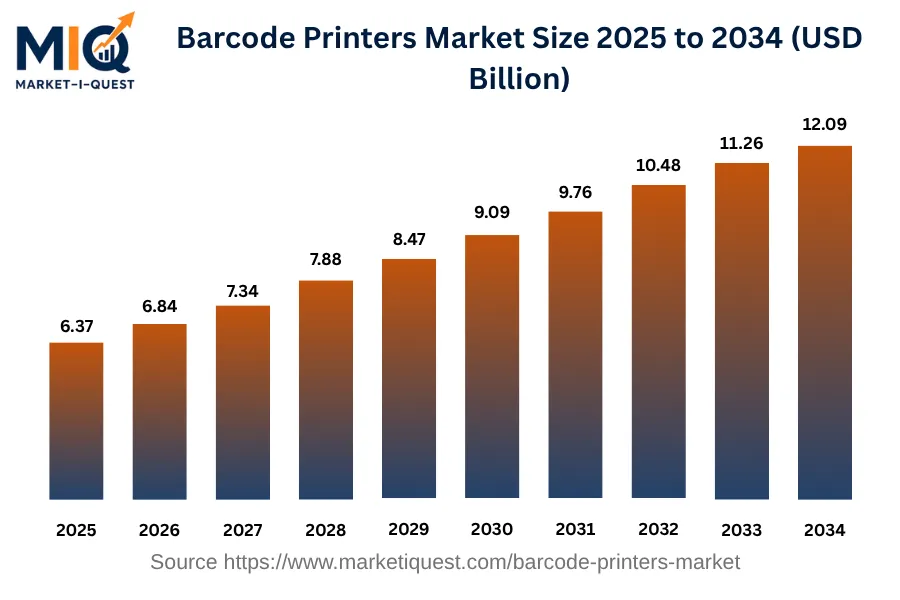
The Barcode Printers Market was valued at USD 6.37 billion in 2025, growing to a worth of USD 12.09 billion by 2034, indicating a CAGR of 7.38% over this period. This considerable growth trajectory was introduced by a 2024 market value of USD 5.93 billion. The rise from 2025 to 2034 signals continuous and substantial increments in the market’s value year on year. Its consistent expansion is reflective of the persistent and escalating demand, demonstrating an overall market that is enlarging at a stable rate. In terms of regional market share in 2024, the Asia Pacific held the most substantial cut with 41.3%, surpassing North America’s share at 29.8%. Europe held 21.2% of the market share, whereas Latin America and Middle East & Africa have considerably smaller shares at 4.2% and 3.6% respectively.

Key Takeaways

  • By Printer Type - Industrial Printers held a significant market share.
  • By Technology - Laser led by accounting for the largest share in the Barcode Printer Market.
  • By Application - Inventory Management emerged as the fastest-growing subsegment in the forecast period from 2025 to 2034.
barcode-printers-market market size

Key Driving Factors

Enforcement of Regulatory Compliance

The market is experiencing boost from the strengthening of regulatory compliance terms across various industries. Particularly in sectors such as healthcare, pharmaceuticals and food & beverages, where tracking each individual product is crucial for reasons such as patient safety, drug counterfeit prevention or tracing food origins during recalls. Regulations such as the Drug Supply Chain Security Act in the USA, the Unique Device Identification directive by FDA, or the EU's Falsified Medicines Directive have made it mandatory for businesses for adopting barcode technology. Barcode printers, therefore, become essential in enforcing traceability, promoting accuracy and ensuring compliance to these regulations.

Shift towards Omni-Channel Retailing

The shift towards omni-channel retailing, which ensures a seamless and consistent shopping experience across all channels, is another determinant driving growth in the market. In omni-channel retailing, maintaining the accuracy of inventory is crucial and barcode technology plays a integral role in this regard. It significantly improves inventory management by reducing human error, facilitates real-time updates regarding the availability of products across various platforms and enables quick checkout processes. Subsequently, retailers are increasingly investing in barcode printers for successfully implementing and maintaining their omni-channel strategies. The need for efficient inventory management accelerates the adoption of barcode printers in the retail sector.

Market Evolution by Timeline

2019-2023
During this period, barcode printers witnessed wider acceptance in retail and logistics for inventory tracking and asset management. Primarily, North America and Europe drove the demand due to the presence of major logistics hubs. Technologically, thermal printers held significant market share. The U.S. Food and Drug Administration's Unique Device Identification (UDI) System drove barcode usage in medical devices. Per unit pricing models prevailed with leading companies such as Zebra Technologies and Sato Holdings gaining market share.
2024
In 2024, sectors such as healthcare, manufacturing and shipping saw a rise in demand for barcode printers. Asia-Pacific region, particularly China and India, showed steady growth due to expanded e-commerce operations. Newly introduced portable barcode printers gained traction for their on-site operability. New EU regulations requiring full traceability of medical devices fueled usage of barcode printers. Subscription-based model emerged offering regular maintenance and support. Industry players worked on creating robust portable devices to tackle durability issues.
2025-2029
In this period, the demand for barcode printers is expected to expand into emerging markets of Africa and Latin America. This will likely arise from growing retail and e-commerce sectors. Technological advances will likely introduce printers with higher print quality and increased efficiency. Manufacturers are likely to be adopted software and cloud-based ways to meet the new GS1 barcode standards for food traceability. Leasing contracts got popular amongst small-medium businesses to reduce upfront costs.
2030-2034
Barcode printer demand throughout this period diversified into verticals including agriculture, food safety, and government services. The Middle East and North African region marked its presence due to the growth in retail and industrial sectors. Advanced RFID (Radio-frequency identification) printers were dominant. ISO/IEC 15459 standard for 'Unique identifiers, individual transport units will likely be influential in barcode adoptions for transport tracking. The shift towards performance-based contracts will likely be noticeable where payment will be tied to printer performance.

Future Market Outlook

Future Opportunities

The market is likely to expand its potential significantly due to increasing automation and digital transformation initiatives in industries such as logistics and retail. The ongoing shift toward 4G and 5G technologies is creating demand for wireless barcode printing solutions, with companies such as Datalogic enhancing their printer designs for supporting these new communication protocols. Additionally, businesses are investing in supply chain transparency, encouraged by regulatory requirements such as the Traceability and Accountability law enacted in the United States. The healthcare sector also presents opportunities for specialized printing solutions, as witnessed by the growing adoption of barcode wristbands for patient identification in hospitals globally. Furthermore, the emergence of AR and VR technologies opens alternatives for interactive barcode printing applications that could enhance customer engagement. Regions such as Southeast Asia are experiencing rapid e-commerce growth, necessitating efficient inventory management systems that rely on barcode technology as a backbone. With evolving consumer preferences for personalized products, companies may explore customizable barcode solutions to cater to niche market segments.

Segmentation Analysis

By Printer Type

The market is divided into subsegments including Label Printers, Mobile Printers, Industrial Printers, and Card Printers. Among these, Industrial Printers accounted for the largest revenue share, while Mobile Printers is expected to grow at the fastest CAGR during the forecast period.

Largest Revenue Share

Industrial Printers

Market Share Leader

Industrial Printers outperformed other types in regards to revenue. However, this dominance is largely driven due to the diverse applications of industrial printers across various industries such as manufacturing, automotive and packaging. The preference for industrial printers is predominantly due to their utility and efficient productivity under robust usage and set of operations. The utilization of these printers in different regions globally also drives their high revenues. Specifically, Asian countries with their growing manufacturing and automotive sectors have significantly contributed to high revenue of industrial printers. Moreover, the global rise in packaging due to rapidly growing e-commerce has boosted the demand for industrial printers. The business adaptation to digitization has also increased the demand for high volume printing.

Fastest CAGR

Mobile Printers

Forecast Period Growth Leader

Mobile Printers builds its growth on the rapid rise of remote working and on-the-go business operations. The adoption of mobile printing solutions shifts high gear accelerated by the demand for allowing work flexibility, enhance efficiency and streamline business operations. The speed at which businesses are adopting digitization, rose by the necessity to stay competitive, resulted in higher demand for mobile printers. The introduction of smarter, more compact and efficient devices has mitigated the barriers to adoption. Future legislative focus on enabling secure and efficient remote work could further push the rapid uptake of mobile printers.

By Technology

The technology-based market segments include Thermal Transfer, Direct Transfer, Laser, Impact, and Inkjet. The Laser subsegment accounts for the largest revenue share, while the Direct Transfer technology is expected to grow at the fastest CAGR during the forecast period.

Largest Revenue Share

Laser

Market Share Leader

The Laser subsegment has been most significant in driving revenues within the technological sector. There are key factors that contribute to this leadership position. One of the crucial factor is the superior precision and quality that laser technology brings to printing. Consequently, industries with high-value goods such as electronics, pharmaceuticals and luxury goods. Moreover, regulatory pressure for clear, tamper-proof labeling in pharmaceuticals and food & beverages also favors the laser approach. With rising acceptance in emerging markets, such as China and India, further boosts the revenue growth, where an expanding middle class increasingly demands high-quality goods. These factors combine to make laser the largest subsegment by revenue in 2024 in the technology-based printing market.

Fastest CAGR

Direct Transfer

Forecast Period Growth Leader

Direct Transfer is anticipated to be the fastest-growing technology segment. This is majorly due to several growth drivers and near-term catalysts. Direct Transfer offers good quality prints, speed and reliability at a lower capital investment compared to options such as Laser, making it favorable for small and medium enterprises and emerging economies. As it does not require any thermal ribbon, it also engages with increasing regulatory and consumer preference for eco-friendly solutions. The manufacturing sector's drive towards digitizing their processes may lead to an increase in the demand for Direct Transfer technologies.

By Application

The application market is divided into subsegments including Asset Management, Inventory Management, Package Labeling, Patient Identification, Product Identification, Shipping Labels, Wristband Printing, Ticketing, Merchandising, Pallet Labels, Compliance Labelling, and Others. Product Identification accounted for the largest revenue share while Inventory Management is expected to grow at the fastest CAGR during the forecast period.

Largest Revenue Share

Product Identification

Market Share Leader

Product Identification is primarily driving the revenue in the application market. The growth drivers for this subsegment are the increasing demand for identification and tracking of products in industries such as pharmaceutical, retail and food & beverage. Businesses are utilizing product identification technologies for maintaining quality standards, ensuring product authenticity and reducing manual errors in the supply chain. Product identification provides itself to core business demands such as accountability, traceability and the overall efficiency of inventory management. Barcodes and RFID's, common product identification technologies facilitate real-time information and visibility of the product across the supply chain.

Fastest CAGR

Inventory Management

Forecast Period Growth Leader

Inventory Management is set for the fastest growth rate of the forecasted period. This subsegment is driven by an increasing demand for improved business operations efficiency and customer satisfaction. Sellers are adopting advanced technologies such as AI and IoT for real-time inventory tracking which reduces over-stocking and under-stocking scenarios. Companies are also integrating inventory management systems with sales and purchase platforms for accurate forecasting. However, progressive regulatory policies promoting digitization and business collaborations with tech companies have become major catalysts for this growth.

Competitive Analysis

Key Market Players

Manufacturers / OEMs

Zebra Technologies
US
Honeywell International
US
SATO Holdings Corporation
Japan

Key Suppliers & Raw Materials

Dowdupont
US
BASF SE
Germany
ExxonMobil
US

Distributors, Integrators & Channel Partners

Barcodes, Inc.
US
Ingram Micro
US
ScanSource
US

Porter’s Five Forces Analysis

This analysis examines the competitive dynamics within the Barcode Printers Market.

Supplier Bargaining Power

Medium

Reliant on specific components, but presence of multiple suppliers reduces power.

Buyer Bargaining Power

High

Many options and low switching cost increase buyers' negotiation power.

Threat of Substitutes

Low

Barcode technology's efficiency and accuracy limit the threat of alternatives.

Threat of New Entrants

Medium

Technological knowledge and capital investment serve as entry barriers.

Competitive Rivalry

High

Numerous key players and aggressive price competition enhance rivalry.

Regional Analysis

Geographic market dynamics and growth opportunities across key regions

Global Market Outlook

barcode-printers-market market regional share

North America

In the base year 2024, the North American Barcode Printers Market experienced robust development owing to various market drivers and emerging trends. Market drivers included rising demand in sectors such as retail, healthcare, and manufacturing. In retail, barcode printers were sought after for improved inventory management and streamlined point-of-sale transactions. The healthcare industry deployed these printers for accurate patient identification and medical record keeping. Manufacturing units made use of barcode printers to enhance their supply chain efficiency. Further, regulations advocating correct product labeling heightened the demand.

In terms of trends, the major shift was towards thermal transfer barcode printers for their superior efficiency and high-quality barcode production. This product shift was indicative of businesses prioritizing long-term durability of barcodes. We also saw an adoption of wireless and mobile barcode printers, reflecting the wider trend of mobility in technology usage. Channel dynamics indicated a preference for purchasing through online platforms over physical stores. M&A were observed with larger firms absorbing smaller niche market players to diversify their product offerings and leverage innovative technology. In summary, North America's Barcode Printers Market in 2024 was shaped by increasing demand across multiple sectors, technology adoption, distinctive buying behaviors, product shifts, and growing online purchases.

Asia Pacific

In 2024, the Barcode Printers Market in the Asia Pacific saw a significant drive in demand due to various factors and trends. Regulatory push towards automation across sectors like retail, manufacturing, and healthcare prominently drove the market. Investment in technology adoption from big economies like China and Japan due to their robust industrial sectors, further fueled demand. Also, India's accelerated move towards digitization in public and private sectors has upshot the market.

On the trend side, the top shift was seen in the growing preference for thermal printers over the traditional laser ones due to their efficient and high-volume printing. Rapid changes in buyer behavior, with more inclination towards online shopping, pressured retailers in South Korea and Australia towards higher investment in logistical support, giving an upsurge to the market. Similarly, a rise in cross-border e-commerce activities leading to an increased demand in the logistics sector in Association of Southeast Asian Nations (ASEAN) markets was another key trend with market impact.

The markets in Asia Pacific also saw partnerships and M&A activities between retail giants and technology providers to strengthen their inventory tracking and enhance customer experience. In 2024, the Barcode Printers Market in this region was dynamic and demonstrated a wide range of market drivers and trends.

Europe

In 2024, the Barcode Printers Market in Europe, led by key regions including the UK, Germany and France, experienced definitive growth fueled by several domains. Technological advancements in barcode printer applications, increased investments in retail infrastructure and regulatory emphasis on tracking & tracing mechanisms drove demand. For instance, Germany's stringent regulations called Track-and-Trace, mandated the application of barcode labels in the pharmaceutical industry, propelling uptake of barcode printers. Additionally, the upswing in e-commerce activities across the UK and France led to amplified investments in warehouse management systems, stimulating the supply dynamics of barcode printers.

Simultaneously, several trends shaped market preferences and behaviors. Growing interest in Industrial Internet of Things (IIoT) solutions across manufacturing sectors in Italy and Spain encouraged adoption of smart barcode printers. Buyers, particularly in retail and FMCG sectors, leaned towards mobile barcode printers for increased operational flexibility. Partnerships, for example, the strategic alliance between Nordic firm ~name~ and UK's ~name~, have evolved as the principal strategy to enhance reach and product line-up. Furthermore, rigorous policy enforcement around product identification and traceability across industries, such as healthcare and utilities in Benelux and Central & Eastern Europe, significantly influenced the adoption of barcode printers. The market thus witnessed considerable transformation and growth in 2024.

Latin America

In 2024, the Latin American market for barcode printers showed a solid pace of growth thanks to the burgeoning demand for improved inventory management and asset tracking systems. The adoption of advanced technologies in the retail and manufacturing sectors drove this growth, particularly in leading economies such as Brazil and Mexico. Investment in the logistics and transportation sectors also contributed to the market expansion as companies sought to optimize their supply chains, further catalyzing demand for barcode printers.

Several trends emerged in 2024 that influenced the barcode printer market. The noticeable shift towards mobile barcode printers, especially in smaller enterprises seeking cost-effective solutions, was significant. In addition, industries such as retail, manufacturing, and healthcare increasingly prioritized real-time data collection, leading to a considerable uptake of wireless and Bluetooth-enabled printers throughout Latin America. The enforcement of industry standards and policies, especially in healthcare for patient identification and medication tracking, also played a pivotal role.

Wide-ranging implementation was seen in Brazil within the commercial industry supplemented by technological integration. Mexico saw significant growth in the retail sector due to ameliorating economic conditions. Argentina made inroads in adopting barcode technologies in public administration, and Chile's mining industry demonstrated potential for the adoption of barcode systems for improved logistic control. In Peru, the retail sector adopted barcode printers to streamline operations, enabling better consumer service and experience.

Middle East & Africa

In 2024, the Barcode Printers Market in the Middle East and Africa exhibited consistent growth. Factors driving this progress included heightened demand due to rapid urbanization, widespread adoption of new technology, investment in infrastructure and favorable government regulations. For instance, Saudi Arabia enforced a policy making barcode labels mandatory for specific commodities, thereby stimulating market expansion. Several noteworthy trends were observed. Technological shifts marked a pivot towards thermal barcode printers for their durability and their role in streamlining operations across sectors such as manufacturing and retail. In the United Arab Emirates, robust E-Government initiatives bolstered demand, while in South Africa, the burgeoning e-commerce sector was a major consumer.

Significant cross-industry collaborations were prevalent, primarily in telecom, financial services, utilities and healthcare. A remarkable example was the strategic alliance between prominent healthcare institutions in Egypt and Nigeria and leading barcode printers manufacturers aimed at strengthening patient identification procedures. In the oil and gas sector in Qatar, advanced barcode printer technology was adopted to maximize operational efficiency and safety. Meanwhile, in the retail sector across Saudi Arabia, Israel and Kenya, the prevailing trend leaned towards barcode printers to facilitate inventory management.

Recent Industry Developments

Latest market innovations, product launches, and strategic initiatives

May 2025

Global enterprise labeling developer Loftware executed a technical product alliance with SATO Corporation to roll out cloud-connected label printing architectures. The deployment allows supply chain operators to interface Loftware's cloud networks directly with Application-Enabled Printing (AEP) equipped SATO barcode printers to secure real-time tracking modifications.

February 2025

SATO expanded its entry-level hardware tier with the introduction of the WT4-AXB 4-inch industrial label printer in the Asia-Pacific region. The hardware serves as the inaugural product in the firm's "Basic Line," balancing core thermal transfer processing and micro-label precision with low-maintenance overhead tailored for small-to-midsize industrial enterprises.

Frequently Asked Questions