Bank Kiosk Market Snapshot

Key Players

  • NCR Corporation (United States)
  • Diebold Nixdorf (United States)
  • Wincor Nixdorf AG (Germany)
  • Hitachi-Omron Terminal Solutions
  • Corporation (Japan)
  • OKI Electric Industry Co. Ltd (Japan)
  • GRG Banking (China)
  • Nautilus Hyosung (South Korea)
  • KIOSK Information Systems (United States)
  • SlabbKiosks (United States)
  • ZIVELO LLC (United States)

Market Size

Base Year 2024
$17.94 Bn
CAGR
9.16%
Forecast 2034
$43.10 Bn

Market Segments

By Type
Single-Function Kiosks, Multi-Function Kiosks, Virtual Teller Machines (VTMs)
By Offering
Hardware, Software, Services
By Application
Deposits, Withdrawals, Loan Applications, Bill Payments, Account Management, Others
By End User
Banks, Credit Unions, Building Societies, Others

Market Dynamics

Drivers
  • Rising demand for self-service
  • Advancements in digital banking technology
Restraints
  • High Installation Costs
  • Cyber Security Threats
Opportunities
  • Rising digital transformation trends
  • Increased self-service banking needs

Market Size

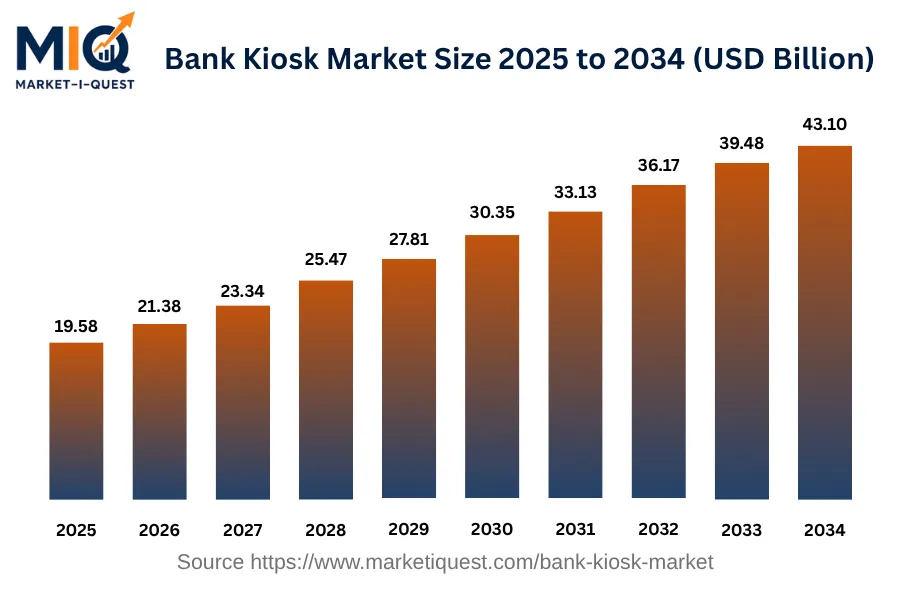
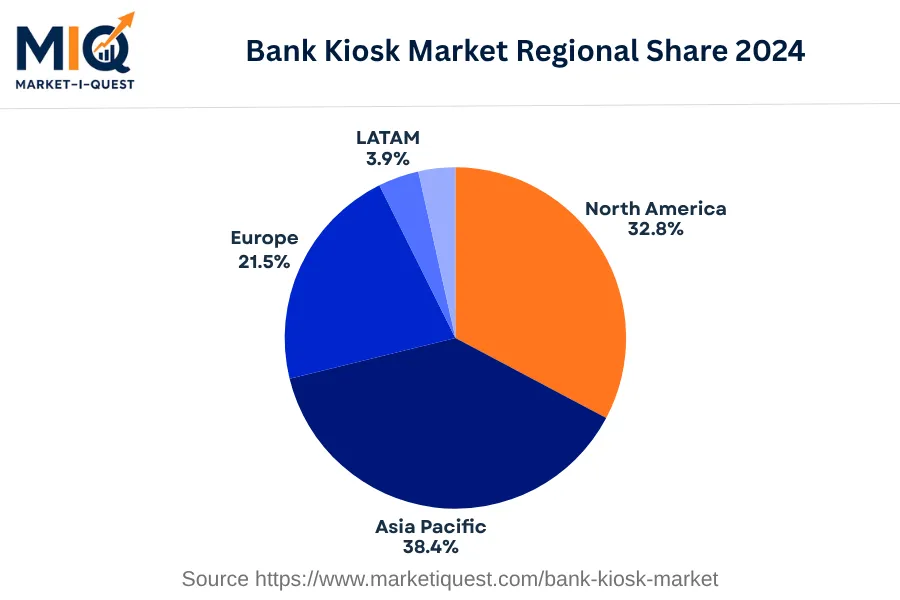
The Bank Kiosk market was valued at $19.58 billion in 2025 and is projected to grow to $43.10 billion by the end of 2034, reflecting a Compound Annual Growth Rate (CAGR) of 9.16%. The market accumulation over this period represents substantial growth in the Bank Kiosk sector due to various factors. The growth commenced from an initial value of $17.94 billion in 2024, paving a progressive path for the industry over the years. The regional share composition in 2024 highlights the division of market size around the world. North America held 32.76%, followed by Asia Pacific, which occupied the majority of the share with 38.41%. Europe came next with 21.48%. Meanwhile, regions like Latin America and the Middle East and Africa (MEA) had a comparatively smaller portion of the market, with 3.86% and 3.49% respectively.

Key Takeaways

  • By Type - Multi-Function Kiosks held dominance offering a number of services.
  • By Offering - Software led in providing a comprehensive suite of kiosk functionality accounting for significant market share.
  • By Application - Deposits led in utilization contributing significantly to the market growth.
  • By End User - Banks held the leading position in employing kiosks and accounted for a substantial portion of the market.
bank-kiosk-market market size

Key Driving Factors

Implementation of Self-Servicing Kiosks Due to the COVID-19 Pandemic

The ongoing COVID-19 pandemic has significantly influenced the bank kiosk market. As a direct response to mitigate against the virus's spread, numerous banking institutions globally have encouraged their customers to use remote banking services. Among these, self-service kiosks stand out. They minimize close person-to-person contact, ultimately promoting an effective social distancing. Consequently, clients can confidently perform different banking operations such as cash withdrawals, bill payments, and check deposits without direct human interaction. Furthermore, the self-service bank kiosks provide round-the-clock service, enhancing customer experience during a time when banking schedule disruptions are plentiful.
Government Regulation for Financial Inclusion

Emerging economies such as India, Nigeria, and Indonesia are driving the bank kiosk market due to national initiatives for financial inclusion. Governments are pressuring banks to set up kiosks in rural and remote areas to provide financial services to traditionally unbanked populations. This proactive approach results in a significant increase in bank account penetrations but also necessitates cost-effective solutions such as bank kiosks. Additionally, the efficiency and user-friendly operation of the bank kiosks are perfect for these demographics. In many scenarios, the drive towards financial inclusion is sometimes coupled with digitalisation initiatives, further propelling the demand for bank kiosks.

Market Evolution by Timeline

2019-2023
During this period, the adoption of bank kiosks has been largely driven by retail banks in North America and Europe aiming to reduce operational costs and improve customer service. The kiosks, typically self-service or video teller machines, were integrated in bank branches and shopping centers. Regulations like GDPR and CCPA influenced their design to ensure data security. The majority vendors supplied standalone kiosks, but interest in integrated solutions with core banking systems was observed. Pricing was predominantly device-based with additional costs for software and maintenance. A key risk was customer resistance to the perceived impersonality of kiosks, which banks managed by deploying staff to assist customers with the new technology.
2024
Rise in adoption is observed in the Asia-Pacific region in 2024, driven by private sector banks in India and China keen to serve an increasingly tech-savvy, urban population. Kiosks are now enabled with biometric and multilingual user interface capabilities, reflecting local supply dynamics and customer preferences. The Unified Payments Interface (UPI) standard in India impacted kiosk features, requiring interoperability with numerous digital payment systems. Pricing shifted towards as-a-service models with product bundles that include device, software, and service. High illiteracy rates in certain areas presented a risk but banks mitigated this with voice-assistant features and user education.
2025-2029
Demand between 2025 and 2029 is driven by rural community banks in North America and Africa, which used kiosks to extend reach in underserved areas. Mobile-banking-integrated kiosks dominate the market, offering banking services seamlessly over various platforms. Growth is moderated by strict anti-money laundering (AML) regulations, pushing kiosks to incorporate advanced KYC processes. A fee-based franchise model became popular, where communities or local entrepreneurs operate kiosks on behalf of banks. Risks include low internet connectivity in some regions which affected kiosk operation. Banks therefore typically installed kiosks in locations with reliable connectivity or used offline modes.
2030-2034
Between 2030 and 2034, corporate banks in emerging economies in Latin America and Africa have become significant buyers, deploying kiosks as service points for an increasingly urbanized population. Kiosks now come with advanced AI-assisted interfaces. Further integration with back-end banking systems is achieved, while compliance with data protection acts remains essential. A performance-based model is now common, involving deals with minimum usage commitments from the banks. The significant risk is a potential increase in kiosk-related frauds. To mitigate this, banks and vendors have doubled down on biometric security features and fraud monitoring systems.

Future Market Outlook

Future Opportunities

Given current trends, the bank kiosk market presents several avenues for growth. As banks prioritize enhanced customer experiences, financial institutions may increasingly partner with technology firms to innovate kiosk applications. For example, the collaboration between Wells Fargo and NCR since 2022 highlights a shift towards robust self-service solutions. Furthermore, the growing trend of financial inclusion motivates banks to expand kiosk deployments in underbanked areas worldwide, such as rural Africa. Kiosks can serve as vital access points, especially in regions lacking traditional banking infrastructure. With the rise of contactless payment systems, as demonstrated by successful rollouts in countries like Australia, banks may innovate further to integrate features like QR Code payments, expediting transactions. Regulations, such as the Payment Services Directive in the European Union, encourage competitive solutions, offering banks the chance to differentiate their kiosk offerings. Moreover, as digital currencies gain prominence, banks like Santander are exploring kiosk-enabled digital wallet services, suggesting that future kiosks may function as multi-faceted financial hubs. Lastly, sustainability initiatives might drive the development of eco-friendly kiosks, evidenced by initiatives in Scandinavia, which prioritize green technologies. These factors collectively indicate that the bank kiosk market is poised for evolution driven by both customer-centric and regulatory forces.

Segmentation Analysis

By Type

The market is divided into subsegments including Single-Function Kiosks, Multi-Function Kiosks, and Virtual Teller Machines (VTMs). Multi-Function Kiosks accounted for the largest revenue share while Virtual Teller Machines are expected to grow at the fastest CAGR during the forecast period.

Largest Revenue Share

Multi-Function Kiosks

Market Share Leader

Multi-Function Kiosks lead the market in terms of revenue generation. This is due primarily to their inherent versatility, fulfilling a range of consumer needs in just one station. Their multifaceted functionality caters to a wide variety of services including telecommunication, transportation, retail, and banking sectors, thereby increasing their utility among customers. Multi-Function Kiosks have a significant footprint in thriving geographies, with strong presence in urbanized regions where high-density, efficient service delivery is crucial. Regulatory frameworks have also induced growth in this subsegment, particularly in regions advocating for digitization as part of their societal development agendum. The purchasing behavior of customers is largely driven by convenience and speed, both of which are optimally provided by these kiosks. Furthermore, the relatively high switching costs deter consumers from reverting to single-function alternatives. Lastly, they are widely available across different channels, further facilitating market penetration and growth.

Fastest CAGR

Virtual Teller Machines (VTMs)

Forecast Period Growth Leader

Virtual Teller Machines (VTMs) are projected to experience the highest growth rate. This surge can be attributed to the blend of traditional banking and digital enhancements that this technology provides. The drivers primarily include increased investment in digitization, a shift toward self-service banking, and the convenience it provides to customers in terms of 24/7 access and shorter queues. However, some barriers to adoption include the initial capital expenditure for banks and the perceived complexity among some user demographics. Nevertheless, the rise of FinTech and ProTech partnerships might reduce these barriers and catalyze growth. Technological advancements, such as improved security protocols and user-friendly interfaces, will facilitate the adoption of VTMs. However, potential near-term risks may include maintenance costs and cybersecurity threats. It's worth noting that the market potential for VTMs is vast owing to an expanding digital banking customer base and an overall trend towards automation in various sectors.

By Offering

The market offering is segmented into Hardware, Software, and Services. In 2024, the Software subsegment leads in terms of revenue, while the Services sector is poised for the quickest CAGR expansion in the near future.

Largest Revenue Share

Software

Market Share Leader

In the base year 2024, the Software subsegment accounts for the triple crown in revenue compared to Hardware and Services. The reason behind the dominating position of Software largely lies in the technological proliferation and digital transformation across various industries. Today, companies from different sectors seek to leverage big data analytics, artificial intelligence, machine learning, and cloud computing to improve their operations and stay competitive. This drives the extensive demand for software products, leading to significant revenue generation. Furthermore, factors such as an increase in demand for simplified applications handling, interoperability, and regulatory compliance supplement the demand for software solutions. The market also benefits from the continuous advancements in software technology and the emergence of software as a service model. Consequently, the constantly evolving business needs and the increasing investment in R&D by major market players fuel the growth of the Software subsegment in terms of revenue.

Fastest CAGR

Services

Forecast Period Growth Leader

Despite trailing in revenue, the Services subsegment is predicted to register the fastest growth in the near future. The rapid rate of expansion can be primarily attributed to the growing demand for specialized services that enable organizations to implement and manage their hardware and software products efficiently. As businesses increasingly focus on their core competencies, they tend to outsource their IT requirements to service providers to ensure seamless operations and focus on achieving business goals. The dynamic nature of technology also demands regular updates and maintenance, further driving the need for IT services. Moreover, businesses look for service providers who can provide them with end-to-end solutions involving consulting, system integration, application management, IT outsourcing, and training services. Challenges include fanatic customer expectations for innovation and the need to stay on top of regulatory changes. Therefore, with all these factors in place, the Services subsegment is set to observe the fastest growth among the market offerings.

By Application

The market is divided into subsegments including Deposits, Withdrawals, Loan Applications, Bill Payments, Account Management, and Others. In 2024, the Deposits subsegment accounted for the largest revenue share whereas Loan Applications is expected to grow at the fastest CAGR during the forecast period.

Largest Revenue Share

Deposits

Market Share Leader

Being a fundamental banking function, the Deposits subsegment in 2024 yielded the highest revenue. This is primarily due to customer need to safeguard and grow their assets, leading to increased operational transactions. In addition to the inherent demand for storing money safely and conveniently, the rise in digital banking platforms has also amplified the deposit subsegment's remunerations with boosted accessibility and lowered service costs. Furthermore, the continuous introduction of attractive deposit schemes by banking institutions to retain and grow their customer base has incentivized deposit growth, contributing significantly to the revenue. Globally, developing economies have seen a surge in their middle-class population, creating a huge customer base for banking services, majorly deposits. The rate further multiplies in urban areas, where the need and awareness regarding savings are high. Regulatory policies encouraging the opening of bank accounts for every citizen also acts as a driver for this subsegment.

Fastest CAGR

Loan Applications

Forecast Period Growth Leader

The Loan Applications subsegment is anticipated to record the fastest CAGR during the forecast period. The primary driving factor behind this growth is the increasing demand for loans in various sectors including residential, commercial, personal, education, and auto, to name a few. This demand is further amplified by demographic factors such as population growth, urbanization, and increase in disposable income. In addition to this, the introduction of simplified application processes through digital platforms has significantly reduced the barriers to entry, leading to rapid adoption. Implementation of supportive policies by governments and regulatory bodies around the globe, offering low-interest rates and extended repayment periods, have catalyzed this growth. However, the risk associated with loan defaults and the increasing scrutiny of lending practices might pose near-term challenges to this otherwise rapidly-growing segment.

By End User

The market in terms of end user is divided into subsegments including Banks, Credit Unions, Building Societies, and Others. In the base year 2024, Banks accounted for the largest revenue share while Building Societies are expected to register the fastest growth during the forecast period.

Largest Revenue Share

Banks

Market Share Leader

Banks hold the predominant share of the market in 2024 due to a number of key factors. Firstly, the sheer size and reach of banking institutions mean they service a larger number of customers compared to other subsegments, leading to significant revenue generation. Moreover, due to the complexity of their operations, banks require a wide array of tools and services, contributing to a higher revenue generation from this segment. Being in a highly regulated environment, banks also have substantial budgets allocated to ensure compliance and maintain competitiveness, further driving the revenue in this segment. Buyers in this segment prioritize solutions that can seamlessly integrate with their already complex and often legacy systems, emphasizing the importance of customizable and interoperable tools. The high switching costs further solidify the revenue from banks as they are likely to stick with their chosen tools or services provider.

Fastest CAGR

Building Societies

Forecast Period Growth Leader

In the forecast period, Building Societies are projected to grow at the fastest rate. The growth of this subsegment can be attributed to a few key factors. Firstly, technological advancements are providing opportunities for Building Societies to enhance their efficiency and customer experience, leading to an increase in adoption. Additionally, there is a simultaneous policy push towards modernization, creating a conducive environment for growth. The availability of capital expenditure is contributing to societies' ability to invest in the required technology. However, barriers to adoption such as lack of technical expertise and resistance to change pose near-term risks to growth. Potential partnerships can expediate growth by fostering knowledge sharing and increasing access to advanced technological solutions.

Bank Kiosk Market Analysis

Key Market Players

Manufacturers / OEMs

NCR Corporation
US
Diebold Nixdorf
US
KIOSK Information Systems
US

Key Suppliers & Raw Materials

Corning Incorporated
US
ZF Electronics
Germany
Elo Touch Solutions
US

Distributors, Integrators & Channel Partners

Wincor Nixdorf International GmbH
Germany
Glory Global Solutions Inc.
UK
Nautilus Hyosung
South Korea

Porter’s Five Forces Analysis

This is an assessment of the competitive dynamics and attractiveness of the Bank Kiosk Market.

Supplier Bargaining Power

Medium

Control varies due to suppliers' abilities to differentiate hardware and software technologies.

Buyer Bargaining Power

High

Buyers have significant power due to a variety of cost-efficient alternatives available.

Threat of Substitutes

High

Mobile banking and online services are substantial substitutes for bank kiosks.

Threat of New Entrants

Medium

Entry barriers are considerable given the need for technology prowess and large capex.

Competitive Rivalry

High

Sharp rivalry exists due to technological advancements, product differentiation attempts and cost competitiveness.

Regional Analysis

Geographic market dynamics and growth opportunities across key regions

Global Market Outlook

bank-kiosk-market market regional share

North America

In the base year of 2024, the Bank Kiosk Market in North America experienced notable activities. Drivers included the increasing investment in automated technology by banks in the U.S., Canada, and Mexico, aiming to enhance customer experience and reduce operational costs. Moreover, the implementation of stringent regulations such as the Dodd-Frank Act in the U.S encouraged banks to adopt self-service solutions, further catalyzing the market growth. Simultaneously, the increasing competition in the banking sector tightened the supply dynamics, impacting the pricing strategies of bank kiosk manufacturers.

As for trends, the shift in buyer behavior was evident as both retail and corporate customers showed strong preference for self-service banking in light of the ongoing digitization wave within the banking sector. Technological advancements led to the dominance of smart bank kiosks equipped with artificial intelligence capabilities. Several North American banks also engaged in partnerships and mergers & acquisitions in a bid to enhance their automated banking solution offerings. In addition, enforcement of policy regarding privacy and security in relation to bank kiosks witnessed strict implementation, affecting the market dynamics significantly. Overall, these factors prescribed the context for North America's Bank Kiosk Market in the base year of 2024.

Asia Pacific

In 2024, the Bank Kiosk Market in the Asia Pacific region exhibited considerable growth with prominent developments observed in China, India, Japan, South Korea, Australia, and key ASEAN markets. Drivers for this included increased investment in digital transformation by banks, responsive government regulations promoting financial inclusion, and robust demand for interactive banking solutions. Technological adoption, such as biometric recognition, further stimulated the market. Competitive pricing models and supply dynamics also played crucial roles in market expansion.

Noteworthy trends included a marked shift towards self-service banking due to altered buyer behavior, reducing operational costs and enhancing customer experiences. Digital integrations in the banking industry amplified, with trends showcasing a higher affinity toward automated payment systems and digital wallets. The emergence of partnerships and M&A increased as banks and tech firms collaborated to deliver advanced banking solutions to customers. Stringent enforcement of data security norms across the region was also significant. Impacted sectors spanned beyond the banking industry including government entities, healthcare, retail, and manufacturing sectors. These sectors leveraged kiosk banking solutions for efficient financial transactions and record-keeping. Overall, the Bank Kiosk Market evidenced a substantial evolution in the Asia Pacific region in 2024.

Europe

In 2024, the European market saw a significant increased activity in bank kiosk deployments across key regions, largely driven by customer demand for efficient, self-service banking solutions. An influx of investment into digital infrastructure by major banking institutions in the UK, France and Germany, spurred technology adoption and fueled growth in the market. Regulatory emphasis on improved customer experience and enhanced data protection, particularly in regions like the Nordics and Benelux, further intensified this progress.

The trend towards digitization predominantly drove changes in the bank kiosk market, as customer behaviour shifted towards convenience and autonomy. Major banks in Italy and Spain initiated technology transformations, integrating cutting-edge kiosk systems into their service channels. Partnerships between banking institutions and technology providers established a steady growth trend, particularly in Central and Eastern Europe. Banking standards that encouraged self-service technology use, alongside related policy enforcement, had a sizable impact on the market trends as well. Sectors that extensively benefitted from the bank kiosk market included retail and government, both of which paralleled the general market trends for increased efficiency and streamlined service delivery. On a broader customer spectrum, the enterprise sector recognised the value of bank kiosks in their operations, exploiting the advantages of digital banking solutions to cater to their business needs.

Latin America

In 2024, the bank kiosk market in Latin America (LATAM) was defined by growing technological adoption for customer service optimization in countries like Brazil, Mexico, Argentina, Colombia, Chile, and Peru. The market was driven by increasing investments in digital banking infrastructure for seamless customer services, such as account information access and bill payments. Government regulations, promoting financial inclusion across LATAM, spurred the adoption of self-service bank kiosks, especially in rural and remote areas. High internet penetration rates fuelled online banking and associated kiosk utilization, particularly in Chile and Argentina.

Market trends reflected a shift towards greater usage of AI-based features in bank kiosks, with many banking institutions integrating chatbot capabilities and voice recognition technology for enhanced user interaction. Digital partnerships and mergers between banks and tech firms were noted, aimed at ensuring the improved functionality and user-friendliness of banking kiosks. Interestingly, preference for bank kiosks witnessed an incremental surge in retail sectors, riding on the convenience factor amidst busy shoppers. The observed drivers and trends, in turn, underscored transformation initiatives adopted by LATAM banking enterprises in 2024. The bank kiosk market reflected a concerted move from traditional to digital banking - an endeavour towards optimising services, enhancing financial inclusion, and embracing technological inference.

Middle East & Africa

In 2024, the Bank Kiosk Market in the Middle East and Africa experienced a surge, largely due to digital transformation in the banking sector. Demand was driven by rigorous financial regulations encouraging digital solutions, significant investments in IT infrastructure, and widespread technology adoption across Saudi Arabia, United Arab Emirates, Qatar, Egypt, South Africa, Nigeria, Kenya, and Israel. Notably, government initiatives such as Saudi Arabia's National Transformation Program, played a key role in increasing accessibility and efficiency in banking.

Trends shaping the market included a shift towards self-service banking to enhance the customer experience and increased partnerships between banking and technology firms to introduce innovative solutions. For instance, Israeli banks adopted advanced technologies to offer customer-centric services gaining momentum in the market. The expansion of fintech initiatives by governments and the private sector in UAE and Saudi Arabia also transformed the face of traditional banking.

Key sectors using bank kiosks included government departments, telecom companies, and healthcare facilities, facilitating payment and informational services. Meanwhile, banks, insurance providers, and other financial services amplified their digital footprint in order to satisfy customer expectations and comply with national digital transformation policies. Consequently, the Bank Kiosk Market in the Middle East and Africa in 2024 showed a substantial uptick in adoption and innovations.

Recent Industry Developments

Latest market innovations, product launches, and strategic initiatives

June 2026

Diebold Nixdorf officially rolled out its next-generation intelligent interactive kiosks tailored for the Banking, Financial Services, and Insurance (BFSI) sector. The modular hardware configurations embed advanced Internet of Things (IoT) connectivity and cloud-based centralized governance software, offering financial institutions real-time device visibility, predictive hardware maintenance alerts, and highly personalized transaction prompts.

Frequently Asked Questions