Balsa Core Materials Market Snapshot

Key Players

  • 3A Composites (Switzerland)
  • Diab International AB (Sweden)
  • EconCore (Belgium)
  • CoreLite Inc. (USA)
  • Evonik Industries AG (Germany)
  • Gurit Holding AG (Switzerland)
  • I-Core Composites LLC (USA)
  • Nida-Core Corp. (USA)
  • Sicomin Epoxy Systems (France)
  • Schweiter Technologies (Switzerland)

Market Size

Base Year 2024
$0.248 Bn
CAGR
5.37%
Forecast 2034
$0.418 Bn

Market Segments

By Product Type
  • Medium Density
  • Low Density
  • High Density
  • High Strength
By Substrate
  • Paulownia
  • Okoume
  • Khaya IV
  • Obeche
  • Others
By End User
  • Wind Turbine Manufacturers
  • Boat Building Industry
  • Sports Equipment Manufacturers
  • Aircraft Manufacturers
  • Architectural and Industrial
  • Others

Market Dynamics

Drivers
  • Increasing demand in wind energy sector
  • High strength-to-weight ratio convenience
Restraints
  • Limited supply of raw material
  • Stringent environmental regulations
Opportunities
  • Increasing demand in aerospace industry
  • Growing renewable energy sector

Market Size

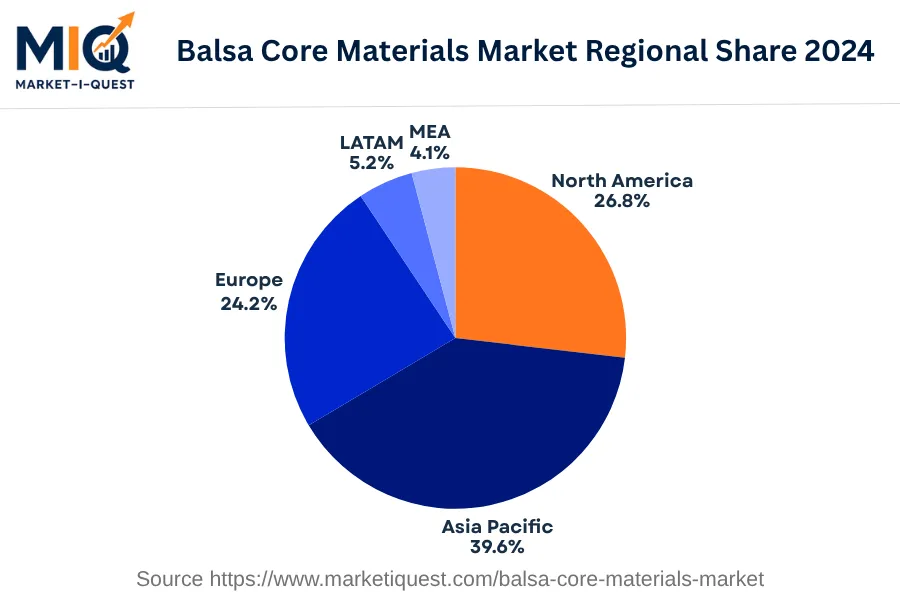
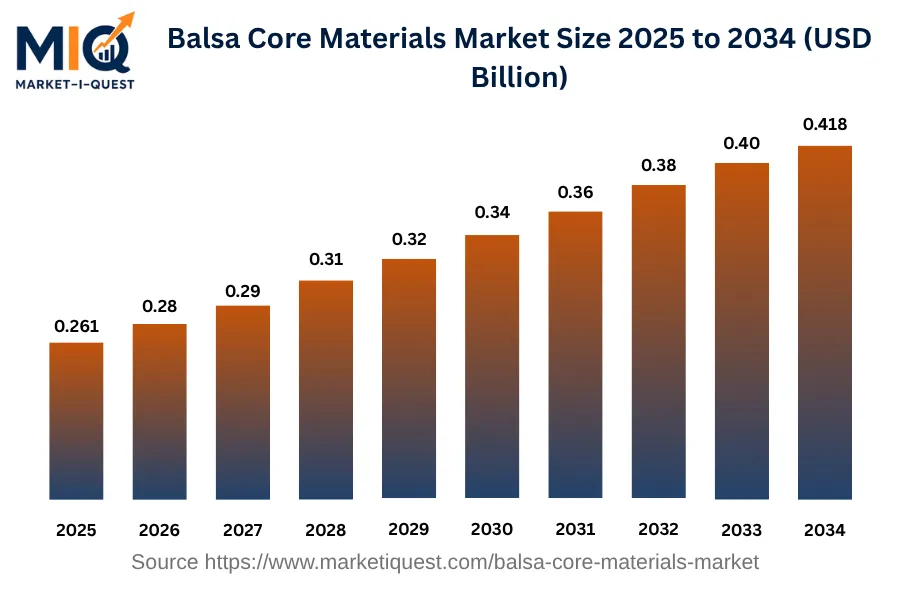
The Balsa Core Materials Market is projected to witness a gradual surge in valuation from USD 0.26 billion in 2025 to USD 0.42 billion in 2034, marking a CAGR of 5.37%. This gain in market value over the span of nine years signifies an evolving commitment toward balsa core materials as a value-add in different sectors. This market, which is starting from a valuation of USD 0.25 billion in 2024, attests to the increasing demand and potential for balsa core materials in various commercial applications. Indeed, from 2024 to 2025 alone, the market sees a rise by USD 0.01 billion. The regional share mix, as of 2024, has been balanced, with Asia Pacific leading at 39.62%, followed by North America and Europe possessing 26.84% and 24.18% respectively. Meanwhile, LATAM and MEA regions held a combined share of 9.36%, consisting of 5.23% for LATAM and 4.13% for MEA.

Key Takeaways

  • By Product - Medium Density was accounted for significant market share.
  • By Substrate - Khaya IV held the majority share accounting for substantial market share.
  • By End-User -Aircraft Manufacturers led the market accounting for the largest share.
balsa-core-materials-market market size

Key Driving Factors

Increasing Adoption of Lightweight Materials in Wind Energy Industry

One of the key driving factors for the balsa core materials market is the growing adoption of lightweight materials in the wind energy industry. Wind turbine blades are increasingly built with composite materials, and balsa wood's high strength-to-weight ratio makes it a prime candidate. The wind energy industry prioritizes weight reduction to enhance the efficiency of electricity generation, and balsa wood meets this need well. It's also relatively inexpensive and renewable, aligning with the industry's sustainable practices. Increased demand for renewable energy globally, particularly wind energy, is therefore directly contributing to a rise in balsa core materials market.

Strict Emission Regulations in the Aerospace Industry

Strict emission norms enforced by international regulatory bodies such as Federal Aviation Administration (FAA) and European Union Aviation Safety Agency (EASA) are directly impacting the balsa core materials market. These regulations mandate reductions in CO2 emissions, which can be achieved by reducing aircraft weight. Therefore, the aerospace industry is increasingly incorporating lightweight balsa core materials into aircraft designs to meet these stringent norms. Balsa wood's unique properties, such as good strength, thermal and sound insulation, along with weight reduction, make it a preferred choice. A trend toward cleaner and more efficient flight is intensifying, forcing manufacturers to innovate with materials, thus fueling demand in the balsa core materials market.

Market Evolution by Timeline

2019-2023
In the period 2019-2023, the major demand for Balsa Core materials came from manufacturing industries for products like wind turbines, due to eco-friendly features and effective performance. Another reputable consumer sector was the Aerospace industry, particularly in regions like Europe and North America. The technology was mainly supplied by western countries, but the resources were primarily produced in Ecuador. An indispensable policy was the EU's Renewable Energy Directive, which led to increased adoption of Balsa Core materials in wind energy applications. The pricing trends were often guided by the costs of shipping and handling, as Balsa is a delicate material. Risks include sourcing limitations, which were countered by establishing sustainable farming practices.
2024
In 2024, the marine industry emerged as a new buyer segment due to the structural superiority of balsa core materials, specifically in the US and Asia-Pacific region. There was a supply disruption due to plans for deforestation in Ecuador, leading efforts towards adoption of synthetic alternatives. The IMO's (International Maritime Organization) 'Green Shipping' policy boosted the use of environmentally friendly materials like balsa. Multi-year procurement models with locking in pricing were common to mitigate raw material price fluctuations. The scarcity in supply exposed the market to the risk of increased dependability on synthetic substitutes.
2025-2029
During 2025-2029, the construction industry displayed increased demand for Balsa Core materials, mainly in emerging economies like India and China. Technology enhancements led to the development of treated balsa, intensifying supply capabilities. The presence of regulations such as China's GB/T Standards influenced the market, compelling adherence to strict quality specifications. Within this period, contractual partnerships focused on green procurement gained popularity. Increasing scarcity in supply was a significant risk, mitigated by improved sustainable farming practices and exploration of backups like synthetic foam and honeycomb cores.
2030-2034
From 2030-2034, renewable energy providers showed peak interest in Balsa Core materials, specifically in European countries. Advancements in production technology led to increased plantation efficiency, translating to stable supply. As the Paris Climate Accord 2030 imposed stricter renewable energy requirements, these materials became a standard for wind energy solutions. Concentrated supply agreements dominated to maintain a balanced market. Risks included extensive dependency on weather conditions, impacting plantation yield. To counteract, transparency in supply chain and limited dependence on synthetic alternatives were promoted.

Future Market Outlook

Future Opportunities

As environmental regulations intensify, opportunities in the Balsa Core Materials market are becoming more prominent, especially in regions like North America and Europe. Companies are currently exploring alternative applications beyond traditional uses in aerospace and marine sectors. In 2023, leading firms like 3M began investing in research to assess balsa wood’s feasibility as an insulating material in construction, driven by the heightened focus on energy efficiency. As regulatory frameworks, such as the International Energy Agency's guidelines, promote the use of renewable resources, balsa wood's appeal as a sustainable building product is expected to grow. Collaboration across industries is increasingly common; for instance, composite manufacturers are partnering with packaging companies to explore balsa's potential in protective packaging solutions. This trend aligns with growing consumer awareness regarding sustainable materials, providing a fertile ground for innovative product development. Furthermore, advancements in processing techniques can yield higher quality balsa composites suitable for demanding applications, opening up new market segments. The trend toward lightweight and high-performance materials positions balsa wood as a viable alternative in various emerging applications, including automotive and recreational goods, where manufacturers prioritize weight reduction and ecological impact. Continued investment in sustainability initiatives is expected to anchor the future growth of the Balsa Core Materials market as industries seek compliant and environmentally friendly alternatives.

Segmentation Analysis

By Product Type

The market is divided into subsegments including Medium Density, Low Density, High Density, and High Strength. Medium Density accounted for the largest revenue share while High Strength is expected to grow at the fastest CAGR during the forecast period.

Largest Revenue Share

Medium Density

Market Share Leader

Medium Density may lead the pack in generating the largest revenue due to its versatility and widespread application across various industries. These products provide a balance of strength, resilience, and cost-effectiveness, making them a popular choice for a wide array of applications. They are often chosen for their good dimensional stability, high strength-to-weight ratio, and superior machinability, among other factors. Industries that commonly utilize Medium Density include packaging, automotive, contracting, and home-building, among others. Covering a broad geographic market from established economies to emerging ones, the Medium Density segment benefits from its ability to meet various regulations and deliver consistent supply with fewer disruptions. The buying decision tends to be based on quality, availability, and price, where Medium Density often outcompetes other types. While switching costs can be high due to the structural changes required, Medium Density's wide acceptance and benefits help maintain its customer base.

Fastest CAGR

High Strength

Forecast Period Growth Leader

High Strength is positioned to be the fastest-growing subsegment within this market. Its superior performance and increasingly industrial applications have powered its rapid progress. High Strength products are best suited for applications demanding higher load-bearing and durability, such as in construction, automotive, and heavy machinery. Technology and material science advancements have helped improve performance characteristics, expanding High Strength's appeal and usability, thereby driving adoption rates. However, the initial high costs and necessity of particular tooling can act as barriers for broad adoption in some areas. Addressing these barriers, corporate investment in technical innovations and expansion of partnerships across sectors may provide new opportunities. As for risks, the current global economic uncertainty and raw material price fluctuations might pose potential disruptions to the segment's growth. These factors notwithstanding, the High Strength segment shows promising signs of a high growth trajectory.

By Substrate

By Substrate, the market is divided into subsegments including Paulownia, Okoume, Khaya IV, Obeche, and Others. In 2024, Khaya IV accounted for the largest revenue share while Paulownia is expected to grow at the fastest CAGR during the forecast period.

Largest Revenue Share

Khaya IV

Market Share Leader

Khaya IV's dominance in 2024 can be attributed to several market dynamics. Chief among them is the robust demand for this variety in the luxury furniture and high-end construction industries due to its aesthetic appeal and durability. Geographically, it's mostly demanded in regions with high per capita income and robust real estate markets. Furthermore, it's easier to process and has a wider range of applications, which makes it appealing to manufacturers. It's also important to consider the market regulation's impact. With its relatively favorable regulatory status compared to other tropical hardwoods, manufacturers have been more keen to opt for Khaya IV over others. Finally, stringent regulations around deforestation and illegally sourced timbers have made other substrates less attractive, subsequently increasing the demand and revenue for Khaya IV.

Fastest CAGR

Paulownia

Forecast Period Growth Leader

The Paulownia substrate is expected to be the fastest-growing subsegment. The rapid projected growth is driven by its unique characteristics, including its light weight, strong resistance to warp, and fast growth rate - making it a highly sustainable option. This has led to it being increasingly adopted in the construction, furniture, and musical instruments industries. Furthermore, the technological advancements in wood processing have reduced the barriers to adoption, contributing to its growth. Market trends towards sustainability and eco-friendly products seem to favor Paulownia for the future. However, increased capital expenditure in research and development and the potential risks related to supply chains might hinder its pace of growth in the less saturated markets. Regulatory policies favoring sustainability could propel its growth even further.

By End User

The market is divided into subsegments including Wind Turbine Manufacturers, Boat Building Industry, Sports Equipment Manufacturers, Aircraft Manufacturers, Architectural and Industrial, and others. Among these, Aircraft Manufacturers accounted for the largest revenue share while the Sports Equipment Manufacturers subsegment is expected to grow at the fastest CAGR during the forecast period.

Largest Revenue Share

Aircraft Manufacturers

Market Share Leader

The Aircraft Manufacturers' position as the highest revenue-generating subsegment in the market can be attributed to multiple factors. Firstly, the sophistication and complexity of aircraft technology require premium materials that command higher pricing. Secondly, the increasing global demand for commercial aircraft coupled with the need to replace older fleets with more fuel-efficient aircraft primarily drives this segment. Geographic factors also contribute significantly as regions like the Asia-Pacific, driven by emerging economies like China and India, are experiencing rapid expansion in their aviation industries. The already established markets in North America and Europe also continue to contribute substantial revenues. Furthermore, industry regulations mandating safety and quality standards ensure consistent demand from the manufacturers. Finally, the high barriers to entry in this sector limit competition and increase the buying power of existing Aircraft Manufacturers, thereby boosting their revenue share in the market.

Fastest CAGR

Sports Equipment Manufacturers

Forecast Period Growth Leader

The Sports Equipment Manufacturers subsegment is projected to witness the most rapid growth in the coming years. Several key drivers underpin this upsurge, among which technology adoption plays a critical role. The increasing incorporation of advanced materials in sports equipment for enhanced performance is driving growth in this sector. Furthermore, the worldwide increase in health awareness and active lifestyle adoption has amplified demand for sports equipment. Steps to reduce trade barriers and partnerships for technological advancements also fuel this sector's growth. There's a growing push towards sustainable sports equipment production which opens up new opportunities to manufacturers investing in green manufacturing practices. However, the sector may face near-term risks in the form of price hikes in raw materials and potential regulatory changes. Yet, the combined impact of these growth drivers highlights the huge potential for growth in the Sports Equipment Manufacturers subsegment.

Competitive Analysis

Key Market Players

Manufacturers / OEMs

3A Composites
Switzerland
Dasso Group
China
Gurit Holding AG
Switzerland

Key Suppliers & Raw Materials

Airtech Advanced Materials Group
US
Baltek Inc.
US
Nord Compensati SPA
Italy

Distributors, Integrators & Channel Partners

Boat Builder Central
US
Avient Corporation
US
US Composites, Inc.
US

Porter’s Five Forces Analysis

This is a detailed analysis of the competitive dynamics of the Balsa Core Materials Market.

Supplier Bargaining Power

Medium

Limited suppliers and high demand give moderate power to producers of balsa wood.

Buyer Bargaining Power

Medium

Diverse applications and available alternatives balance the power of bulk buyers.

Threat of Substitutes

High

Synthetic alternatives and other lightweight materials pose a significant substitution threat.

Threat of New Entrants

Low

High entry barriers due to capital intensity and sourcing difficulties limit new entrants.

Competitive Rivalry

High

The market is highly competitive with established manufacturers battling for market share.

Regional Analysis

Geographic market dynamics and growth opportunities across key regions

Global Market Outlook

balsa-core-materials-market market regional share

North America

In 2024, the North American Balsa Core Materials Market was experiencing substantial growth due to a variety of factors. The rise in demand for lightweight yet strong materials in the wind energy, marine, and automotive industries resulted in increased investment and rapid adoption of balsa core materials. Furthermore, policies promoting renewable energy sources stimulated the demand for high performance materials in wind turbine manufacturing. Lastly, pricing dynamics reinforced the market’s growth, as the relative affordability of balsa core materials boosted their desirability.

Trending in the market, buyer preference leaned towards the use of environmentally friendly products, elevating balsa into the spotlight due to its natural and renewable properties. The rise in technology also influenced the shift towards balsa for high-speed and high-performance applications, specifically within the aerospace sector. Channel dynamics also evolved with the significant expansion of e-commerce, enhancing the distribution and accessibility of balsa core materials. Mergers and acquisitions were active, with companies such as 3A Composites and Baltek engaging in strategic partnerships to expand their footprints across the region. Key consumers of these materials across the region were primarily industries such as wind energy, marine, automotive, aerospace, construction, and retail. With the emphasis on lightweight and eco-friendly materials for various applications, the North American market for Balsa core materials was robust in 2024.

Asia Pacific

In 2024, the Asia Pacific Balsa Core Materials Market experienced a substantial boom, driven mainly by robust demand in the construction, marine, and wind energy sectors. Economic development in countries such as China, India, and ASEAN markets spurred substantial infrastructure investment, creating demand for these materials due to their superior compressive strength and thermal insulation properties. Furthermore, escalating concerns about environmental sustainability fostered increased adoption of green construction practices, where balsa core materials are highly favored. Technological advancements, particularly in Australia’s woodworking industry, streamlined the production process of balsa core materials, positively impacting supply dynamics.

Consumer preference has leaned towards light-weight and durable materials, further boosting the market for balsa wood. The wind energy sector in China and India witnessed an uptick in the use of balsa core materials for wind turbine blades manufacturing due to its outstanding fatigue resistance. In Japan and South Korea, enhanced building codes have pushed the market's growth, introducing broader application horizons for balsa core materials. Additionally, there’s a notable rise in partnerships and M&A activities across the region, particularly with companies involved in manufacturing and retail sectors, indicating a competitive and thriving market landscape. Regulatory policies in the Asia Pacific region, particularly from governments, enforcing green building codes, played a crucial role in market dynamics.

Europe

The Balsa Core Materials Market in Europe experienced stable growth in 2024, with Germany and France leading in consumption, closely followed by the UK, Italy, Spain, the Benelux, the Nordics, and Central & Eastern Europe. Key drivers for this growth include the rapid development of renewable energy, mainly wind power, which increasingly uses balsa core materials in turbine blades for optimal strength-to-weight ratio. Additionally, stringent European environmental regulations were enforcing the use of lightweight, energy-efficient materials in construction and transportation industries, boosting the demand for balsa. Investments in R&D also facilitated technological advancements, further improving balsa’s durability and heat resistance.

Market trends in 2024 indicate a remarkable shift towards sustainably sourced balsa products in sectors like manufacturing, government, and utilities, primarily responding to increased consumer awareness. An observed surge in partnerships and M&A activities within the market players suggested an intensified competitive landscape. The enforcement of stricter quality and safety standards by the policy-makers underscored the drive for higher-grade balsa in applications like shipbuilding and aerospace, where the material’s performance is crucial. Moreover, the increasing adoption of online channels for B2B transactions, due in part to the COVID-19 pandemic, also impacted the way these materials were distributed and purchased across Europe.

Latin America

In 2024, the Balsa Core Materials Market in LATAM indicated considerable growth, specifically driven by the demand from industries such as wind energy, marine, and aerospace. The boom in wind energy projects, particularly in Brazil and Mexico, increased the need for lightweight yet stiff materials like balsa. Simultaneously, advancements in production technology ensured a consistent supply and triggered material adoption across sectors.

Key trends observed include heightened buyer preference for end-products with enhanced fuel efficiency, a feature facilitated by balsa core materials. Brazil's move towards environmentally friendly marine vehicles, directly influenced by its Clean Shipping Regulation, increased the usage of these materials. Meanwhile, in Argentina and Colombia, advancements in composite technology have encouraged local enterprises to integrate balsa core materials in aircraft manufacturing.

Furthermore, the core materials market benefited from strategic partnerships and M&As, notably in Mexico and Chile, fostering market consolidation and technology exchange. Peru, on the other hand, witnessed strict policy enforcement concerning sustainable sourcing of balsa, with the Peruvian Balsa Sustainability Regulation shaping procurement practices.

Middle East & Africa

In the base year 2024, the Balsa Core Materials Market in the Middle East and Africa demonstrated vibrant growth dynamics. Increased investments in construction and renovation activities in countries like Saudi Arabia and United Arab Emirates provided a robust demand for Balsa core materials. The adoption of eco-friendly building technology, coupled with stringent building regulations in Qatar and Israel, enhanced the market's growth. Additionally, major oil and gas corporations in Nigeria and Egypt increased their utilization of these materials due to their high strength-to-weight ratio and thermal insulation properties.

There was a noticeable shift towards End-Grain Balsa material due to its enhanced durability and versatility across industries. Key players in Israel, South Africa, and Kenya invested in strategic partnerships and mergers in a bid to expand their market presence and cater to the evolving customer needs. The enforcement of green building standards across the telecom and utility sector in countries like South Africa stirred a rise in the application of sustainable materials like Balsa. Furthermore, resellers in Saudi Arabia and the UAE took advantage of digital channels to navigate supply-chain disruptions, enabling these countries to maintain a stable market environment. The Balsa Core Materials market had a fulcrum of activities in government-led infrastructure projects, manufacturing, oil and gas, and utilities sectors.

Recent Industry Developments

Latest market innovations, product launches, and strategic initiatives

January 2026

Major balsa processors, including Svenska Aerogel and regional timber groups, initiated a series of commercial ramp-up agreements to pilot ultra-lightweight hybrid core variants. The alliance focuses on backing balsa core frameworks with advanced thermal and acoustic insulation barriers for modular building panels and transport vehicle bulkheads.

Frequently Asked Questions