Ballistic Composites Market Snapshot

Key Players

  • Hexcel Corporation (US)
  • Teijin Limited (Japan)
  • Morgan Advanced Materials (UK)
  • Honeywell International Inc. (US)
  • Royal DSM (Netherlands)
  • Gurit Holding AG (Switzerland)
  • Solvay (Belgium)
  • BAE Systems (UK)
  • PRF Composites (UK)
  • Barrday Corporation (Canada)

Market Size

Base Year 2024
$2.85 Bn
CAGR
8.57%
Forecast 2034
$6.49 Bn

Market Segments

By Raw Material
  • Polymer Matrix Composite
  • Polymer-Ceramic Matrix Composite
  • Metal Matrix Composite
By End Use
  • Vehicle Armor
  • Body Armor
  • Helmets & Face Protection
  • Others

Market Dynamics

Drivers
  • Increased defense budget allocation
  • Enhanced ballistic protection demand
Restraints
  • High production cost
  • Export regulations
Opportunities
  • Military modernization programs
  • Advancements in composite technology

Market Size

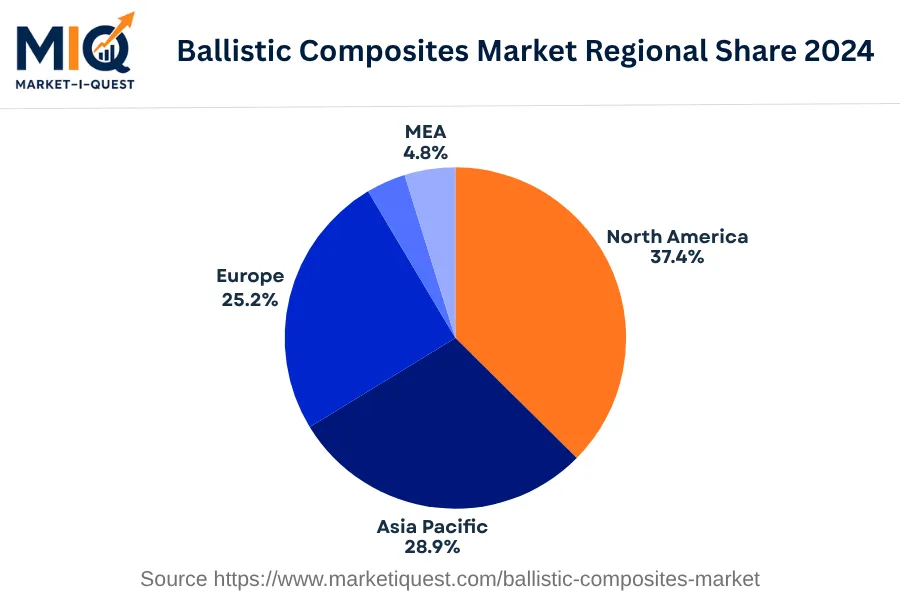
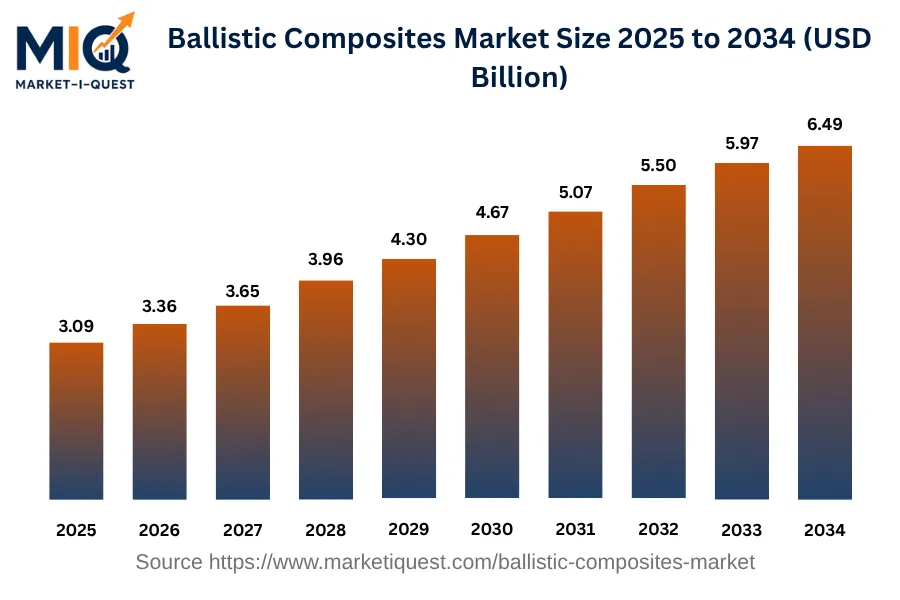
The Ballistic Composites Market was valued at USD 3.09 billion in 2025, and is expected to reach USD 6.49 billion by 2034, growing at a CAGR of 8.57%. This growth trajectory indicates a near doubling of the market over the nine years between these two points. The main factors behind this growth are improvements in materials science enabling more efficient production and developments in engineering offering higher performance composites for a variety of uses. In terms of regional shares, North America held the largest portion of the market in 2024 with 37.4%, followed by the Asia Pacific with 28.9%. Europe was not far behind at 25.2% with LATAM and MEA making up the remainder of the market with 3.7% and 4.8% respectively.

Key Takeaways

  • By Raw Material - Polymer Matrix Composite led the market accounting for the highest share.
  • By End Use - Body Armor was the dominant sub-segment taking up the largest market share.
ballistic-composites-market market size

Key Driving Factors

Increase in Defense Expenditure

Over the recent years, spending in the defense sector has surged significantly, particularly in countries such as the US, China, and Russia. This phenomenon is spurred by the escalating geopolitical tensions worldwide, which has led to a demand for advanced defense equipment for national security purposes. Ballistic composites, light but robust materials commonly used in the manufacturing of defense equipment like body armor and vehicle armor, have become critical because of their superior characteristics such as high thermal resistance and stiffness. Hence, the dramatic rise in defense budgets is driving the demand for ballistic composites.

Need for Lighter, Durable Materials in Aerospace and Automotive Industries

The aerospace and automotive sectors are major consumers of ballistic composites. The automotive industry's need for lighter, durable materials for producing high-performance vehicles is currently on the rise. As industries transition towards the use of electric vehicles, these composites provide lightweight properties with high strength, contributing to better performance and increased energy efficiency. Similarly, in the aerospace sector, the requirement for lightweight materials to enhance fuel efficiency and overall performance of aircrafts creates a high demand for ballistic composites. These materials' superior strength, heat resistance abilities and durability make them ideal choices for the manufacturing of crucial aircraft components like turbine blades, interiors and structural parts. Consequently, the trend towards lighter, high-performance materials in the aerospace and automotive industries is fueling the growth of the ballistic composites market.

Market Evolution by Timeline

2019-2023
In this period, we saw a significant increase in demand for ballistic composites, especially from the military and defense sectors due to the rising global security issues. This demand was primarily driven by countries with high defense budgets like United States, China, and Russia. On the supply side, key players such as Honeywell and Teijin started production of ballistic composites with advanced manufacturing technologies. Constraints included high cost of raw material and lack of skilled labor. The Carbon Fiber Reinforced Plastics (CFRP) standard was widely adopted, setting quality parameters for ballistic composites. Pricing was mainly based on material type and production complexity. Dependencies on government contracts led to extensive partnership discussions even as security risks tied to supply and production persisted.
2024
Ballistic composites gained momentum in non-defense areas such as automotive and aerospace industries this year. Particularly, countries like Japan and Germany started adopting it for their high-performance vehicles and aircrafts. Meanwhile, DuPont introduced a series of bio-based ballistic composites, potentially solving the cost issues of raw materials. The market faced challenges regarding recyclability and waste reduction, prompting revisions in ISO standards. A significant development was the advent of performance-based contracts, transitioning from product-based pricing. Extreme weather conditions raised concerns over logistics and supply chain disruptions, causing companies to invest in contingency plans.
2025-2029
With escalating geopolitical tensions, the demand for ballistic composites soared, predominantly from India, Israel, and Saudi Arabia. Suppliers, primarily SGL Carbon and Mitsubishi Chemical, enhanced production by leveraging Artificial Intelligence and Automation-based manufacturing. The enforcement of stricter emission standards spurred a shift towards lighter and stronger materials, leading to greater acceptance of ballistic composites. Contracts dominated by long-term supply agreements, often bundled with maintenance, increased. Risks centered on price volatility of raw materials and trade tariff tensions. Industry response included strategic sourcing from diverse global locations.
2030-2034
Demand in this period was increasingly diversified. Emerging economies keen on modernization like Indonesia and Thailand buoyed the market. The supply was led by progress in nanotechnology applications in ballistic composites. Despite initial apprehension, incorporation within 3D-printed products became commonplace. Regulations aimed at minimizing carbon footprints led to tussle between carbon composites and bio-based alternatives. Subscription-based pricing models began to emerge, underpinning the shift towards 'Composites as a Service' agreements. The overarching risk was tied to geopolitical instability affecting international trade and regulation.

Future Market Outlook

Future Opportunities

The continuous evolution of the ballistic composites market presents various opportunities shaped by current technological and regulatory landscapes. The rising threat of global conflicts and terrorism, especially in Europe and the Asia-Pacific region, has significantly increased military spending, as noted by NATO’s 2023 defense expenditures report. This emphasis on enhanced protection directly paves the way for increased contracts in ballistic composite materials, particularly for armored vehicles and personal protective gear. Furthermore, new regulations governing personal armor standards, like the NIJ 0101.07 standard introduced in 2020 by the National Institute of Justice, are driving manufacturers to enhance the quality and performance of their products. The demand for commercial applications, such as high-performance drones and aerospace applications, has gained traction; notable companies such as Boeing are actively testing ballistic composite materials for use in their aircraft components. Additionally, the automotive industry’s focus on lightweight solutions due to fuel efficiency mandates offers OEMs the chance to adopt ballistic composites within vehicles for added safety. As of 2023, global supply chain improvements and advanced manufacturing techniques like 3D printing have started attracting interest, particularly for prototype development in defense technologies. These developments suggest that the ballistic composites market will capitalize on diversification and innovation efforts, aligning with emerging threats and stringent safety regulations.

Segmentation Analysis

By Raw Material

The market is divided into subsegments including Polymer Matrix Composite, Polymer-Ceramic Matrix Composite, and Metal Matrix Composite. Polymer Matrix Composite accounted for the largest revenue share while Metal Matrix Composite is expected to grow at the fastest CAGR during the forecast period.

Largest Revenue Share

Polymer Matrix Composite

Market Share Leader

The dominance of the Polymer Matrix Composite subsegment in revenue generation can be attributed to its various beneficial features and widespread applications. These composites are known for their durability, versatility, resistance to heat, chemicals, and wear, which makes them suitable for multiple industries such as automotive, aerospace, and construction. Therefore, the industrial demand for these composites drives their significant revenue share. Further, their less production complexity compared to other composites contributes to their high revenue, as they are easier and cheaper to produce, resulting in a competitive advantage. Geographic regions with a robust industrial sector, especially in aerospace and automotive, influence their demand. Flexible regulation policies for production and sustainability measures in developed markets are another factor supporting their revenue. Moreover, with customer purchasing increasingly driven by the quality and lifespan of products, the demand for Polymer Matrix Composites is likely to maintain its upward trajectory.

Fastest CAGR

Metal Matrix Composite

Forecast Period Growth Leader

Notwithstanding a smaller base, the Metal Matrix Composite subsegment is projected to observe the fastest growth in the coming years. Its growth profile is built majorly on its superior properties including high strength, durability, and excellent thermal conductivity. These attributes position it for significant adoption in industries such as the automotive sector for weight reduction and consequent fuel efficiency. Barriers to the growth of Metal Matrix Composites include the relatively higher cost and complex manufacturing process. However, technological advancements in manufacturing processes, increasing investments in R&D, and growing partnerships for production expansion are serving as catalysts to overcome these adoption barriers. In the short term, risks such as fluctuations in raw material prices and the high level of competition could impact this subsegment’s growth. Nonetheless, the overall growth outlook for the Metal Matrix Composite subsegment remains robust.

By End Use

The market is divided into subsegments including Vehicle Armor, Body Armor, Helmets & Face Protection, and Others. By 2024, the Body Armor subsegment accounted for the largest revenue share while Vehicle Armor is expected to grow at the fastest CAGR during the forecast period.

Largest Revenue Share

Body Armor

Market Share Leader

The Body Armor subsegment holds the largest share in the market. This dominance is due to the increasing security concerns worldwide and the continuous advancements made in the development of strong, lightweight materials that offer improved protection. Body armors are widely used by military and defense personnel, law enforcement agencies, and private security officers, all of which have seen an increase in demand due to the escalating global tensions and increased initiatives for law and order. Additionally, the geographic areas with the most substantial purchase and usage of body armor include regions with active military conflicts and high crime rates. There are stringent regulations in place for body armor production and trade, pointing towards a market with serious attention to quality and safety standards. The key purchasing criteria include protection levels, comfort features, product weight, and price, with customers tending to be loyal due to high switching costs.

Fastest CAGR

Vehicle Armor

Forecast Period Growth Leader

The Vehicle Armor subsegment is predicted to grow at the fastest CAGR during the forecast period. Critical drivers of this growth include the rising threats from insurgent groups globally and advancements in weapon technologies, making armored vehicles a necessity for nations to protect their defense forces. In addition, there's an increase in defense spending on securing and upgrading fleets of armored vehicles. This heightened demand is also spurred by expanding private security sector investment in armored vehicles for VIP protection. However, the high costs of these vehicles and their maintenance may pose as a barrier to mass adoption. Looking toward the future, collaborations with tech companies to integrate advanced technologies such as AI and Unmanned Ground Vehicles (UGVs) into armored vehicles present a significant growth opportunity. Relative near-term risks may come from geopolitical changes causing defense budget alterations.

Ballistic Composites Market Competitive Analysis

Key Market Players

Manufacturers / OEMs

Barrday Corporation
Canada
Royal DSM
Netherlands
Honeywell International Inc.
US

Key Suppliers & Raw Materials

Teijin Ltd
Japan
Toray Industries
Japan
Solvay
Belgium

Distributors, Integrators & Channel Partners

3M Company
US
DuPont
US
Pacific Coast Composites
US

Porter’s Five Forces Analysis

An intensive review of the ballistic composites market using Porter's Five Forces.

Supplier Bargaining Power

Medium

Suppliers with unique ballistic materials hold reasonable influence over market.

Buyer Bargaining Power

High

Dense competition and abundance of suppliers gives high bargaining power to buyers.

Threat of Substitutes

Low

Limited alternatives to ballistic composites decrease the threat of substitutes.

Threat of New Entrants

Low

High entry barriers such as substantial capital requirements and stringent regulatory compliance checks hinder new market entrants.

Competitive Rivalry

High

Intense competition among established companies with diversified product portfolios.

Regional Analysis

Geographic market dynamics and growth opportunities across key regions

Global Market Outlook

ballistic-composites-market market regional share

North America

In 2024, the North American ballistic composites market was primarily driven by the increased need for advanced protective gear and equipment in defense and security-related sectors, such as the U.S. Department of Defense and the Royal Canadian Mounted Police. Key influencers over market dynamics are the escalating geopolitical tensions, increased investment in defense infrastructure, and substantial technological advancements in light-weight and high-strength composite materials. Government norms, such as the U.S's Berry Amendment, requiring the Department of Defense to give preference to domestically-produced goods, also increased demand for North American-made ballistic composites. Furthermore, high manufacturing demand from other sectors like automotive and aerospace prompted suppliers to upscale production, which improved pricing dynamics.

On the trends front, there was a noticeable shift towards the adoption of polyethylene composite materials for enhanced product efficiency. Cross-industry collaborations, such as the partnership between DuPont and Teijin Aramid, led to innovative product design and functionality improvements. The increasingly stringent enforcement of Occupational Safety and Health Administration guidelines in the U.S. and the Canada Occupational Health and Safety Regulations necessitated the use of ballistic composites in personal protection equipment across industries such as utilities and manufacturing. Thus, the heightened focus on safety, material innovation, and regulatory compliance formed the crux of the demand and supply dynamics in the North American ballistic composites market for 2024.

Asia Pacific

In 2024, the ballistic composites market in the Asia Pacific is a dynamic eco-system, shaped by increasing demand from defense, aerospace, and automotive sectors. Drivers in the market include the heightened military spending in countries like China and India, which in turn is amplified by regional security issues. In addition, due to ongoing technological adoption, polymer matrix composites, which offer superior strength-to-weight ratio, is seeing a surge in uptake. Moreover, government investments into research and development in countries like South Korea and Japan are fueling the technological advancements in ballistic composites, specifically those that offer light-weight solutions.

On the trend front, ballistic composites are progressively being adopted into civilian applications in response to increasing automotive safety requirements. Furthermore, we observe a rise in partnerships and collaborations, as exemplified by Australian firms integrating with global supply chains, thereby enhancing product availability. As governments enforce stringent regulations in the Asia Pacific, manufacturers are showing an inclined preference towards environmentally-friendly production methods.

Europe

In 2024, the European Ballistic Composites Market exhibited interesting developments united by robust demand and innovation. Regulatory changes in the defense sector, predominantly in countries like Germany and the UK, were pivotal drivers, reinforcing the emphasis on lightweight and durable composite materials for enhanced military efficiency and personnel protection. Italy and Spain's investment in advanced technology adoption, particularly nano-technologies, led to the elevation in ballistic composites' performance. Furthermore, the market witnessed a price surge in raw materials, noticeably aramid fibers, spurring a significant inflation in the market's supply dynamics within the Benelux region.

Trending in 2024 was a discernible shift towards polyethylene composites across Europe due to their higher impact resistance and durability. This movement was particularly evident in the defence and aerospace sectors in France and Central & Eastern Europe. A major aspect of the year was the emergence of new sales channels, with digital platforms and direct-to-consumer sales gaining traction, notably in the Nordics. M&A activities, motivated by the quest for product and tech diversification, accelerated, predominantly in Germany. In terms of policy enforcement, the European Union's increasingly stringent regulations concerning the sustainable manufacturing of ballistic composites were among the most prominent features of the market landscape.

Latin America

In 2024, the ballistic composites market in Latin America (LATAM) solidified itself as a robust segment of the region's defense sector. Driving this growth are increased security concerns, primarily in nations such as Brazil and Mexico, catalyzing governmental spending in defense and security, thereby channeling investment into ballistic composites. Additionally, technological adoption of innovative, lightweight yet resilient materials for protection equipment manifests in an augmented demand.

Furthermore, national regulations are incentivizing manufacturing within the region, notably in Colombia and Argentina, to reduce procurement reliance on foreign entities. Dynamic supply chain adjustments have seen multiple domestic partnerships form in response to such policies, bolstering the capacity for local production. Consequently, pricing variations have been observed, largely dictated by raw material costs and specific technological prowess of different countries. Simultaneously, there is a growing trend of adopting high-performance polyethylene composites in military applications across LATAM. Particularly in Chile and Peru, this shift is evident due to its superior impact resistance and lower procurement costs. Regional defense manufacturers are also forming strategic partnerships, enhancing technology transfer and overall product quality. Enforcement of standardization policies ensures uniformity in production irrespective of geographical location within LATAM. In essence, enterprises and government bodies are the primary costumers in this market, gravitating towards locally sourced, high-quality ballistic composites manufactured in compliance with regulations.

Middle East & Africa

In the base year of 2024, the ballistic composites market arose as a significant sector in the Middle East and Africa, driven by the escalating security concerns and increased defense spending, particularly in countries such as Saudi Arabia, Israel, and the United Arab Emirates. Boosted by investments from these key actors, the demand for advanced combat gear and senior grade vehicles equipped with ballistic composites skyrocketed, prompting an increase in the adoption of superior technology by suppliers. In response to climbing demand, innovative manufacturers shifted towards the development of more lightweight, robust materials, a trend mirrored in buyer behavior in the defense sector. With a consequent focus on reducing the overall weight of military equipment without compromising on protection.

Government interests in securing localized supply sources for critical defense materials led to the increased facilitation of partnerships and M&As among manufacturers to encourage domestic production capacities. This was coupled with the enforcement of strict regulations to ensure the quality of products entering the market. Among industries, the government and defense sectors emerged as key customers, while the oil and gas and utilities sectors also showed an increased interest in these composites due to the high-security risks associated with these industries. In Israel, technological advancements attracted attention from the healthcare sector due to the potential applications of ballistic composites in medical equipment protection. Overall, the market's drivers and trends demonstrated a robust landscape.

Recent Industry Developments

Latest market innovations, product launches, and strategic initiatives

June 2025

The UK Ministry of Defence and localized composite component manufacturers executed a series of multi-million dollar fleet supply frameworks. The strategic industrial ramp-up focuses on standardizing lightweight, customizable carbon-fiber and aramid-matrix shell configurations across high-volume Unmanned Aerial Vehicle (UAV) airframes and emergency field-folding protective barriers.

Frequently Asked Questions