Automotive Lubricants Market Snapshot

Key Players

  • Royal Dutch Shell (Netherlands)
  • ExxonMobil Corporation (United States)
  • BP Plc (United Kingdom)
  • Chevron Corporation (United States)
  • Total SA (France)
  • China National Petroleum Corporation (China)
  • Fuchs Petrolub AG (Germany)
  • Valvoline Inc. (United States)
  • Castrol (United Kingdom)
  • Lukoil (Russia)

Market Size

Base Year 2024
$73.6 Bn
CAGR
2.8%
Forecast 2034
$97.01 Bn

Market Segments

By Base Oil
  • Mineral Oil
  • Synthetic Oil
  • Semi-synthetic Oil
  • Bio-Based Oil
By Product Type
  • Engine Oil
  • Gear Oil
  • Grease
  • Coolants / Antifreeze Fluids
  • Brake Fluids
  • Others
By End User
  • Passenger Cars
  • Light Commercial Vehicles
  • Heavy Commercial Vehicles
  • Two-Wheelers
  • Others

Market Dynamics

Drivers
  • Rising automotive industry demand
  • Increasing vehicle fleet size
Restraints
  • Stringent environmental regulations
  • Slowdown in vehicle production
Opportunities
  • Electric vehicle lubricant development
  • Emerging markets expansion

Market Size

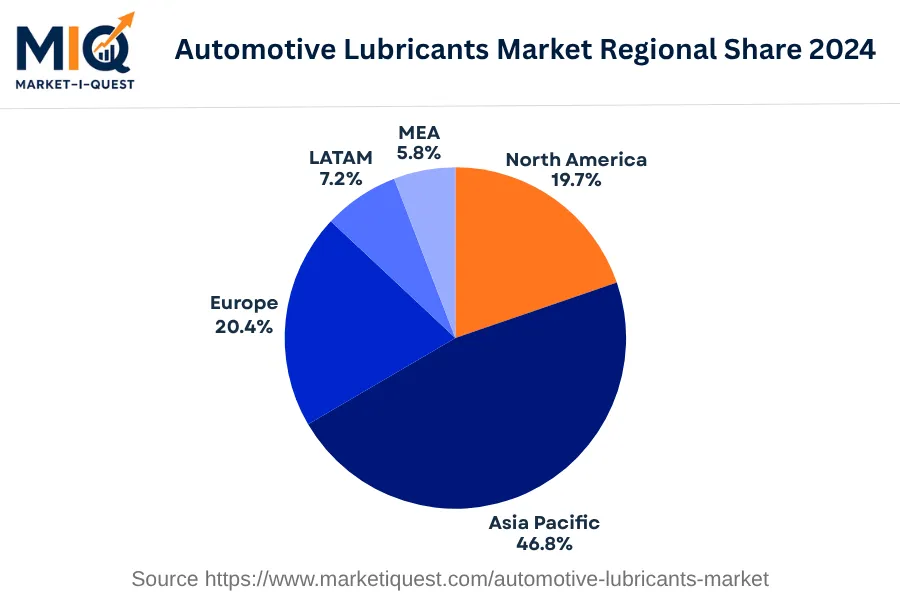
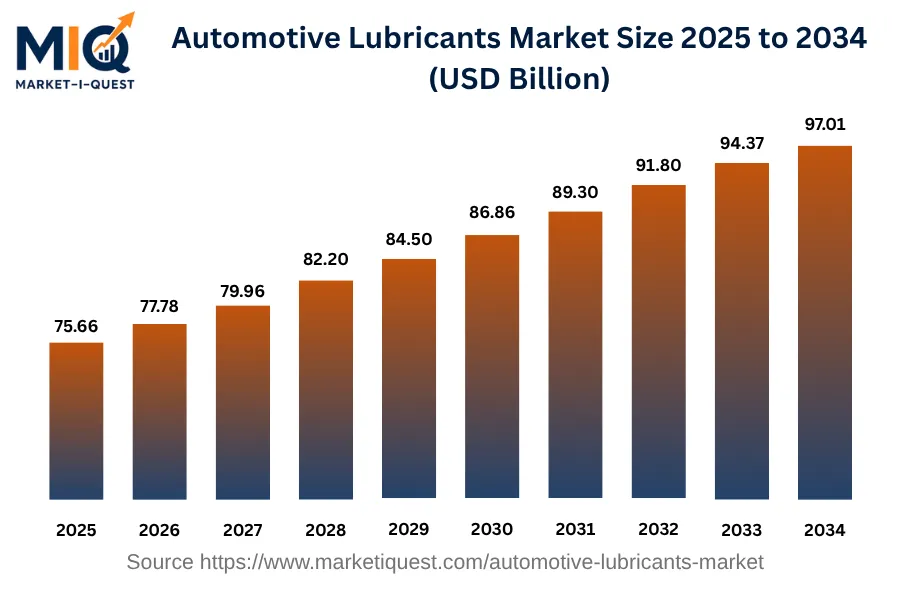
The Automotive Lubricants Market size in 2025 is projected to reach $75.66 billion from the previous year's worth of $73.60 billion. By the end of 2034, a significant growth is expected as the market size is predicted to reach $97.01 billion, growing at a Compound Annual Growth Rate (CAGR) of 2.8%. This growth trajectory is attributed to the increasing demand for automotive lubricants. In 2024, the regional share was distributed with Asia Pacific holding the largest share of 46.8%. North America followed with a share of 19.7% and Europe trailed slightly behind with 20.4%. The rest is covered by LATAM and MEA with shares of 7.2% and 5.8% respectively. Although Asia Pacific leads the share, it is evident that there is a reasonably even spread of demand for automotive lubricants globally.

Key Takeaways

  • By Base Oil - Mineral Oil held a dominant segment share in the Automotive Lubricants Market in 2024.
  • By product type aspect - Engine Oil was the largest contributor to the Automotive Lubricants Market in 2024.
  • By the End User category - Passenger Cars led the share accounting for a significant portion of the Automotive Lubricants Market in 2024.
automotive-lubricants-market market size

Key Driving Factors

Implementation of Strict Environment Regulations

The worldwide implementation of stricter environment regulations by governments is a significant factor driving the automotive lubricants market. For example, Euro 6 standards in Europe and Bharat Stage VI emission standards in India demand lower sulfur and ash content in lubricants to minimize engine emissions. Such regulations compel lubricant manufacturers to produce and supply high-quality, environmentally friendly lubricants, escalating the growth of the automotive lubricants market. This trend is expected to continue as governments prioritize air quality improvements and push for the adoption of electric and hybrid vehicles.

Growing Adoption of High-Performance Lubricants in Auto Industries

Another important driver for the automotive lubricants market is the growing adoption of high-performance lubricants in auto manufacturing industries. Modern automotive engines are designed to be compact and powerful, leading to high temperatures and pressures. High-performance lubricants are essential to protect these engines and ensure their efficient operation. Leading auto manufacturers like General Motors, Ford, and Honda are specifying the usage of these high-quality lubricants in their vehicles, and these recommendations are followed by car owners to maintain their vehicles' optimal performance. This trend boosts the demand and growth of the high-performance automotive lubricants market.

Market Evolution by Timeline

2019-2023
During this period, China and India witnessed a substantial demand for automotive lubricants, predominantly due to the growth of the vehicle population. OEMs like BMW and Toyota serviced this demand reducing friction in engine components and improving fuel efficiency. They faced competitive pricing issues due to the swift entry of local manufacturers. Environmental regulations such as EU's 'REACH' influenced formulation, leading to more biodegradable lubricants. Fixed-price contracts dominated commercial practices. The most significant risk was adulteration by counterfeiters, to which manufacturers responded by incorporating high-security labels how consumers identify genuine products.
2024
In this year, electric vehicles (EVs) ownership rose, particularly in Europe, leading to a strategic shift in lubricant demand. Synthetics outperformed mineral oils due to their ability to manage more significant temperature fluctuations common with EVs. Moreover, redesigned drivetrains required specialized lubricants, creating space for new entrants like Castrol's EV fluid range. New standards emerged in response to these changes, including the ILSAC GF-5 and API SN. Contracts now included warranty and service agreements, with partnerships between manufacturers and EV manufacturers. The primary risk was technology obsolescence, with ongoing research in solid-state batteries potentially eliminating the need for liquid lubricants.
2025-2029
The demand for lubricants in traditional powertrains continued to decline, specifically in developed markets like the US and UK, most noticeably in the passenger car segment. In contrast, demand in heavy-duty and off-road vehicles remained solid as their electrification was slower. The rise in biodiesel and hybrid vehicles fueled the demand for compatible lubricants. Lubrizol and BASF diversified their product range to capture this evolving trend. Policy-wise, the Corporate Average Fuel Economy (CAFE) standards in the US (requiring improved fuel efficiency) factored into product design. Fixed pricing slowly started to give way to value-driven contracts, correlating to the longevity of the lubricant. One significant risk in this period was sourcing of raw materials amidst increasing environmental concerns.
2030-2034
In this period, demand for lubricants became niche, centering on heavy-duty vehicles, aviation, marine, and some car segments in developing markets. Fewer players continued in the market, with a shift towards high-performance, specialized lubricants. Continual pressure for environmental compliance drove further bio-availability in the product range. Advancements in alternative fuels (like Hydrogen) led to an exploration of new lubricants forms. 'Fluids-as-a-Service' acquired prominence, where lubricant pricing tied with vehicle performance metrics and usage. The shortage of base oils due to stricter environmental norms became a prominent risk, encouraging investment into innovative, sustainable raw materials like plant-based oils.

Future Market Outlook

Future Opportunities

Future opportunities in the automotive lubricants market are closely tied to the ongoing shift towards sustainability and regulation compliance. As of 2023, the U.S. Environmental Protection Agency is emphasizing the adoption of greener lubricants to reduce overall environmental impact, creating avenues for companies producing bio-based and synthetic alternatives. This regulatory push may encourage organizations like TotalEnergies to expand their portfolio of biodegradable products. The electrification of vehicles presents a niche market for lubricants, especially with advancements in battery technologies; coolant and lubrication solutions tailored for hybrid models could become increasingly common, as highlighted by Ford’s commitment to hybrid technology through enhanced lubricant products in 2023. Additionally, the rising prevalence of connected vehicles necessitates smart lubricants equipped with sensors and IoT functionalities to monitor performance in real-time, a prospect that firms like Shell are exploring with their advanced fluid technologies. Partnerships between lubricant manufacturers and OEMs could become vital, as seen with Mobil and Ford, which allows for the co-development of vehicle-specific lubricant solutions. This collaborative approach reflects a trend towards specialization, opening doors for niche companies. Additionally, investments in research and development focused on sustainable practices will likely catalyze innovative lubricant solutions, ensuring compliance with stringent regulations while meeting customer expectations for performance and environmental responsibility.

Segmentation Analysis

By Base Oil

The market is divided into subsegments including Mineral Oil, Synthetic Oil, Semi-synthetic Oil, and Bio-Based Oil. Mineral Oil accounted for the largest revenue share while Bio-Based Oil is expected to grow at the fastest CAGR during the forecast period.

Largest Revenue Share

Mineral Oil

Market Share Leader

Mineral oil, known for its cost-effectiveness and widespread availability, leads the oil base market in terms of revenue. Traditionally, the industrial sector and automotive industry have been reliable customers, attracted by the oil's high lubrication properties and heat resistance, making it a mainstay of machinery operations. Geographically, regions with prolific industrial activities such as China and the United States further elevate the demand. Additionally, regulatory acceptance of mineral oil in a multitude of applications and absence of significant purchasing criteria changes for base oil have maintained a steady market share. The supply chain is mature, with suppliers having developed efficient distribution channels, diminishing switching costs for customers and keeping mineral oil in a dominant market position.

Fastest CAGR

Bio-Based Oil

Forecast Period Growth Leader

Bio-Based Oil is projected to achieve the fastest growth in the oil base market, fueled by shifting customer and industrial preferences towards sustainability. Global pressure for reduced carbon emissions provides catalyst, with many companies divesting from fossil fuels and investing in bio-based alternatives. Growth drivers particularly lie in the automotive industry's acceptance of bio-based oil and the advent of advanced technologies that enhance oil performance and suitability for a wider range of applications. Barriers include higher initial costs and limited availability in comparison to conventional oils, but the continuous development of production technologies and strengthening of global supply chains are gradually mitigating these challenges. Potential risks include regulatory changes and market acceptance of other sustainable alternatives, which may influence growth.

By Product Type

The market is divided into subsegments including Engine Oil, Gear Oil, Grease, Coolants / Antifreeze Fluids, Brake Fluids, and Others. Engine Oil accounts for the largest revenue share while Coolants/Antifreeze Fluids is expected to grow at the fastest CAGR during the forecast period.

Largest Revenue Share

Engine Oil

Market Share Leader

Engine oil, due to its pivotal role in the automotive industry, contributes a significant percentage of the revenue in the global lubricants market. Every automobile, irrespective of brand or type, requires engine oil for smooth operation and for increasing the lifespan of the engine by reducing wear and tear. This constant necessity makes it an ever-present demand in the market. Furthermore, as engine technologies advance, higher quality engine oils that protect and augment the improved functionalities emerge, justifying higher price points and therefore, more revenue. Additionally, its use is not just limited to personal cars, but also commercial vehicles and industrial machinery, expanding its market. Growth in freight transportation and a rise in the number of commercial vehicles further drive its demand. An uptick in the sales of heavy-duty vehicles, especially in developing economies, is also contributing to climbing engine oil revenues.

Fastest CAGR

Coolants / Antifreeze Fluids

Forecast Period Growth Leader

Antifreeze, also referred to as coolant, is anticipated to emerge as the fastest-growing subsegment. This growth is fueled by the growing global automotive industry and the escalating demand for longer engine life. In addition to its primary function of preventing the engine from freezing in cold climates and boiling over in hot ones, it also protects the engine from rust and corrosion, attributes that are propelling its demand upward. Hybrid and electric vehicle growth may also spur the segment's growth. These cars operate at higher voltages necessitating the use of coolant with improved quality, thereby, adding a price premium resulting in higher growth. High adoption rates witnessed in regions with extreme temperature fluctuations like North America and Northern Europe are also acting as catalysts for accelerated growth. Potential risks may lie in fluctuations of raw material prices which could impact market growth.

By End User

The market is divided into subsegments including Passenger Cars, Light Commercial Vehicles, Heavy Commercial Vehicles, Two-Wheelers, and Others, where Passenger Cars accounted for the largest revenue share while Two-Wheelers are expected to grow at the fastest CAGR during the forecast period.

Largest Revenue Share

Passenger Cars

Market Share Leader

The Passenger Cars subsegment captured the largest share of revenue in 2024. As the predominant mode of transportation globally, passenger cars constitute the largest segment of the automotive industry based on common market structures. Drivers of this demand range from the need for personal mobility, particularly in regions where public transportation infrastructure is underdeveloped, to the increase in purchasing power amongst the middle class in emerging markets. This is coupled with the expansion of car ownership in mature markets due to replacement demands and growing preference for high-end SUVs. Purchasing criteria for passenger cars often centre on factors such as fuel efficiency, safety features, and in-car technology, with geography and regulation playing significant roles in shaping these preferences. Further, the supply and distribution channels, which include both traditional dealerships and online platforms, have bolstered the accessibility and availability of passenger cars to customers, contributing to its high revenue generation.

Fastest CAGR

Two-Wheelers

Forecast Period Growth Leader

Two-Wheelers is projected to be the fastest-growing subsegment in the coming years. Two-wheelers, including motorcycles and scooters, are popular in densely populated urban areas and emerging markets, where they are considered a cost-effective alternative to cars. Their ease of maneuverability in traffic and lower fuel and maintenance costs contribute to their increasing popularity. Additionally, advancements in technology, including the proliferation of electric two-wheelers and development of connected mobility, serve as key growth catalysts. Partnerships between two-wheeler manufacturers and ride-sharing platforms have also spurred demand. However, regulatory challenges and safety concerns represent near-term risks to this growth. Capital expenditure in production and development of advanced two-wheelers will be critical in maintaining growth momentum. Overall, the two-wheeler segment presents significant growth potential, especially with support from appropriate policies and infrastructural development.

Competitive Analysis

Key Market Players

Manufacturers / OEMs

Royal Dutch Shell
Netherlands
ExxonMobil
US
BP
UK

Key Suppliers & Raw Materials

Evonik Industries
Germany
Nynas AB
Sweden
Huntsman Corporation
US

Distributors, Integrators & Channel Partners

Schaeffer Manufacturing Co
US
FUCHS Group
Germany
Amsoil Inc
US

Porter’s Five Forces Analysis

This is an analysis of the competitive forces within the Automotive Lubricants Market.

Supplier Bargaining Power

Medium

Limited suppliers and high-quality requirements moderately strengthen supplier power.

Buyer Bargaining Power

Low

Buyer power is low due to the specialized nature and essentiality of automotive lubricants.

Threat of Substitutes

Low

Low threat due to the lack of effective substitutes for high-performance automotive lubricants.

Threat of New Entrants

High

Low entry barriers and high demand can attract new players, heightening this threat.

Competitive Rivalry

High

High rivalry is fueled by numerous well-established competitors and minimal product differentiation.

Regional Analysis

Geographic market dynamics and growth opportunities across key regions

Global Market Outlook

automotive-lubricants-market market regional share

North America

In 2024, the North American automotive lubricants market presented a dynamic landscape shaped by key demand factors, regulatory pressures, and evolving technological adoption. Shifts in consumer behavior towards sustainable practices spurred an increased demand for environmentally-friendly lubricants, a trend backed by the Biden administration’s clean energy policy in the U.S. Heavy investments in EV technologies by automotive giants like General Motors necessitated advanced lubricant solutions, causing an upsurge in research, development, and supply of high-performance lubricants. Fluctuating crude oil prices, however, kept pricing instability in check, affecting the region's overall market economics.

The year saw a prevalent shifting trend towards synthetic and bio-based lubricants, driven by consumers’ and regulators’ push for eco-compliant solutions. Increased online sales, particularly in Canada and the U.S, shifted channel dynamics, with e-commerce platforms seeing greater traction. Notable transparency in product profiling was observed, with lubricant manufacturers detailing additive and base oil components to cater to an informed customer base. Industry partnerships and M&A activities proliferated, as demonstrated by Exxon Mobil's acquisition of a major bio-lubricant manufacturer, aimed at standardizing lubricant production practices. Policy enforcement in the realm of environmental sustainability was rigorously pursued in Mexico, influencing manufacturers to adopt 'green production.' The impact of these drivers and trends was most observed within industries such as automotive manufacturing, transportation, and heavy machinery.

Asia Pacific

In 2024, the Asia Pacific automotive lubricants market held a significant share of the global market. China and India, propelled by their burgeoned automobile sectors, were driving robust demand while Japan and South Korea experienced steady consumption owing to mature automobile markets and high automotive service standards. Increasing adoption of synthetic lubricants, especially in China and Japan, coupled with the introduction of stricter emission norms across the region, resulted in enhanced engine efficiency, contributing to market growth. Infrastructure investments, particularly in India and key ASEAN markets, improved logistical facilities, thereby facilitating supply dynamics and competitive pricing.

Conversely, the rise of electric vehicles in Australia hinted at a shift in buyer behavior with potential implications on future lubricant requirements. Technological advancements saw lubricant manufacturers in South Korea partnering with auto giants for specialty lubricant solutions, another manifestation of evolving product needs. Channel dynamics experiencing a shift were evident in the increased online sales of lubricants across most economies in Asia Pacific, although physical retailers remained a key point of sale. Policy enforcement, especially related to environment conservation necessitated partnerships and mergers, as evident in China’s increasingly stringent anti-pollution policies. Car manufacturers, as primary customers led demand, followed by governments and utility companies investing in transportation infrastructure.

Europe

In 2024, the automotive lubricants market in Europe showed substantial activity. The market's robustness was driven by factors such as regulatory pressures for reduced emissions, catalysing demand for high-performance lubricants. Investments in automobile technology, like hybrid and electric vehicles, fostered a need for specialized lubricants. The expansion of automotive manufacturing in Eastern Europe significantly fueled supply dynamics. Amid these drivers, several trends were discernible. Due to environmental policies like EU Commission Regulation (EC) No 661/2009, chemically advanced, eco-friendly lubricants gained traction. Consumers also gravitated towards synthetic lubricants for their prolonged engine life and fuel efficiency, an uptake noticeable in Germany, France, and the United Kingdom. Distribution channels also metamorphosed with the rise of e-commerce platforms, particularly in the Nordics and Benelux regions, revolutionizing the procurement process. In terms of sectoral application, automotive lubricants found substantial use in manufacturing industries, vehicle fleets of retail enterprises, and governmental utility services.

Strategic partnerships emerged prominently, exemplified by the collaboration between Italian lubricant makers and Spanish auto-manufacturers to develop customised solutions. Consolidation via mergers and acquisitions was another visible trend in 2024—primarily in Central and Eastern Europe, with large players striving for market dominion.
Overall, market dynamics in 2024 were directed by regulatory mandates, technology infusion, and innovative supply mechanisms—stimulating both competition and collaboration in the European automotive lubricants market.

Latin America

In the base year 2024, the automotive lubricants market in Latin America (LATAM) showed substantial dynamics. Drivers included escalating demand for efficient vehicle performance in Brazil and Mexico's thriving automotive industries. Notably, Argentina's regulatory framework mandated higher product standards, promoting synthetic lubricants for better fuel efficiency. Also, Colombia witnessed significant investment to enhance lubricant quality and production capacities. Meanwhile, Chile's robust mining sector propelled the adoption of advanced technology lubricants for heavy-duty vehicles.

Trends were also noteworthy. LATAM witnessed a wave of conscious buying from Brazil and Argentina, with increased preference for eco-friendly, biodegradable lubricants. Moreover, Mexico saw a transition to e-commerce channels for lubricant procurement due to advantageous pricing and convenience. Partnerships for technological collaboration were rampant in Colombia and Chile, where leading global players joined local firms to extend product lines. Furthermore, the enforcement of stringent environmental policies in Peru and Mexico compelled manufacturers to seek greener compositions. The principal sectors demanding automotive lubricants included commercial transport enterprises, mining ventures, and vehicle manufacturing industries. Retail demand was buoyant with private vehicle owners in Brazil, Argentina, and Mexico showing strong uptake. Government patronage was evident in policy support for sustainable lubricant manufacturing in Peru and Colombia. Overall, the base year indicated a vibrant scenario combining demand growth, regulatory influence, technology adoption, and shifting buying behaviors.

Middle East & Africa

In 2024, the Middle East and Africa's Automotive Lubricants Market reflected a dynamic interaction of supply and demand. Reacting to urbanization, vehicle sales surge in Saudi Arabia increased lubricant demand. Conversely, environmental regulations pushed lubricant manufacturers to reduce sulfur content in UAE and Saudi Arabia. Notably, technology adoption in manufacturing processes gave pockets of remarkable innovation with improved lubricant efficiency in Israel and South Africa. Diversified car manufacturers in Egypt also expanded product lines, engendering consistent demand.

Shifting consumer behavior emphasized environmentally conscious purchases. In Nigeria and Kenya, distributors made headway with biodegradable lubricants. Concurrently, major auto players formed partnerships to launch electric vehicles in South Africa, further influencing lubricant requirements. Oil and gas establishments in Qatar responded by broadening lubricant portfolios, incorporating synthetic and biodegradable options. Meanwhile, automotive lubricant standards underwent stricter enforcement, particularly in Saudi Arabia, driving many local manufacturers to align production methods with global best practices. Digital sales channels introduced cost efficiencies, prompting retailers in Egypt and UAE to adopt online platforms extensively. Moreover, government sectors, particularly in UAE, Saudi Arabia, and South Africa, played a significant role in influencing lubricant standards, digital marketing trends, and consumer behavior through impactful regulations and policies.

Recent Industry Developments

Latest market innovations, product launches, and strategic initiatives

May 2026

Shell expanded its Helix Ultra fully synthetic engine oil lineup to include formulations optimized for hybrid and light commercial vehicles. The rollout specifically targets high-temperature operating conditions across Asian markets, matching tighter OEM viscosity grades and friction tolerances.

October 2025

Castrol India expanded its Castrol ON EV portfolio by introducing a bio-synthetic thermal management fluid. Incorporating renewable-content technology, the fluid targets electric vehicle battery cooling and drivetrain efficiency, establishing a bio-based alternative to petroleum-derived oils.

April 2025

Daewoo entered India’s automotive lubricant market in partnership with Mangali Industries, launching a high-performance lubricant range for two-wheelers, passenger cars, commercial vehicles, and agricultural machinery.

Frequently Asked Questions