Automotive Lithium-Ion Battery Market Snapshot

Key Players

  • LG Chem (South Korea)
  • Panasonic Corporation (Japan)
  • BYD Company (China)
  • Tesla Inc. (United States)
  • Samsung SDI Co. Ltd. (South Korea)
  • A123 Systems (United States)
  • Contemporary Amperex Technology Co. Limited (China)
  • GS Yuasa Corporation (Japan)
  • Hitachi Ltd. (Japan)
  • Johnson Controls (Ireland)

Market Size

Base Year 2024
$64.83 Bn
CAGR
15.95%
Forecast 2034
$284.76 Bn

Market Segments

By Battery Type
Nickel-Cobalt-Aluminum Oxide (NCA), Nickel-Cobalt-Manganese Oxide (NCM), Lithium Iron Phosphate (LFP), Lithium Nickel Manganese Cobalt Oxide (NMC)
By Form Factor
Cylindrical, Prismatic, Pouch
By Power OUtput
Low Power (100 kWh), Medium Power (100-500 kWh), High Power (>500 kWh)
By Application
Electric Vehicles, Hybrid Electric Vehicles, Plug-in Hybrid Electric Vehicles

Market Dynamics

Drivers
  • Increasing demand for electric vehicles
  • Advancements in battery technology
Restraints
  • High production costs
  • Safety concerns
Opportunities
  • Growing EV adoption
  • Untapped renewable energy sector

Market Size

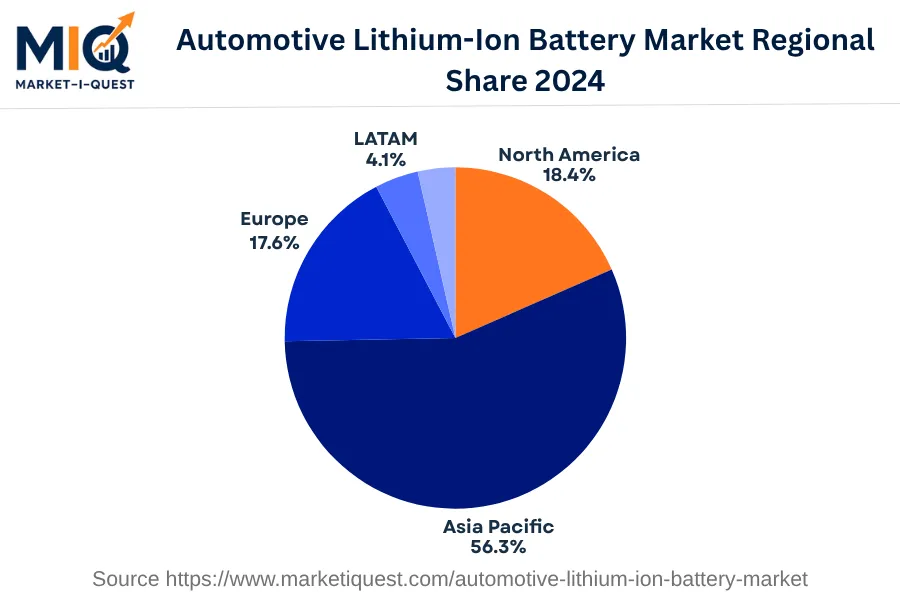
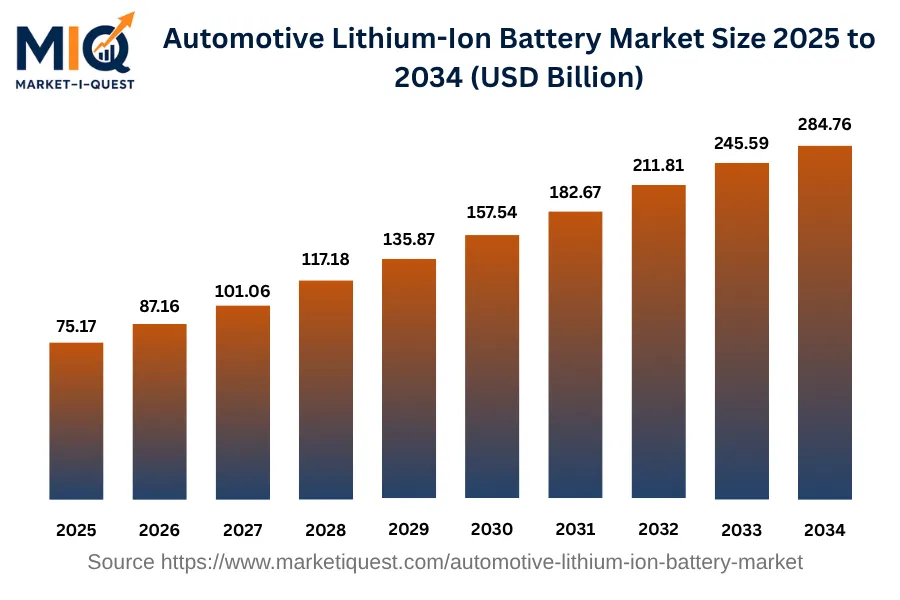
Automotive Lithium-Ion Battery Market, size valued USD 75.17 Billion in 2025 and expected to reach USD 284.76 Billion by 2034 with CAGR 15.95% due to increasing adoption of electric vehicles. Development of advanced lithium ion battery technology, increasing government policies to adopt clean energy and build a dedicated charging infrastructure. Asia Pacific accounted for the major market share of 56.3% in 2024, North America and Europe with 18.4% and 17.6% market share respectively, whereas LATAM and MEA stand with 4.1% and 3.5% of market share.

Key Takeaways

  • By Battery Type - Nickel-Cobalt-Aluminum Oxide (NCA) held a remarkable market position.
  • By Form Factor - Prismatic expanded notably accounting for a substantial share in the market.
  • By Power Output - High Power (>500 kWh) led the market due to increasing demand for powerful electric vehicles.
  • By Application - Hybrid Electric Vehicles sustained its leading position accounting for the majority of the market share.
automotive-lithium-ion-battery-market market size

Key Driving Factors

Strict Emission Norms by Regulatory Bodies

Governments across the globe are implementing vehicle emission standards that push for a reduction in a vehicle’s carbon footprint. Europe’s Euro VI standards and China’s China6 standard requires a 23-25% reduction in CO2 and NOx emission levels. This demand leads vehicle manufacturers to adopt electric and hybrid technologies. As a key component required in vehicle battery technology, lithium ion batteries are enable vehicle manufacturers to adopt standards which is a driver of market growth.

Consistent Reduction in Lithium-ion Battery Prices

Over the last decade, battery costs have plummeted significantly, leading to electric vehicles becoming ever more affordable. Such price declines are primarily due to improvements in the manufacturing process and economies of scale from the large number of EV battery manufacturers. Given the scale that the industry operates at and is moving towards, battery costs are expected to decline further, helping the rate of adoption of EV technology, which ultimately fuels demand for automotive lithium-ion batteries.

Market Evolution by Timeline

2019-2023
Demand during this period was driven primarily by automakers integrating batteries into hybrid and electric vehicles across Europe and Asia. Producers focused on improving energy density, duration, and safety, with LG Chem, Panasonic, and CATL emerging as key suppliers. Stricter global emission standards, including the EU's CO2 regulations, accelerated EV adoption and battery demand. Pricing centered on volume contracts tied to projected vehicle production. However, insufficient supplies of lithium and cobalt remained a persistent challenge, prompting a rise in recycling initiatives.
2024
In 2024, end-user demand turned up. The electrification of public transit, together with the advent of robo-taxis in Europe and China, is leading to a wave of battery demand. Automotive and auto-parts companies fast-tracked the development of solid-state batteries to deliver enhanced robustness, speed, and security. New emission requirements also became a fact of life, and car makers and their suppliers inked longer-term contracts linked to new vehicle platform launches. Direct dealings between car makers and miners to guarantee their supply chains are also gaining steam.
2025-2029
End user demands in the coming years are expected to become more ambitious towards batteries providing high-speed performance in electric vehicle and energy storage capacity, particularly in countries such as Germany and Australia, which are considered a reference point for energy policies. It's predicted a gradual shift from lithium-ion towards sodium based and solid state batteries production technologies. Measures like China's Made in 2025, which aims to strengthen the role of the nation in the lead position for technologies of the industry such as battery manufacturing technologies will help to achieve these targets. Trends in pricing are anticipated to be dominated by raw material price fluctuations, cost per kWh gains and potential geopolitical disruption.
2030-2034
Growth in this period is expected to stem from expanding EV adoption in developing markets and utility-scale renewable energy storage needs. As producers approach the practical limits of lithium-ion energy density, exploration of beyond Li-ion chemistries will intensify. Global sourcing and recycling programs are expected to ease raw material constraints, supported by regulations such as the EU's Battery Directive. Direct sales between manufacturers and end-users are also likely to gain ground, reducing reliance on intermediary channels.

Future Market Outlook

Future Opportunities

The drive for cost-effective and long-lasting batteries allows leaders such as CATL and LG Energy Solution to establish an expanding presence in car models, an endeavor encouraged by the International Renewable Energy Agency. Battery manufacturers are taking notice of changes driven by regulations, such as U.S. EPA rules imposed in 2023 that boost battery efficiency. Recycling batteries is another area of opportunity. The trend of mandatory material recovery has taken root in Germany and Canada, while Redwood Materials continues to build its battery recycling capacity. Supply chain resiliency is strengthening through strategic partnerships like the one forged in 2022 by Ford with SK Innovation. Researchers are developing alternative chemistries, like silicon and lithium-sulfur-called out in a 2023 report from the U.S. Department of Energy-which could decrease reliance on lithium.

Segmentation Analysis

By Battery Type

The market is divided into subsegments including Nickel-Cobalt-Aluminum Oxide (NCA), Nickel-Cobalt-Manganese Oxide (NCM), Lithium Iron Phosphate (LFP), and Lithium Nickel Manganese Cobalt Oxide (NMC). Of these, the NCA accounted for the largest revenue share while LFP is expected to grow at the fastest CAGR during the forecast period.

Largest Revenue Share

Nickel-Cobalt-Aluminum Oxide (NCA)

Market Share Leader

NCA leads the market on the strength of its extensive use across EV powertrains. Its high energy density, longevity, and reliable performance in sub-optimal temperatures make it a preferred choice among manufacturers. Demand is concentrated in regions with strong EV manufacturing bases, including China, the U.S., and Europe, where tightening emission regulations continue to reinforce adoption. A well-established supply chain and moderate switching costs further cement NCA's position as the revenue leader.

Fastest CAGR

Lithium Iron Phosphate (LFP)

Forecast Period Growth Leader

LFP is projected to deliver the highest growth on the back of its scalability, improved safety, and cost effectiveness. Heat-resistant technology, minimizing thermal runaway, has reduced its combustion threat and appeal as safety concerns become ever more central for regulators and the end user. Cost efficiencies have been achieved from eliminating the use of cobalt, removing political sensitivities concerning cobalt extraction. Despite being lower than both NCA and NCM with regards to energy density, LFP’s technological progress and support from policy and industry will ensure this segment continue to rise.

By Form Factor

The market has been segmented by Form Factor into Cylindrical, Prismatic, and Pouch. In 2024, the Prismatic segment accounted for the largest revenue share, while the Pouch subsegment is expected to witness the fastest growth during the forecast period.

Largest Revenue Share

Prismatic

Market Share Leader

High Energy Density and Compact Size is Behind Revenue Leaders. Revenue from prismatic cells accounts for the highest percentage owing to its small form factor and energy-density compared to button type or cylindrical form factors, these make prismatic cell well-suited for small portable electronic devices, for instance smartphones and notebooks. Market penetration for prismatic cells in North America and Europe are high and will continue to see dominance owing to high customer adoption rate of high technology based product along with the number of leading manufacturers present in the market. Regulatory incentives promoting the use of energy-efficient products will give push the adoption of these products while customer requirement to opt for light weighted and compact device will maintain a minimal switching cost despite the premium price of prismatic cells.

Fastest CAGR

Pouch

Forecast Period Growth Leader

Pouch cells are set to be a leading battery form factor owing to their formability and ease of construction and lower material weight and simplicity, to match modern device designs. Swelling can also be addressed to prolong battery lifespan and open new applications. This segment will likely see robust growth fuelled by investments in R&D, along with support from partners across the supply chain, albeit facing high capital intensity, and safety mandates.

By Power OUtput

The market is divided into subsegments including Low Power (100 kWh), Medium Power (100-500 kWh), and High Power (>500 kWh). In 2024, the High Power segment accounted for the largest revenue share while the Low Power segment is expected to grow at the fastest CAGR during the forecast period.

Largest Revenue Share

High Power (>500 kWh)

Market Share Leader

The high-power batteries register the largest revenue as the companies are increasing the usage of high output machines in industrial sector to improve the productivity. Asia-Pacific and North America regions dominate the demand for high-power battery due to their role as the industrial clusters and favorable government policies with lower taxes and fewer regulations on power consumption. Buying considerations for power batteries include both efficiency of consumption as well as cost. It is estimated that higher switching cost of the machines will maintain a healthy customer base.

Fastest CAGR

Low Power (100 kWh)

Forecast Period Growth Leader

The fastest growth is projected in Low Power batteries. This is due to more innovation, increased operational efficiency and faster, more efficient and scalable technology in the market. It is fuelled by favorable government policies on energy conservation, with its much lower initial capital and partnerships with environmental bodies. Near-term risks still exist in less mature technologies and long payback cycles but its outlook remains same.

By Application

The market is divided into subsegments including Electric Vehicles, Hybrid Electric Vehicles, and Plug-in Hybrid Electric Vehicles. In 2024, Hybrid Electric Vehicles accounted for the largest revenue share while Electric Vehicles are expected to grow at the fastest CAGR during the forecast period.

Largest Revenue Share

Hybrid Electric Vehicles

Market Share Leader

The EV-focused hybrid market-which commands premium margins due to regulations that favour reduced emissions, efficiency improvements, and consumer preference-has received its highest sales volumes from Europe. Its an best-performing revenues in North America where hybrid vehicles have an already established market base and robust government incentives. Hybrids not only bring substantial fuel savings and reductions in emissions compared to traditional vehicles without the range anxieties that have historically plagued their fully electric cousins but they also benefit from existing infrastructure that spans dealerships and repair shops.

Fastest CAGR

Electric Vehicles

Forecast Period Growth Leader

Electric vehicles (EVs) will witness the steepest rate of growth on account of rapid technology development, decreasing battery prices and increasing government support. Breakthroughs in battery tech are steadily reducing concerns about range, while large scale manufacturing and sales of EVs will inevitably reduce prices and offer wider accessibility to consumers. Meanwhile, governments are supporting this paradigm through vehicle purchase incentives, tax concessions, and various benefits for EV drivers, as well as joint ventures between car manufacturers and tech firms to fasten technological advancements. Any disparity in charging infrastructure and changes in government regulations are the other aspects worth tracking.

Competitive Analysis

Key Market Players

Manufacturers / OEMs

Panasonic Corporation
Japan
LG Chem Ltd
South Korea
BYD Co Ltd
China

Key Suppliers & Raw Materials

Albemarle Corporation
US
Tianqi Lithium Industries, Inc.
China
SQM S.A.
Chile

Distributors, Integrators & Channel Partners

Tesla, Inc.
US
General Motors Company
US
Ford Motor Company
US

Porter’s Five Forces Analysis

Analysis of competitive forces impacting the Automotive Lithium-Ion Battery Market.

Supplier Bargaining Power

Medium

Suppliers have some influence due to the scarcity of raw materials like lithium.

Buyer Bargaining Power

Low

Many buyers have limited alternatives due to OEM supply chain integrations.

Threat of Substitutes

Medium

Potential substitutes such as solid-state batteries could disrupt the market.

Threat of New Entrants

High

Technological advances and increasing EV demand attract new players.

Competitive Rivalry

High

High competition driven by major global companies and innovation.

Regional Analysis

Geographic market dynamics and growth opportunities across key regions

Global Market Outlook

automotive-lithium-ion-battery-market market regional share

North America

North American market in 2024 continues to showcase dynamic market and stiff competitive landscape in both supply and demand segments. Increased fuel-efficiency targets in US, Canada, Mexico coupled with manufacturer investments in EV and technological enhancements are driving market growth. With rising fuel prices and incentives such as the federal EV tax credit in the United States increasing demand for Battery Electric Vehicles (BEVs), demand for Lithium-Ion batteries continue to be driven by the same factors.
Public-private infrastructure expansion is helping improve urban mobility networks to support BEV growth. Tesla and General Motors are at the forefront of this evolution, supported by expanding charging stations and the U.S. Clean Air Act tightening emission limits.

Asia Pacific

2024 is shaping up to be an active year for Asia Pacific’s market thanks to strong EV penetration growth momentum. Strict environmental rules continue to keep the China EV market booming, the next-gen battery tech boom will soon start in Japan with big investments, and the Indian EV market is growing thanks to govt incentives. Rising awareness among ASEAN countries like Indonesia and Thailand toward EVs further supports growth in the region.
Chinese player CATL and South Korean rival LG Chem continue to lead tech improvements to reduce cost and increase production efficiency while Australian companies forge strategic partnerships with overseas manufacturers to develop local capacity. Consumers are warming up to the prospect of EVs as technology improve – China's New Energy Vehicle scheme is pushing growth while energy density of batteries and lifecycle is improving – India and China see growth in online channels as M&A also remain active in supply chains – for instance the Geely investment in Denmark based Northvolt to access battery tech.

Europe

The market is being supported by robust growth in EVs. Driven by the pace of EV adoption. German, French, British and Benelux countries are pushing forward with mandates and incentives that should drive battery demand. Substantial investment in battery production facilities will bolster Europe’s supply chain resilience and scale as Germany and France continue to invest heavily in plants. High energy-density battery types is the clear trend among stakeholders and continues falling prices due to increasing scale and innovation are helping drive increased adoption rates.
Growing demand for clean transportation is becoming an area consumers are increasingly attracted to and development in solid state battery types is also an emerging area of focus. Companies such asVolkswagen and BMW are involved in partnerships and acquisitions. Regulators across the continent are continuing to enhance performance and safety standards for batteries. Germany and France are increasing the focus on recycling strategies to handle their end of battery life.

Latin America

The Latin America EV market is set to experience immense growth in 2024 on the back of strong adoption and consumer trends; however, challenges persist for mass electrification across the region. The increasing concern over climate change in Latin America is driving sales and production of electric vehicles, notably in Brazil, Mexico, and Argentina. Advances in battery technology regarding energy density, longevity, and safety standards continue to promote further EV sales. Colombia, as well as Chile, are already laying the groundwork in implementing regulations in favor of electric vehicles, and in the Peruvian market, consumer demand for premium and longer-lasting batteries are gaining ground, particularly for new EV models that utilize solid-state or lithium-sulfur batteries.
Additionally, there is a substantial amount of new product developments occurring in EV batteries with the industry increasingly looking to new chemistry technologies to improve efficiency. Both automotive and battery makers have entered into agreements to maintain a consistent battery supply to auto plants and the global automotive industry’s crackdown on greenhouse gas emissions standards is stimulating additional demand within all the market segments, including government, industrial, retail, and many others in Latin America.
Middle East & Africa

Several drivers of the Middle East and Africa EV market in 2024 include surging EV sales, increased interest in renewables. Rise of favorable regulations such as those being supported through Saudi Arabia’s Vision 2030 targets, growth in investments in renewables from UAE and Qatar and continued drop in battery costs. There is a growing consumer awareness towards sustainable means of transport which is reflected in the increasing popularity of EVs in markets such as South Africa and Israel. A competitive environment will be reflected in increased M&A and strategic partnerships between battery manufacturers and automobile firms. Increased pressure to reduce emission standards through regulatory means such as the Solid Green initiative in South Africa will also compel battery makers and auto manufacturers to move towards clean technologies.

Recent Industry Developments

Latest market innovations, product launches, and strategic initiatives

September 2025

Toyota and Panasonic expanded their battery production partnership to establish additional manufacturing facilities focused on lithium-ion batteries for electric vehicles.

February 2025

Volkswagen Group China and CATL signed a strategic MoU to deepen EV battery R&D, including lithium battery R&D, new materials, parts development, recycling, battery swapping, V2G, and raw-material transparency.

Frequently Asked Questions