
Automotive LiDAR Market Snapshot

Key Players

  • Velodyne Lidar (United States)
  • Innoviz Technologies (Israel)
  • Quanergy Systems (United States)
  • LeddarTech (Canada)
  • Luminar Technologies (United States)
  • RoboSense (China)
  • Valeo (France)
  • Continental AG (Germany)
  • Aptiv (Ireland)
  • Bosch (Germany)

Market Size

Base Year 2024
$1.32 Bn
CAGR
11.4%
Forecast 2034
$3.89 Bn

Market Segments

By Technology
  • Mechanical LiDAR
  • Solid State LiDAR
By Range
  • Short-range (≤50 m)
  • Medium-range (50–150 m)
  • Long-range (>150 m)
By Vehicle Type
  • Passenger Vehicles
  • Commercial Vehicles

Market Dynamics

Drivers
  • Increasing Autonomous Vehicle Demand
  • Advancements in LiDAR Technology
Restraints
  • High implementation costs
  • Strict regulatory challenges
Opportunities
  • Rising autonomous vehicle demand
  • Implementation in advanced driver-assistance systems

Market Size

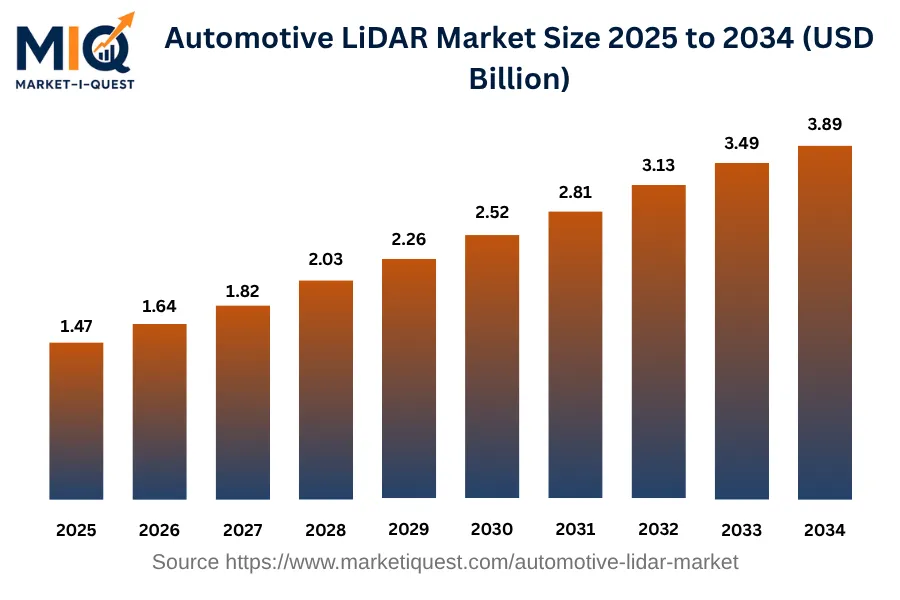
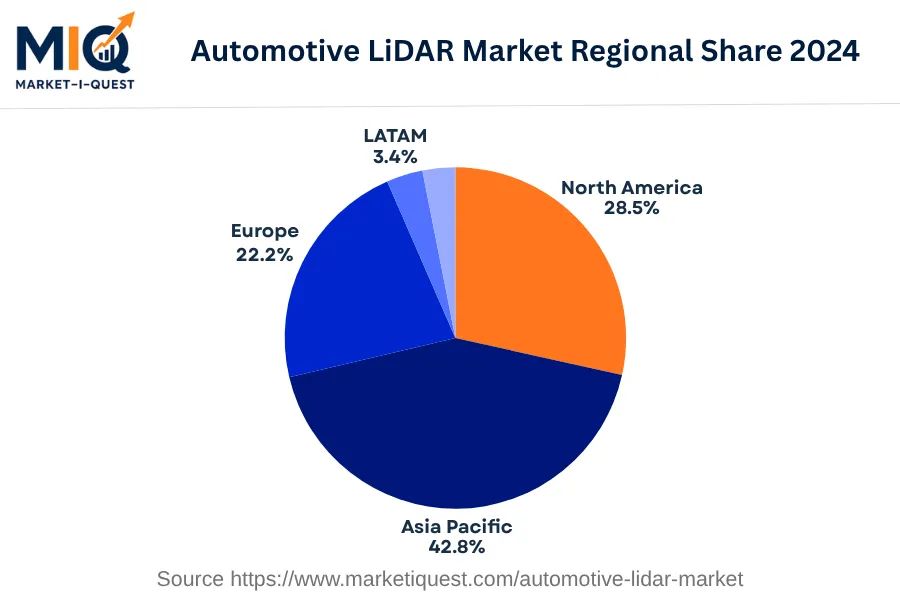
The Automotive LiDAR market size is projected to grow from USD 1.47 billion in 2025 to USD 3.89 billion by 2034, with a compound annual growth rate (CAGR) of 11.4%. The market is foreseeing an uptick from its estimated value of USD 1.32 billion in 2024, displaying a potential for substantial expansion in the forthcoming years. The substantial growth demonstrated in this decade-long period is mainly attributed to several crucial factors. Detailed among these factors include technological advancements propelling the evolution of the market and rising demand in the automotive sector. The regional share in 2024, offers an insightful perspective on the market's geographical distribution, with Asia Pacific contributing the largest share of 42.83%, followed by North America at 28.47%, Europe at 22.16%, LATAM at 3.44%, and MEA accounting for 3.1%.

Key Takeaways

  • By Technology - Mechanical LiDAR led showcasing rapid advancements in solid-state technologies.
  • By Range - Long-range (>150 m) held the lead in autonomous vehicle navigation.
  • By Vehicle Type - Passenger Vehicles held a dominant position reflecting the increasing consumer demand for advanced safety measures.
automotive-lidar-market market size

Key Driving Factors

Implementation of Advanced Driver Assistance Systems (ADAS)

Automotive manufacturers worldwide are increasingly implementing Advanced Driver Assistance Systems (ADAS) in their vehicles. ADAS helps to enhance vehicle safety by providing features like automatic braking, collision avoidance, and lane departure warning, among others. LiDAR technology plays a crucial role in ADAS, as it provides precise and real-time data about the vehicle's surroundings, which is required for these safety features to function effectively. Government bodies worldwide are advocating for improved vehicular safety norms, which is further encouraging manufacturers to incorporate ADAS in their vehicles. This trend towards enhancing vehicle safety through implementing ADAS is a major driving force for the Automotive LiDAR market.
Rise of Autonomous Vehicles

The surge in research and development activities related to autonomous vehicles is another significant driving force in the Automotive LiDAR market. LiDAR sensors play a key role in autonomous driving, providing comprehensive 3D mapping and distance measurement for safe navigation. With companies like Tesla, Waymo, and Uber heavily investing in autonomous vehicle technology, the demand for LiDAR systems is expected to grow substantially. In specific regions, such as California in the US, where autonomous vehicle testing is legally permitted, the adoption of LiDAR technology is particularly notable. Therefore, the rise of autonomous vehicles and their requirement for LiDAR systems is accelerating the growth of this industry.

Market Evolution by Timeline

2019-2023
During this period, key buyers in the automotive LiDAR market were mostly autonomous vehicle manufacturers in North America and Europe. Components were typically imported from Asia due to cost advantages. The industry saw a surge in hardware integration, with many automakers incorporating LiDAR into their vehicles. However, there was a significant constraint of power consumption and heat generation by LiDAR sensors. Regulatory guidelines such as ISO 26262 for functional safety became more prominent, impacting the market. Fixed pricing was common with longer-term contracts used for upfront capital investment. The major risk was the lack of proven reliability in extreme weather conditions, which many manufacturers sought to overcome through rigorous testing.
2024
In 2024, the demand for automotive LiDAR started diversifying beyond autonomous vehicles to advanced driver-assistance systems (ADAS) due to safety features. The supply included solid-state LiDARs providing better performance. Software integration became more sophisticated, but compatibility issues occurred frequently. The EURONCAP standards started requiring LiDAR sensors for better crash ratings, boosting the market. Predominantly, the market transitioned towards a usage-based pricing model with an increase in shared mobility services. Concerning risks, the dependency on a limited number of suppliers was a major point of contention, leading to diversified sourcing strategies.
2025-2029
Demand for automotive LiDAR broadened to include industrial autonomous vehicles and high-end cars in China and Japan. LiDAR integration into vehicles reached a mature stage with improved mapping and object detection. Constraints included high installation costs and a need for regular sensor calibration. The introduction of global standards such as ISO-15675 influenced market acceptance. More competitors led to competitive pricing, lowering production costs. Risks involved concerns regarding data privacy and security as LiDAR systems collected detailed spatial information. Likely response to this included more stringent data protection regulations and increased emphasis on cybersecurity in LiDAR systems.
2030-2034
Demand for LiDAR was widespread, supported by increased adoption of autonomous vehicles globally. Technology advancements resulted in reduced sensor size, higher accuracy and more economical mass-production. Still, managing vast amounts of data produced by LiDAR sensors remained a constraint. Policies continued to evolve; the EU Green Deal likely encouraged low-emission autonomous vehicles fitted with LiDAR systems. Product-as-a-Service models became popular, facilitating easier upgrades. Market risks inclined towards fluctuating raw material prices impacting sensor manufacturing costs. Potential mitigation strategies likely incorporated diversified supplier bases and buffer inventory management.

Future Market Outlook

Future Opportunities

Future opportunities in the automotive LiDAR market are closely linked to current technological developments and regulatory initiatives. The growth of electric vehicles (EVs) has created an increased demand for advanced sensor technologies, including LiDAR. In 2023, major automakers like Ford and General Motors are actively integrating LiDAR in their EV platforms to enhance safety and automation features. Additionally, the European Union's Green Deal, introduced in 2019, aims to create a sustainable transportation ecosystem, which may lead to broader adoption of LiDAR solutions in urban areas. With autonomous vehicle trials gaining momentum, particularly in cities like Los Angeles and Shenzhen since mid-2021, numerous pilot programs are testing the capabilities of LiDAR systems in real-world scenarios. Moreover, the heightened focus on road safety, propelled by the National Highway Traffic Safety Administration’s efforts in the U.S. since 2022, suggests an increased regulatory push for advanced driver-assistance systems incorporating LiDAR technologies. Countries like Germany are also working on legislation to address the integration of autonomous driving technologies in public infrastructure. The intersection of these trends indicates opportunities for companies to innovate around LiDAR applications beyond traditional automotive uses, such as in logistics and mapping services, reflecting an evolving landscape driven by both governmental and private initiatives.

Segmentation Analysis

By Technology

The technology market is divided into subsegments, including Mechanical LiDAR and Solid State LiDAR. Of these, Mechanical LiDAR accounted for the largest revenue share while Solid State LiDAR is expected to grow at the fastest CAGR during the forecast period.

Largest Revenue Share

Mechanical LiDAR

Market Share Leader

Mechanical LiDAR leads the technology market due to its usage in a vast range of applications including robotics, drone navigation, and autonomous vehicles, making it a preferred choice for these sectors. It utilizes moving parts to transmit light pulses that collect crucial data of their surroundings. Its ability to provide detailed data even in low light conditions remains unparalleled, contributing significantly to its revenue share. Customers prefer this technology due to this precise data capture capability, which aids in achieving greater accuracy in mapping and navigation, thus surging the demand. While its complexity and size sometimes are drawbacks for some use cases, its high resolution and wide field of view have translated into a larger market share than its counterparts. Despite the appearance of compact designs like Solid State LIDAR, Mechanical LiDAR still enjoys widespread industry adoption due to its proven performance.

Fastest CAGR

Solid State LiDAR

Forecast Period Growth Leader

Solid State LiDAR is projected to have the fastest growth in the forecast period. This technology, in contrast to Mechanical LiDAR, has no moving parts, which makes it more compact, robust and cost-effective in the long run. It is seeing increasing adoption in sectors that value these attributes, such as the autonomous vehicle industry. However, its current limited field of view and resolution compared to Mechanical LiDAR pose adoption barriers. Despite these drawbacks, the ongoing investments in research and development, industry partnerships for its implementation in vehicles, and policy catalysts favoring solid-state technology are expected to facilitate its rapid growth. Companies are pushing for the improvement of this technology, viewing the miniaturization and durability as a significant advantage for integration in everyday technology, although technical advancements need to keep up with this fast-paced demand.

By Range

The market is divided into several subsegments including short-range (≤50 m), medium-range (50–150 m), and long-range (>150 m). Among these, the long-range (>150 m) subsegment accounted for the largest revenue share while the short-range (≤50 m) subsegment is expected to grow at the fastest CAGR during the forecast period.

Largest Revenue Share

Long-range (>150 m)

Market Share Leader

In the base year 2024, the long-range subsegment emerged as the leader in terms of revenue. This can be attributed largely to the widespread use of long-range items in numerous industries. The key end users in this segment typically value long-range items for their ability to operate over extended distances, which increases efficiency and minimizes operational difficulties. This is especially true in larger geographies where operations spread over larger areas. In addition, regulations often favor long-range items, valuing their longer lifespan and lower environmental impact, which further bolsters demand. The purchasing criteria tends to lean towards such high-functionality items, despite their often-higher pricing, due to the benefits and long-term cost savings they bring about. Therefore, despite the high switching costs, businesses have continually favored the long-range subsegment, leading to its large revenue share.

Fastest CAGR

Short-range (≤50 m)

Forecast Period Growth Leader

Although the short-range subsegment didn't lead in terms of revenue in 2024, it is projected to record the fastest growth rate in the forecast period. This can be attributed to several growth drivers. Firstly, advancements in technology have led to compact and cost-effective solutions, sparking interest and increasing adoption rates in industries where close proximity operations are common. Additionally, policies focusing on safety and efficiency are also favoring the use of short-range items and thus, propelling their demand. The presence of low capital expenditure further incentivizes businesses to try these new technologies. However, one should also be aware of near-term risks such as potentially slow initial adoption rates due to resistance to change and lack of knowledge about these new technological offerings.

By Vehicle Type

The market is divided into subsegments including Passenger Vehicles and Commercial Vehicles. As per prevailing trends, Passenger Vehicles accounted for the largest revenue share while Commercial Vehicles are expected to grow at the fastest CAGR during the forecast period.

Largest Revenue Share

Passenger Vehicles

Market Share Leader

Situated firmly at the pinnacle of the vehicle market, passenger vehicles have continually dominated in terms of revenue generation. This can be attributed to a gamut of factors. First and foremost, the demand is heightened given that these vehicles serve the mobility needs of the vast majority of the global population. As urbanization expands, the urge for ownership of personal mobility solutions also proliferates. In addition to this, a rise in disposable incomes worldwide has paved the way for more consumers to afford cars, thereby spurring the passenger vehicle market. Secondly, the availability of a variety of passenger models ranging from sedans and hatchbacks to SUVs and luxury cars provides customers with broad options tailored to their needs and budget. Thirdly, regulatory bodies globally are offering incentives to promote the use of eco-friendly passenger vehicles, bolstering growth further. Lastly, the robust distribution channels encompassing both traditional dealerships and online platforms are making vehicle purchases more convenient, contributing to the largest revenue share.

Fastest CAGR

Commercial Vehicles

Forecast Period Growth Leader

Commercial vehicles are predicted to be the fastest-growing segment as per CAGR outlook. This robust growth can be linked to the expansion of commerce and trade activities that necessitate improved logistics services. Commercial vehicles are integral components of logistics and supply chain operations, making them pivotal in today's globalized economy. Furthermore, advancements in technology are introducing innovative models with enhanced fuel efficiency, payload capacity, and durability, making them attractive for fleet operators. Despite concerns over initial high costs, the long-term cost benefits provided by these vehicles override initial hesitance, favoring adoption. In tandem with this, regulatory policies aimed at curbing greenhouse gas emissions are promoting the adoption of greener commercial vehicles. Investments, partnerships, and technological integrations within the sector are also set to boost the market growth. Near-term risks could involve fluctuating fuel prices or a slowdown in global trade activities; however, the shift towards e-commerce bodes well for sustained growth in commercial vehicle usage.

Competitive Analysis

Key Market Players

Manufacturers & OEMs

Velodyne Lidar
US
Quanergy Systems
US
Continental AG
Germany

Key Suppliers & Raw Materials

Lumentum Holdings Inc.
US
OSRAM Licht AG
Germany
Innoviz Technologies LTD
Israel

Distributors, Integrators & Channel Partners

Trimble Inc.
US
Innodisk Corporation
Taiwan
Geodetics Inc.
US

Porter’s Five Forces Analysis

An analysis of the competitive dynamics within the Automotive LiDAR market.

Supplier Bargaining Power

Medium

Owing to limited number of suppliers providing critical components for LiDAR.

Buyer Bargaining Power

Low

High switching costs are incurred, given the technical nature of products.

Threat of Substitutes

Low

Lack of credible alternative technologies providing similar accuracy and reliability.

Threat of New Entrants

Medium

New entrants face barriers like initial capital expenditure and advanced technical know-how.

Competitive Rivalry

High

Intense competition among established players like Velodyne, Luminar and Waymo.

Regional Analysis

Geographic market dynamics and growth opportunities across key regions

Global Market Outlook

automotive-lidar-market market regional share

North America

In 2024, the North American automotive LiDAR market experienced substantial developments. Factors such as increased investment in autonomous vehicles, the rise of advanced driver-assistance systems (ADAS), and supportive government regulations for vehicle safety drove the market. For instance, the US government’s push for collision-avoidance systems in automobiles necessitated the incorporation of LiDAR technology, stimulating demand. Meanwhile, companies amped up research and development efforts, as observed in numerous strategic partnerships between LiDAR manufacturers and automotive companies.

There was a paradigm shift in buyer behavior, favoring technologically-advanced vehicles, thereby bolstering the LiDAR market. This inclination resulted from benefits such as efficient traffic-flow management and reduced traffic collisions. The increasing transition towards electric and self-driving vehicles, particularly in the US and Canada, cemented this trend. Additionally, the market saw an upsurge in joint ventures and partnerships – collaborations like those between Ford and Argo AI or Waymo and Magna revealed the emphasis on technology-optimized automobiles. Lastly, stringent policy enforcement was also a key trend, with the Mexican government introducing automotive safety regulations that necessitated the use of ADAS technology, further propelling the LiDAR market's growth. Thus, 2024 saw a dynamic and transformative phase for the North American automotive LiDAR market.

Asia Pacific

In 2024, the Automotive LiDAR Market in the Asia Pacific region demonstrated noticeable dynamism, primarily driven by rising automotive production, escalating demand for advanced driver assistance systems (ADAS), and expanding autonomous vehicle projects in countries like China, South Korea, and Japan. Increasing investments in automotive technology and the welcoming regulatory environment, particularly in China and South Korea, expedited deployment of LiDAR in mass-market vehicles. Subsidies in EV sector from governments across India, China, and Japan were also a significant stimulant for this market.

Consumer preference trend leaned towards higher vehicle safety and advanced autonomous features, further propelling heightened adoption of LiDAR systems. Technological advancements led to the miniaturization and cost reduction of LiDAR units, altering the competitive architecture and amplifying accessibility for the mainstream vehicle segment. Key partnerships occurred amongst LiDAR suppliers and automotive manufacturers, companies like Hyundai and Velodyne forming alliances, thereby fostering more comprehensive market penetration. Stringent policy enforcement in Japan and Australia around vehicular safety further buttressed the market. The Asia Pacific LiDAR market served sectors like automotive manufacturing predominantly. Major customers consisted of large-scale automobile manufacturers, autonomous vehicle developers, and enterprise-level end users operating in the urban mobility and transportation domain.

Europe

The Automotive LiDAR market in Europe showcased a dynamic landscape in 2024, influenced by various drivers and shaped by ongoing trends. Primary drivers included an increase in the adoption of autonomous vehicles in Germany, Italy, and the United Kingdom, necessitating advanced vehicle sensors for reliable, safe navigation. Stringent safety regulations enforced across Europe, particularly in France and Benelux, further escalated the demand for automotive LiDAR systems. Last, technology advancements led by manufacturers in the Nordics contributed to improved system efficiency and reduced pricing, fuelling market growth.

Evolving trends saw a shift in consumer preference towards solid-state LiDARs, chiefly in the United Kingdom and Spain, accentuating their compactness and durability. Partnerships and mergers amongst major players became commonplace, enhancing access to innovative LiDAR technologies. For instance, Central and Eastern Europe saw collaborations between prominent automotive manufacturers and LiDAR technology providers. Policy enforcement regarding standardisation of vehicle safety systems further compelled widespread utilisation of LiDAR in the automotive sector. This was most notable in enterprise-level consumers, primarily in automotive manufacturing sectors in Germany and Italy, and in government-led public transportation initiatives in France and the Nordics.

Latin America

In 2024, the automotive LiDAR market in Latin America experienced marked industry growth and technological adoption. The increase in smart city initiatives, particularly in Brazil and Mexico, drove demand for automated and efficient transportation solutions. Regional governments implemented stringent safety regulations, encouraging automobile companies to incorporate LiDAR technology in their vehicle safety systems. Investment in automotive R&D also surged, with Argentina, in particular, focusing on enhanced driving assistance systems. Adoption of advanced sensor technologies further pushed the growth of the LiDAR market, given their crucial role in autonomous vehicles.

Consumer behavior trended towards preference for advanced safety and autonomous features in cars, especially in high-income segments in Chile and Peru. Technology shifts were apparent as solid-state LiDAR solutions gained traction due to their compact size and high reliability. The automotive companies in the region frequently engaged in partnerships to mutualize the costs and expertise needed for LiDAR implementation. Moreover, regulatory bodies in LATAM actively promoted the standardization of LiDAR technology across the industry. Sectors such as enterprise and manufacturing substantially contributed to the LiDAR market, given their investment in vehicle fleet management and logistic applications. Latin American governments also showed interest in LiDAR technology for use in public transportation and traffic management infrastructure.

Middle East & Africa

In 2024, the Middle East and Africa Automotive LiDAR market delivered notable activity amidst technological advancement and heightened security needs. Drivers for market dynamics included the adoption of autonomous vehicles in technologically advanced nations such as Israel and UAE, elevating demand for LiDAR technology. Increased government investment in smart city infrastructure, particularly in Saudi Arabia and South Africa, provided substantial impetus. In Egypt and Nigeria, tightening regulations on vehicle safety standards led to greater emphasis on collision avoidance systems, fuelling LiDAR uptake.

On the trends front, consumer preference for enhanced automotive safety and performance significantly influenced LiDAR adoption, mainly in affluent societies like Qatar and UAE. The increasing focus on self-driving technology led to partnerships between automotive companies and LiDAR technology providers. For example, Israeli autonomous vehicle company, Mobileye, employed LiDAR in their advanced driver-assistance systems. Enforcement of stringent road safety policies in Saudi Arabia stimulated the need for advanced LiDAR systems. Sectors such as logistics and transportation, private vehicle ownership, and utilities displayed substantial demand for LiDAR technology, with the major clients being telecom, oil and gas companies embracing automation and safety measures. As a technological centerpiece, Automotive LiDAR played an integral role in shaping the transportation landscape of the Middle East and Africa in the base year 2024.

Recent Industry Developments

Latest market innovations, product launches, and strategic initiatives

April 2025

NHTSA issued an Automated Vehicle Framework that provided clearer regulatory direction for autonomous and ADAS development in North America, supporting LiDAR adoption.

Frequently Asked Questions