
Automotive Interior Materials Market Snapshot

Key Players

  • Toyota Boshoku Corporation (Japan)
  • Lear Corporation (United States)
  • Magna International Inc. (Canada)
  • Calsonic Kansei Corporation (Japan)
  • Faurecia Interior System (France)
  • Grupo Antolin (Spain)
  • Autoneum Holding Ltd (Switzerland)
  • Hyundai Mobis Co Ltd (South Korea)

Market Size

Base Year 2024
$56.73 Bn
CAGR
5.6%
Forecast 2034
$97.83 Bn

Market Segments

By Material Type
  • Textiles
  • Plastic
  • Leather
  • Wood
  • Metal
By Application
  • Seats
  • Dashboard
  • Door Panels
  • Headliners
  • Flooring)
By Vehicle Type
  • Passenger Cars
  • Commercial Vehicles
  • Electric Vehicles
  • Luxury Vehicles

Market Dynamics

Drivers
  • Rising demand for luxury vehicles
  • Growing environmental concerns
Restraints
  • High production costs
  • Stringent environmental regulations
Opportunities
  • Rising consumer demand
  • Advancements in materials technology

Market Size

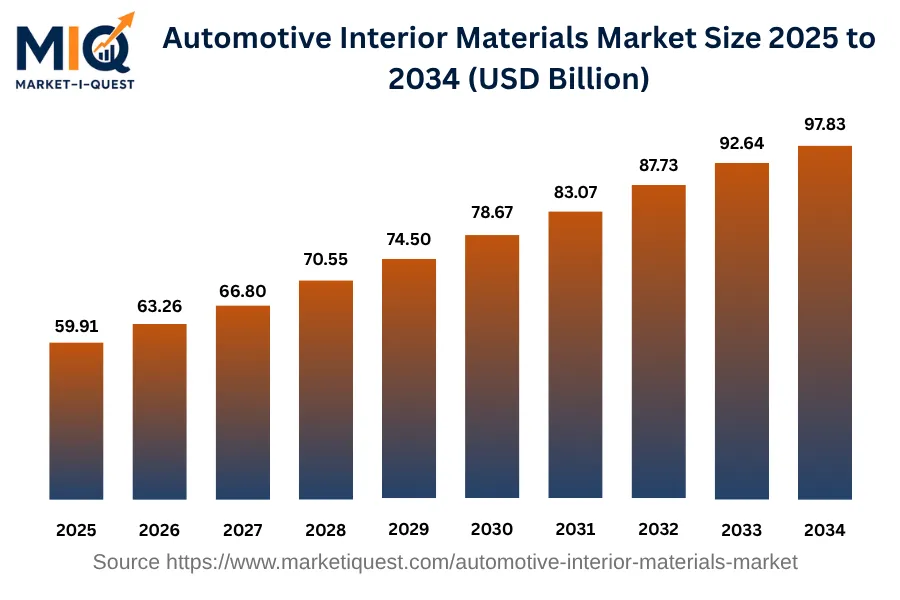
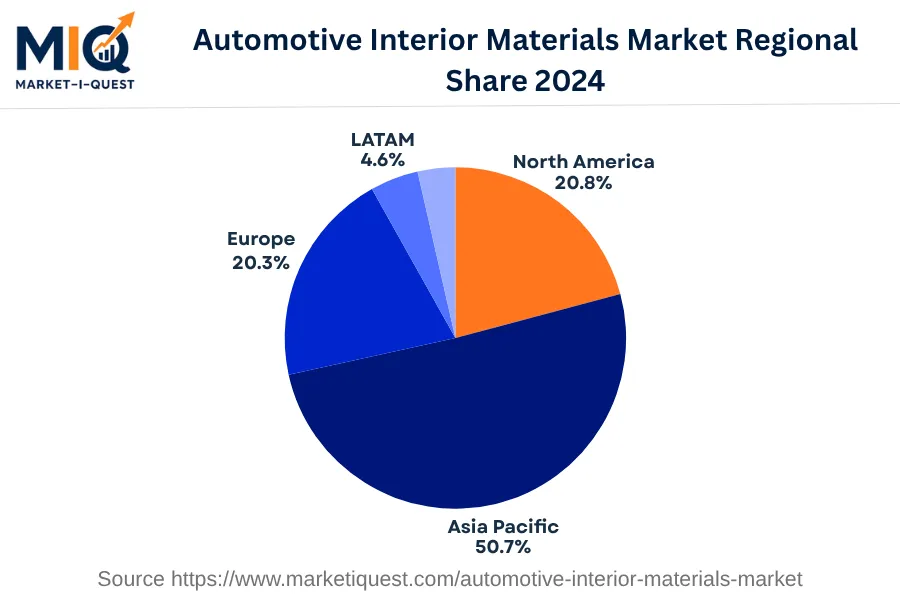
The Automotive Interior Materials Market was worth USD 59.91 billion in 2025 and is projected to reach a value of USD 97.83 billion by 2034, reflecting a CAGR of 5.6%. This change points to an upward trajectory in the sector during the review period. Specifically, the market experienced a growth from USD 56.73 billion in 2024 to nearly USD 60 billion by the end of 2025. This trend continued for the following years leading up to 2034, indicating a sustained market expansion. The regional share in 2024 showed that the Asia Pacific held the lion's share with 50.7%. The North American and European markets followed suit with 20.84% and 20.31% respectively, while Latin America and Middle East & Africa held lesser shares of 4.57% and 3.56% respectively. These shares suggest that the Asia Pacific region was the dominant player in the Automotive Interior Materials market during this period.

Key Takeaways

  • By Material Type - Plastic led in the Automotive Interior Materials Market accounting for a significant share in 2024.
  • By Application - Seats held the dominant position accounting for the largest proportion in 2024.
  • By Vehicle Type - Passenger Cars were the leading segment holding the majority market share in 2024.
automotive-interior-materials-market market size

Key Driving Factors

Implementation of Regulations on Vehicle Emission Standards

Increasing global concern over environmental degradation is driving various governments to implement stricter vehicle emission standards. These regulatory pressures influence automotive manufacturers to seek lightweight materials for vehicle interiors, which subsequently reduces the overall weight of the vehicle, hence positively impacting its fuel efficiency, leading to lower carbon emissions. The interior materials used include thermoplastics, fabric, leather, and others. The adoption of these lightweight interior materials by automotive manufacturers is a significant driver for the growth of the automotive interior materials market.
Change in Consumer Preferences towards High-End Luxury Vehicles

A notable shift in consumer preference towards high-end luxury vehicles implies an increase in customer demand for premium interior materials, such as genuine leather and high-quality fabrics. This trend is largely driven by the growing middle-class income group in emerging economies, like India and China, where the aspiration for luxury vehicles is rapidly growing. Automotive manufacturers are responding to this demand by using premium interior materials to create aesthetically appealing, comfortable, and durable vehicle interiors. Thus, the shift in consumer preference towards luxury vehicles is fueling the demand for sophisticated automobile interior materials in the market.

Market Evolution by Timeline

2019-2023
During this period, luxury car buyers with environmental conscience, especially in Europe and North America, showed a considerable demand for sustainable automotive interior materials. The leading supplier was a renewable forest product company, Stora Enso, that launched DuraSense, a blend of wood fibres and polymers, targeted at the automotive industry. However, the lack of integration between suppliers and car manufacturers resulted in limited options for customisation. As virtual crash tests standards enforced by governments, the application of these sustainable materials was to pass rigorous testing before integration. Economically, the emerging 'pay per use' model allowed customers to change the interior of their cars without a high upfront cost, attracting more users towards sustainable solutions. A significant challenge was the reluctance of many car manufacturers to switch to new materials because of the high associated costs and concerns over durability.
2024
In 2024, there was a noticeable shift in demand from North America and Europe towards Asia, specifically China, for luxury vehicles with sustainable interiors. Also, an increased use of synthetic leathers, particularly Alcantara, a carbon-neutral synthetic material, became prominent. The European Chemicals Handling Regulations posed challenges for suppliers related to the use of certain chemicals in the production of interior materials. Transitioning towards a 'cost per mile interior refurbishment' model provided advantages in the form of personalised, refreshable vehicle interiors. However, the disruption caused by lockdowns due to COVID-19 resulted in reduced production capacities which significantly impacted the industry.
2025-2029
In this period, sustainability gained more significance over luxury in the choice of automotive interior materials across the globe. The European market saw more integrated cooperation between suppliers like BASF SE and car manufacturers such as Volvo to create more customised and sustainable options for customers. Several new regulations to standardise the use of recyclable and carbon-neutral materials in automobile manufacture were introduced. Subscription-based models complemented by 'on-demand interior replacement' services enabled prolonged use of vehicles. Still, the major constraint was the underdeveloped recycling infrastructure for these new materials, which required more investment and innovations.
2030-2034
During these years, EV buyers, especially in emerging markets like India and Brazil, became the biggest demand drivers for sustainable automotive interior materials. Innovative materials derived from mushroom and pineapple leather such as Mylo and Piñatex were introduced. Regulations under the Paris Agreement mandated the use of low-carbon materials in automobile manufacture. Car leasing companies and material suppliers developed partnerships with recycling companies to build robust recycling infrastructure leading to circular economy models. While high transition costs continued to be the major hurdle, government subsidies and public-private partnerships helped overcome this challenge.

Future Market Outlook

Future Opportunities

As the automotive industry transitions toward electrification, there is a growing opportunity for interior materials that support electric vehicles. These materials not only need to be lightweight to enhance battery efficiency but also should include features such as sound insulation, which is particularly important in EVs, as highlighted by the 2022 initiative from Audi to focus on acoustic comfort in electric models. The demand for customization and personalization in vehicle interiors is rising, a trend accelerated by programs like BMW's Individual program launched in 2021, offering bespoke options for consumers. Additionally, as regulations concerning vehicle recycling become stringent in regions like the EU and North America, there are opportunities for manufacturers to develop materials that facilitate end-of-life recyclability, in line with ongoing legislative discussions around sustainability practices. In 2023, Toyota announced plans to increase the use of recycled textiles in their models, which could create new markets for suppliers focused on innovative fabric technologies. Moreover, collaborations between automotive manufacturers and technology firms, such as Ford and Amazon's partnership to enhance interior connectivity through Alexa-enabled systems, underline the potential for integrating advanced technologies into traditional materials. The exploration of modular interior designs represents another promising avenue; companies like Hyundai are investigating adaptable interior configurations for multi-functional use. Collectively, these trends indicate that the automotive interior materials market is on the brink of substantial evolution, driven largely by regulatory pressures and shifting consumer expectations.

Segmentation Analysis

By Material Type

The market is divided into subsegments including Textiles, Plastic, Leather, Wood, and Metal. Amongst them, Plastic accounted for the largest revenue share while Textiles is expected to grow at the fastest CAGR during the forecast period.

Largest Revenue Share

Plastic

Market Share Leader

The Plastic subsegment holds dominance in terms of revenue share in this market. Its impressive performance can be attributed to its favourable attributes such as durability, ease of moulding and relatively low cost, making it an appealing choice for a variety of applications. The versatility of plastic has enabled its broad use across diverse industries ranging from packaging, construction, electrical and electronics, automotive and much more. The flourishing growth of these end-user industries, particularly in emerging economies, has directly contributed to the booming demand for plastic materials. Additionally, plastic materials are available in various grades and types, each characterized by distinct features, further expanding its application base. Importantly, the widespread availability and supply of plastic, supported by a well-established supply chain, has facilitated its continual market penetration. However, it is worth noting that the scrutiny around plastic's environmental footprint has heightened and therefore, the industry's ability to innovate and adapt sustainable practices may impact future market dynamics.

Fastest CAGR

Textiles

Forecast Period Growth Leader

Textiles is projected to exhibit the fastest growth rate in the forecast period. This robust growth trajectory is driven by several factors, key among them being the escalating global demand for clothing and apparel, home textiles, and technical textiles. The global textile market's growth is increasingly being bolstered by advancements in technology, leading to the emergence of innovative textiles. For instance, smart and functional textiles, possessing unprecedented properties such as temperature control and health monitoring, have been gaining traction, opening up new verticals for growth. Additionally, ongoing global trends towards sustainability further act as a catalyst as the demand for environmentally-friendly, organic, and natural fiber textiles is on the rise. However, the market does face obstacles such as high capital investments needed, uncertainties in raw material prices and regulatory pressures related to environmental concerns, which may pose risks to the segment's rapid growth.

By Application

The application of market is divided into subsegments including Seats, Dashboard, Door Panels, Headliners, and Flooring. Among these, the Seats segment accounted for the largest revenue share while the Headliners segment is expected to grow at the fastest CAGR during the forecast period.

Largest Revenue Share

Seats

Market Share Leader

The Seats segment has garnered the most revenue for various reasons. Seats form an essential part of the vehicle, contributing significantly to the overall comfort and driving experience. As consumers increasingly prioritize comfort in vehicles, the demand for high-quality, comfortable seats has risen significantly. Moreover, the rising trends of personalization and luxury offerings in the automotive sector are encouraging manufacturers to invest heavily in advanced, feature-packed seats, further boosting the revenue of this segment. Geographically, it can be inferred that more developed regions with mature automotive markets, like North America and Europe, contribute significantly to this segment's revenue due to the high demand for premium and luxury vehicles. Regulatory push for enhanced vehicle safety is also driving advancements and investments in seats, particularly with features like seat belt reminders and adjustable seats. The purchasing criteria for seats often revolve around comfort, durability, and aesthetics, with customers willing to pay premium prices for high-quality seats – contributing to the segment’s high revenue.

Fastest CAGR

Headliners

Forecast Period Growth Leader

Although not the current revenue leader, the Headliners segment in the automotive market is poised to grow rapidly. A few factors drive this growth. Headliners are increasingly being recognized as an essential aesthetic and comfort feature in vehicles, prompting manufacturers to invest in their innovation and improvement. Technological advancements, such as integration with smart features like overhead lighting, Bluetooth speakers, and sunroof controls are creating a significant growth opportunities for the segment. Furthermore, policy regulations around energy efficiency and noise control are leading to the adoption of headliners with better insulation properties. The emergence of electric vehicles is further propelling the segment's growth as these cars require specialized headliners to accommodate additional features like ambient lighting and sensors. However, there might be adoption barriers in less developed markets due to cost considerations. Thus, focus on cost-efficient production methods and partnerships with local manufacturers can potentially catalyze growth in such regions.

By Vehicle Type

The vehicle market is divided into subsegments including Passenger Cars, Commercial Vehicles, Electric Vehicles, and Luxury Vehicles. In 2024, Passenger Cars accounted for the largest revenue share while Electric Vehicles is expected to grow at the fastest rate during the forecast period.

Largest Revenue Share

Passenger Cars

Market Share Leader

In 2024, the Passenger Cars segment yielded the highest revenue due to vital factors such as affordability, ease of use, and higher demand compared to other vehicle types. With the average consumer prioritizing cost-effectiveness and the need for reliable daily transportation, passenger cars have remained a highly preferred choice. Geographically, the consumer base for this segment is widespread, as passenger cars are sought after globally, particularly in developing regions where the demand for affordable and practical commuting options continues to rise. Furthermore, government regulations favoring the mass production of passenger cars backed by positive economy and employment rates have bolstered this segment's growth. However, switching costs are a significant factor, as transitioning to commercial, electric, or luxury vehicles usually requires a higher capital investment.

Fastest CAGR

Electric Vehicles

Forecast Period Growth Leader

Despite not generating the most revenue in 2024, the Electric Vehicles segment is projected to grow at the fastest rate. This growth is driven by greater environmental awareness, technological advancements, and favorable government policies that encourage the adoption of electrified transportation. Rising fuel prices and the world's move toward sustainability are also significant catalysts for this growth, presenting the electric vehicle as an attractive alternative to traditional fuel-based vehicles. However, the high cost of electric vehicles and the lack of a widely-spread recharging infrastructure present barriers to adoption. Partnerships between automotive manufacturers and governments across the globe to improve charging infrastructures and implement incentives for electric vehicle ownership mitigate these obstacles and further foster the swift growth of this segment. Current uncertainties, such as the supply of key components like batteries and the universal adoption of electric vehicles, pose near-term risks.

Competitive Analysis - Automotive Interior Materials Market

Key Market Players

Manufacturers / OEMs

Toyota Boshoku Corporation
Japan
Lear Corporation
US
Faurecia Interior Systems Inc.
France

Key Suppliers & Raw Materials

Adient Plc
Ireland
Magna International Inc.
Canada
DowDuPont Inc.
US

Distributors, Integrators & Channel Partners

Grupo Antolin
Spain
Dräxlmaier Group
Germany
IAC Group
Luxembourg

Porter’s Five Forces Analysis

This analysis studies the competitive dynamics of the Automotive Interior Materials Market.

Supplier Bargaining Power

Medium

Availability of numerous suppliers causes competition, but specialization in materials balances power.

Buyer Bargaining Power

High

Numerous suppliers in the market give buyers significant purchasing options and negotiation power.

Threat of Substitutes

Low

Specialized nature of automotive interior materials lowers the threat from substitute products.

Threat of New Entrants

Medium

The entry barriers are moderate because of high investments and technological expertise required.

Competitive Rivalry

High

Intense rivalry due to presence of numerous globally established brands.

Regional Analysis

Geographic market dynamics and growth opportunities across key regions

Global Market Outlook

automotive-interior-materials-market market regional share

North America

In 2024, the North American automotive interior materials market was highly dynamic, driven by shifts in demand factors, regulatory constraints, technological advancements, and evolving supply dynamics.

Key demand drivers included heightened consumer expectations for comfort and luxury, particularly within the U.S. premium vehicle sector. In Canada, stringent regulations on material safety and emissions had a significant impact on market dynamics, driving the adoption of more sustainable, low-emission materials. Investment in advanced materials research was particularly noticeable, with U.S. automakers seeking innovative ways to enhance interior aesthetics and functionality. Adoption of new technology, such as 3D printing in seat fabrication, emerged prominently in Mexico, where cost-efficiency remained a critical driver. Supply dynamics were also crucial, with shifts in raw material prices impacting market profitability and production decisions.

The North American market saw several notable trends in 2024. Valve towards personalized, user-centric designs led to increased differentiation in interior offerings across all three countries. In response to evolving buyer behavior, there was a clear shift towards the use of more sustainable, recyclable materials in vehicle interiors. Partnerships and M&A activity were prevalent as companies sought to strengthen their portfolios and capabilities in a competitive market. Policy enforcement around material safety standards also tightened significantly, raising the bar for entry and encouraging diversification in material use.

Asia Pacific

In 2024, the Asia Pacific market for Automotive Interior Materials witnessed substantial activity. A significant driver was escalating demand, particularly in China and India, due to the surging middle class's growing vehicle ownership. Regulatory initiatives, such as China's "New Energy Vehicle Development Plan," invigorated interest in eco-friendly interior materials. In Japan and South Korea, technological adoption accelerated with leading automakers incorporating advanced, lightweight materials in interiors to enhance fuel efficiency.

Trends in buyer behavior reflected evolving preferences for luxury and comfort, especially among consumers in Australia and key ASEAN markets. Technological shifts were visible with the emerging significance of bio-based materials for interior components. Companies like Toyota in Japan actively pursued green technology, following enforcement of stricter environmental regulations. Partnership activities spiked, for example by Hyundai with global suppliers to revamp interiors with high-quality, sustainable materials. E-commerce became a significant sales channel, with a rise in online vehicle purchases altering conventional distribution dynamics. The automotive manufacturing sector was the primary customer base, with retail demand progressively increasing due to expanding online platforms. Regulations centered on carbon emissions and sustainability significantly influenced market progression in 2024.

Europe

In 2024, the European Automotive Interior Materials Market stood firm, influenced by specific demand factors, technology adoption, and regulatory requirements. The implementation of stringent regulations related to vehicular emissions and fuel economy prompted an extensive demand for lightweight and durable interior materials. Increased investment in advanced material manufacturing technology paved the way for the development of high-grade synthetics and smart textiles, predominantly in Germany and the United Kingdom. The pricing dynamics for these materials, however, somewhat hindered market growth, chiefly in regions like Spain and Central & Eastern Europe.

Key trends included a dramatic shift in consumer preference towards eco-centered interiors, with customers in the Nordics, Benelux, and France leaning heavily towards bio-based plastics and recycled materials. Product innovation and technology played a significant role, and the integration of smart features into automotive interiors became increasingly popular, especially within the premium car sector in Italy and Germany. Furthermore, a substantial number of partnerships and acquisitions were observed among the manufacturers as a strategic move to acquire new technologies and satisfy rising customer expectations. Enforcement of EURO-7 regulations standards by the European Union significantly influenced market dynamics, pushing automobile manufacturers to align their production methodologies accordingly.

Latin America

In 2024, the Automotive Interior Materials Market in Latin America, with Brazil, Mexico, Argentina, Colombia, Chile, and Peru being key contributors, witnessed notable dynamics and trends. Key drivers for this growth included amplified demand for premium vehicles, stringent regulations regarding vehicle emissions reducing weight and increasing fuel efficiency, and major investments for the advancement of automotive interior materials. Technological adoption aided the emergence of innovative materials such as bio-based plastics, fostering competitive pricing in the market.

Trends shaping the market involved a shift in buyer behavior towards purchasing high-quality, sustainable, and durable interior materials. Accelerated by technological advancements, this shift enabled broader options for customization - a rising consumer demand. Furthermore, an increase in partnerships and M&As, especially in the manufacturing sector, bolstered a wider distribution network and diversified product offerings across the region. More stringent policy enforcements were seen, specifically in Brazil and Mexico, with the automotive sector meeting higher standards of safety, comfort, and noise vibration harshness (NVH) in interior materials. This progressive market, therefore, demonstrated a strong potential for both local manufacturers and international entrants in the automotive interior materials sector.

Middle East & Africa

In the base year 2024, the Middle East and Africa Automotive Interior Materials Market witnessed significant progression. Market drivers included heightened demand for high-end vehicles, particularly in Saudi Arabia and the United Arab Emirates, necessitating the use of quality interior materials. Stringent regulations in countries such as Israel compelled the adoption of eco-friendly materials in automotive interiors. Increased investment in automotive sectors by South African and Nigerian governments stimulated market expansion. On the supply side, initial adoption of advanced technologies to produce lightweight, durable materials were observed, with manufacturers in Egypt and South Africa leading this initiative. Competitive pricing dominated market dynamics, with Qatari manufacturers adopting aggressive pricing strategies to penetrate deeper into the market.

Trend-wise, a noticeable shift towards buyer preference for vehicles with luxe leather interiors, especially in Saudi Arabia and the UAE, was prevalent. Car manufacturers in these countries responded by partnering with premium interior materials suppliers. A significant technology shift was the increased implementation of recycling in the manufacture of automotive interior materials, particularly in Israel. Furthermore, policy enforcement reflecting stricter environmental standards significantly impacted automotive manufacturing in Egypt. The prevalent sectors engaged in this market included government entities, oil and gas corporations, telecom companies, healthcare, and manufacturing industries, notably seen in Kenya where manufacturing firms showed increased interest in high-quality automotive interior materials.

Recent Industry Developments

Latest market innovations, product launches, and strategic initiatives

July 2024

Antolin partnered with MIT ADT University to collaborate on automotive interior design projects, focusing on new materials, technologies, and design concepts that enhance the passenger experience.

Frequently Asked Questions