
Automated Test Equipment Market Snapshot

Key Players

  • Advantest Corporation (Japan)
  • Teradyne Inc. (United States)
  • Keysight Technologies (United States)
  • National Instruments Corporation (United States)
  • Spea S.p.A. (Italy)
  • Chroma ATE (Taiwan)
  • Astronics Corporation (United States)
  • Marvin Test Solutions Inc. (United States)
  • Rohde & Schwarz (Germany)
  • StarTest (Israel)

Market Size

Base Year 2024
$8.24 Bn
CAGR
6.1%
Forecast 2034
$14.90 Bn

Market Segments

By Device Type
  • Integrated Circuits
  • Hard Disk Drives
  • Printed Circuit Boards
  • Others
By Testing Type
  • Logic Testing
  • Printed Circuit Board Testing
  • Interconnection and Verification Testing
By End-use Industry
  • Automotive & Transportation
  • Consumer Electronics
  • Telecommunication
  • Healthcare
  • Semiconductor
  • Others

Market Dynamics

Drivers
  • Increasing demand for consumer electronics
  • Growing complexity of electronics design
Restraints
  • High equipment costs
  • Lack of skilled technicians
Opportunities
  • Rising semiconductor industry
  • Increasing digitalization trends

Market Size

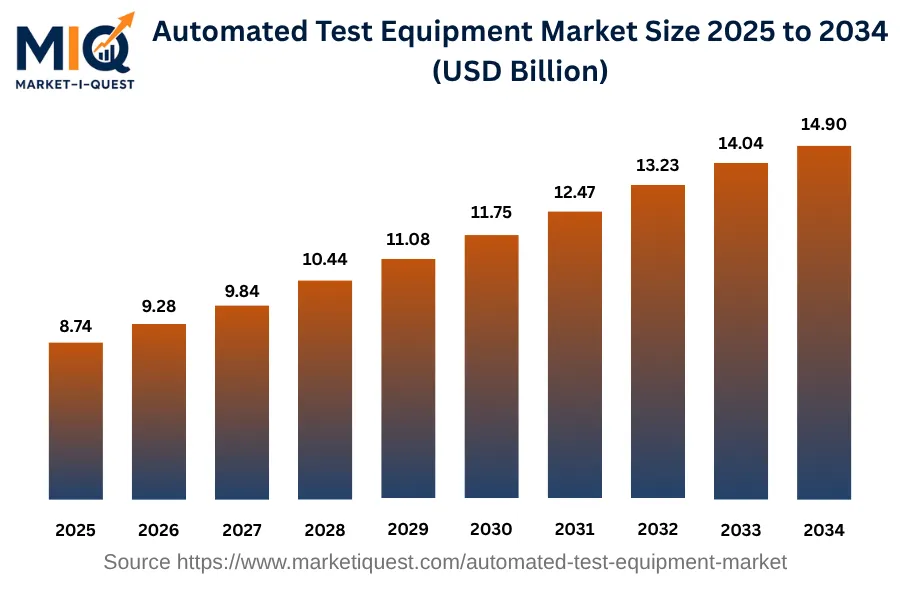
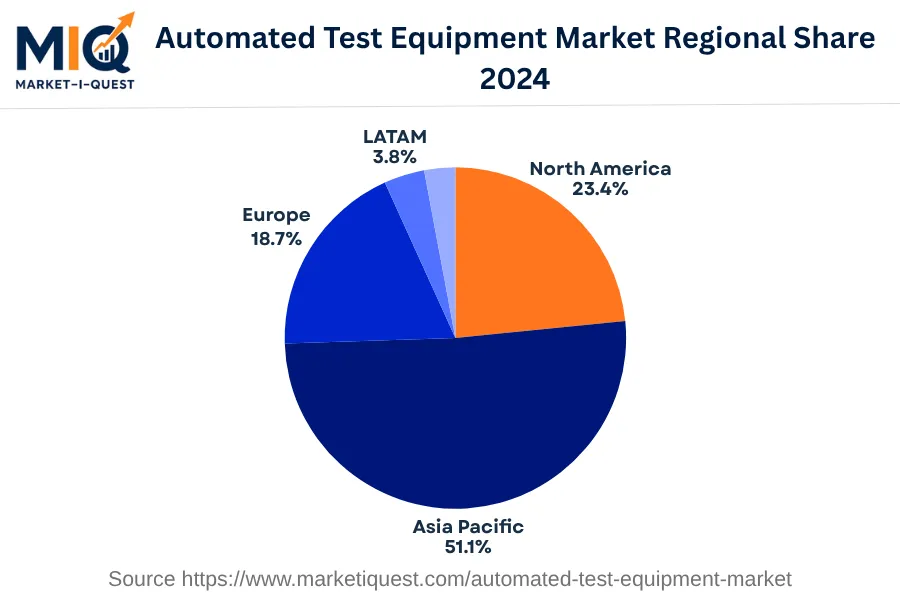
The Automated Test Equipment Market held a value of 8.24 billion USD in 2024, increasing to 8.74 billion USD by 2025. By 2034, the market value is projected to reach 14.90 billion USD, showing a CAGR of 6.1%. This growth is driven by an increased market demand and advancements in technology within the years. The growth indicates constant market expansion throughout the projected period. In terms of regional share in 2024, Asia Pacific held the majority market share at 51.1%, followed by North America at 23.41%, Europe at 18.73%, LATAM at 3.84% and the MEA region at 2.94% respectively.

Key Takeaways

  • By Device Type - Integrated Circuits led the market accounting for a significant share in 2024.
  • By Testing Type - Printed Circuit Boards Testing held the largest share of segment in 2024.
  • By End-use - Semiconductor held a substantial market share in 2024.
automated-test-equipment-market market size

Key Driving Factors

Upsurge in Smartphone and Other Electronics Manufacturing

The automated test equipment market is considerably driven by the upsurge in the international smartphone and electronics manufacturing. Including countries such as China, Vietnam and India have seen a significant increase in electronics manufacturing industries in recent years. This rise in production is driven by both the shift of manufacturing facilities within these areas due to minimized labor costs and a growing domestic market as an increasing population affording smartphones, tablets and other gadgets. Automated test equipment plays an major role in the quality control process within these industries. It efficiently verifies functionalities of electronic devices and smooth detection of any defects on a large scale, thus resulted in increasd growth with reducing the count of faulty products. This increasing gadget production and the subsequent need for quality assurance has been a major drivers in pushing the increased adoption of automated test equipment.
Increasing Complexity of Electronic Devices

The rapid development and increasing complexity of electronic devices is a significant driver for the automated test equipment market. Consumers demand for devices with higher performance and multiple features, such as 5G smartphones, autonomous driving systems and the increase use of AI in electronic appliances driving manufacturers for design enhanced electronic designs. The testing of these devices demanded a constant pace with increasing complexity. Automated test equipment's ability to perform rigorous, detailed and quick assessment of complex electronic devices. With running multiple tests simultaneously, reducing the downtime to validate and troubleshoot these complex systems. The demand of manufacturers for the reduction of time-to-market of their products to lead the competition. Quick and efficient design validation and troubleshooting facilitated by the automated test equipment allows quicker product releases, driving the market for such equipment.

Market Evolution by Timeline

2019-2023
This period primarily drove buyers from telecommunications, automotive, semiconductor industries worldwide. Emerging 5G and IoT technologies require rigorous equipment testing. In terms of supply providers expand offerings with solutions featuring enhanced chip testing capabilities. However, high deployment costs is limited by small-medium enterprises adoption. Countries, especially the US and China, heavily invested in smart infrastructure, further boosting the adoption of ATE. Contract services became a dominant business model due to the increased cost on SMEs.
2024
Notable, increasing demand from aerospace and defense sectors as these industries with requirement of high precision testing equipment for complex aircraft systems. With the supply side experiencing significant advancements with a focus on miniaturization and energy efficiency of ATEs. However, the adoption of miniature testers might be constrained due to their higher cost. Governments worldwide push for digital transformation initiatives, indirectly driving ATE markets. The adoption of 'pay per use' models becomes common for reducing the costs.
2025-2029
The demand primarily comes from developing regions like India, Brazil and Southeast Asian countries. Renewable energy sectors fuel the demand for efficient testing for solar panels and batteries. In terms of supply ATE manufacturers seek ways to reduce production costs serving to price-sensitive markets. The European Union's strict regulations for equipment safety standards for market growth. Metering as a service model becomes prominent due to cautious investment behavior in these uncertain times.
2030-2034
This phase is projected to see demand from Artificial Intelligence and Machine Learning sectors. Advanced chipsets requiring high precision ATEs is driven by this demand. Suppliers may experience barriers in maintaining operational efficiency and integration and interoperability of new systems. Government initiatives promoting AI and ML can positively affect the market. While, companies collaborate with government and private sectors for shared investments.

Future Market Outlook

Future Opportunities

With increasing demand for high-quality electronic devices continues to rose the future opportunities in the automated test equipment sector. The increasing adoption of electric vehicles, particularly in the automotive sector with the European Union towards greener technologies. By 2024, industry leaders like Tesla required robust testing for advanced electronic systems for creating specialized market for ATE . Moreover, advancements in autonomous systems with companies like Boeing with increased investing in drones are driving the demand for reliable testing equipment to ensure safety and compliance with regulations, such as the FAA's Remote ID requirements introduced in 2023. The 2022 update of ISO 26262 increasing the necessity for stringent automotive safety standards, indicating manufacturers to innovate testing methods. In medical technology, the revision of ISO 13485 has increased the pressure on device manufacturers to ensure enhanced testing procedures, opening opportunities for ATE solutions tailored according to this market. The recent trend toward functional safety in industrial automation, as highlighted in partnerships involving companies like Siemens, provides a significant opportunity for ATE providers to develop comprehensive testing solutions that meet new safety criteria. Overall, these developing sectors reflect a favorable environment for ATE providers to diversify and tailor their offerings to meet the demands of various industries.

Segmentation Analysis

By Device Type

The market is divided into subsegments including Integrated Circuits, Hard Disk Drives, Printed Circuit Boards, and Others. Integrated Circuits accounted for the largest revenue share while Printed Circuit Boards are expected to grow at the fastest CAGR during the forecast period.

Largest Revenue Share

Integrated Circuits

Market Share Leader

Integrated Circuits (ICs) holds the largest portion of the market primarily to their broad adoption across a various applications and industries. With aiming to reduce and optimize electronics this transform ICs demand. Notably, they form a major modern electronic devices, from computers and smartphones to automobile systems and home appliances. The key drivers for this segment's growth are ever-evolving consumer electronics market and the consequent, relentless demand for optimized, smaller devices. Technology developments, innovation in chip design, and integration capabilities are further propelling the market's revenue. The Asia-Pacific region, dominant in electronics production, has been a significant geographical contributor to IC revenue—given the presence of manufacturing giants and rising disposable incomes driving an upsurge in electronic device demand. Considering purchasing criteria, customization capabilities, cost-effectiveness, and performance efficiency of ICs keep them desirable. As an industry norm, the high switching costs and established distribution channels further cement their market standing.

Fastest CAGR

Printed Circuit Boards

Forecast Period Growth Leader

On the contrast, Printed Circuit Boards (PCBs) are projected to witness the fastest growth rate in the forecast period. This growth projection is underpinned by PCBs' critical role in connecting electronic components through pathways etched from copper sheets, which are then laminated onto a non-conductive substrate. Favoring their rapid adoption is the accelerating trend of electronics' miniaturization and complex circuitry, as PCBs enable compact and efficient routing of circuits. Rapid technological advancements, particularly in the telecommunication and automotive sectors, are expected to serve as catalysts for this growth. Regulatory focus on energy-efficient electronics also drives advancements in PCB designs, encouraging their broader adoption. However, manufacturers face the barrier of investing in high-precision manufacturing techniques, which may pose a near-term risk to growth. It's assumed that firm-level strategic partnerships could alleviate capital expenditure concerns while bolstering production capabilities and coping with this projected demand surge.

By Testing Type

The market is divided into subsegments including Logic Testing, Printed Circuit Board Testing, Interconnection and Verification Testing. Printed Circuit Board Testing accounted for the largest revenue share while Logic Testing is expected to grow at the fastest CAGR during the forecast period.

Largest Revenue Share

Printed Circuit Board Testing

Market Share Leader

Printed Circuit Board (PCB) Testing is responsible for the largest revenue share in 2024 mainly due to its vital role in the production process of electronic devices. PCB testing involves the application of tests, inspections, and procedures to detect and identify defective components or assemblies. The high demand for electronic devices such as smartphones, tablets, and computers, coupled with the need for quality and durability, has driven substantial growth in this subsegment. The advent of complex technologies like AI, IoT, and 5G also led to the integration of multi-function PCBs in different electronic systems, increasing the demand for PCB testing. Geographical regions such as Asia, home to major electronics manufacturing hubs like China and Taiwan, add to the significant revenue share as these regions emphasize quality assurance, regulatory compliance and reduction in production waste.

Fastest CAGR

Logic Testing

Forecast Period Growth Leader

Logic Testing is projected to be the subsegment with the fastest growth rate, driven by the growing complexity of digital systems and the need for advanced testing solutions. As digital systems continue to evolve, the use of logic gates to build complex switching circuits has become more prevalent, which necessitates comprehensive testing procedures to ensure performance and reliability. Additionally, the push towards more energy-efficient and smaller devices has led to the increased use of integrated circuits, which require comprehensive logic testing to validate functionality and reliability. In terms of adoption barriers, the rapid development of technology can pose a challenge, as it requires constant updates in testing methodologies. Near-term risks could include technological obsolescence and the potential high costs associated with implementing advanced testing systems.

By End-use Industry

The market is divided into subsegments including Automotive & Transportation, Consumer Electronics, Telecommunication, Healthcare, Semiconductor, and Others. The semiconductor segment accounted for the largest revenue share while the healthcare segment is expected to grow at the fastest CAGR during the forecast period.

Largest Revenue Share

Semiconductor

Market Share Leader

The semiconductor industry has been leading the market in terms of revenue generation due to its widespread usage across various verticals. The primary growth drivers for this industry are the growing demands for smart technologies including Artificial Intelligence, Internet of Things, and Machine Learning. As these technologies continue to penetrate various industries, the demand for sophisticated semiconductor items has skyrocketed. Geographically, the Asia-Pacific market has been the largest contributor due to the presence of major semiconductor manufacturing companies. Additionally, the growing digitalization trends in countries like China and India have further expanded the reach of the semiconductor industry. Regulatory aspects have also boosted the semiconductor sector, with governments across the world offering favorable policies for technological advancements. Customer purchasing trends have been evolving with a focus more on quality and brand recognition, which further cements the status of established semiconductor companies.

Fastest CAGR

Healthcare

Forecast Period Growth Leader

The healthcare sector is expected to exhibit the fastest growth rate during the forecast period. This growth is a result of the growing trend of digitalization in healthcare, implementation of various healthcare IT solutions, and increasing government initiatives regarding eHealth. Innovations in technology such as telehealth and telemedicine are propelling the demand for electronics and communication devices. Overcoming the barrier of slow adoption, especially in developing nations, partnerships have played a vital role. Collaboration between healthcare and tech firms to develop intuitive and efficient solutions has driven the segment's growth. Factors such as rising healthcare expenditure, demand for remote patient monitoring services, and growing geriatric population are further likely to trigger the growth. However, near-term risks such as cybersecurity threats, data privacy issues, and high initial investment in IT infrastructure may hamper the growth to some extent.

Competitive Analysis

Key Market Players

Manufacturers / OEMs

Teradyne Inc.
US
Advantest Corporation
Japan
Keysight Technologies
US

Key Suppliers & Raw Materials

Semiconductor Equipment Corp.
US
National Instruments
US
Rohde & Schwarz
Germany

Distributors, Integrators & Channel Partners

Axxon Electronics, Inc.
Canada
MLB Co., Ltd.
Japan
RS Components
UK

Porter’s Five Forces Analysis

This analysis explores the competitive dynamics within the Automated Test Equipment Market.

Supplier Bargaining Power

Medium

Suppliers' power is balanced, driven by the specialization of equipment parts.

Buyer Bargaining Power

High

Buyers have strong power due to multiple suppliers and relative ease of switching.

Threat of Substitutes

Low

Substitute products are limited due to the specific functionality of automated test equipment.

Threat of New Entrants

Medium

Entry is feasible but challenging due to technology development cost and regulatory standards.

Competitive Rivalry

High

Significant rivalry exists due to the presence of several large multinational players.

Regional Analysis

Geographic market dynamics and growth opportunities across key regions

Global Market Outlook

automated-test-equipment-market market regional share

North America

In 2024, the North American market for Automated Test Equipment (ATE) highlighted a robust activity within sectors such as manufacturing, retail, and utilities. Key drivers included an accelerated need for quality assurance, stringent regulations promoting product safety and increasing investments in sophisticated technology in countries such as the U.S., Canada and Mexico. Whereas, the adoption of AI and machine learning in test mechanization substantially increased supply dynamics, mitigating risks of faulty components.

Simultaneosly, buyer behavior evolved with a marked preference for accurate, quick and cost-effective automatic testing services. An evident trend became wide-scale shift towards SoC (System on Chip) ATEs, likely due to their superior functionality in component integration tests. Partnerships and M&A activity shaped the competitive landscape a notable example would be Accenture's strategic acquisition of Electro Optic Systems. The stringent policy enforcement resulted in manufacturers shifting towards an ATE system to ensure compliance. For example, in the United States, the Federal Communications Commission (FCC) mandated certain radio frequency device tests which benefitted the ATE market. Thus, healthcare looking for automation efficiencies, emerged as impacting sector adopting ATE to ensure strict patient safety standards.

Asia Pacific

In 2024, the Automated Test Equipment market in Asia Pacific experienced substantial growth. With robust demand in electronics manufacturing sectors, particularly in China and South Korea contribution in this rise. India's policy of "Make in India" also spurred investments in domestic electronics manufacturing infrastructure, further expanding ATE market. Rapid technology adoption in Japan and Australia with the shift towards 5G, increased the need for advanced testing equipment in communication and IT sectors.

Simultaneously, market trends highlighted a shift towards cost-effective and highly efficient ATEs. Key market players, particularly from China and Japan, formed strategic partnerships for innovation and acceleration in development of similar products. The implementation of stringent quality standards across manufacturing sectors in ASEAN markets fueled demand for efficient ATEs. Additionally, a noticeable trend around the increasing use of cloud-based automated testing equipment in India and Australia due to the rising adoption of Industry 4.0 technologies in manufacturing and utilities sectors. Thus, the growth factors and trends led to the expansion of the ATE market in Asia Pacific in 2024, particularly within manufacturing, IT, and utilities sectors in key Asian economies.

Europe

In 2024, the European Automated Test Equipment (ATE) market showcased significant expansion, driven by various factors included by increased demand for efficient and cost-effective testing solutions, major technological upgrades, and the crucial deployment of 5G. Specifically, in Germany and France, a rise in the adoption of ATE systems influenced by the growth in the automotive and semiconductor industries. Regulatory policies with encouraging energy efficiency and safety also drove the ATE market, particularly in the UK. Italy saw high investment in the telecommunications sector, which led to the proliferation of ATE. In terms of trends a shift towards system-on-a-chip and memory chip testing due to the growing complexity and density of semiconductors.

Additionally, the increasing demand for consumer electronics across the Nordics and Central & Eastern Europe resulted in the growth of ATE systems to assure product quality. With a notable increase in strategic collaborations, particularly in the United Kingdom and Germany aiming for advancements in ATE technology. Thus, considered crucial during the manufacturing process across sectors including enterprise, healthcare and retail, ATE has essentially continued to demonstrate its indispensability due to its critical role in detecting faults early, ensuring product reliability and quality.

Latin America

In 2024, the Latin American market for Automated Test Equipment (ATE) showed significantly more dynamic due to the rise in manufacturing and technology adoption across regions like Brazil, Mexico, Argentina, Colombia, Chile and Peru. These markets were driven by the mass production of electronics, the rise in local manufacturing and technology companies and the drive toward industrial automation, requiring cost-efficient and error-free testing. A notable supply catalyst was the penetration of international ATE suppliers establishing commercial synergy with local manufacturers. With influential trend such as shift towards adopting ATE in the automotive industry in Mexico and Brazil due to their robust vehicle production. Also, the emergence of 5G technology in regions like Chile and Argentina injected substantial demand for ATE in their telecom sector. With the enforcement of quality control measures in sectors such as healthcare and utilities were visible, indicating an increased usage of ATE. Notably, the rise in partnerships between local retail providers and global ATE providers was facilitating easy access and wide-spread adoption.

With critical government mandates across LATAM countries significantly encouraging domestic products digital testing, contributing to constant year-on-year ATE market growth in the region. In Colombia, retail and manufacturing sectors emerged as leading ATE consumers responding to the quality standards enforced by government. Thus, 2024 witnessed a rose ATE market in Latin America, centered around manufacturing, tech adoption, automotive, telecommunications, healthcare, utilities and retail sectors.

Middle East & Africa

In 2024, the Automated Test Equipment Market in the Middle East and Africa indicated growth driven by several major factors. Such as increased investments in telecom and network infrastructure, particularly in Saudi Arabia, United Arab Emirates and Egypt drove strong demand for automated testing solutions. Additionally, regulatory protocols in Nigeria and South Africa for quality control in manufacturing sectors spurred the adoption of advanced testing equipment. Shifts in oil and gas operations, specifically within Qatar requiring stringent quality checks also boosted market growth.

With several trends including an increase in technology adoption amongst smaller industries, especially in Kenya and Israel, who sought cost-effective options for quality control. Partnerships between local telecom companies and international automated test equipment providers in the United Arab Emirates became more common to ensure network reliability and performance. Meanwhile, financial services sector in South Africa increasingly adopted automated test equipment to validate the robustness of digital platforms. Policies enforcing stricter quality standards in government-owned sectors in Saudi Arabia led to the procurement of high-tech testing devices. The manufacturing sector across the region, particularly automotive manufacturing in Egypt, embraced automated testing to streamline processes and increase productivity.

Recent Industry Developments

Latest market innovations, product launches, and strategic initiatives

June 2026

Teradyne introduced a fully integrated test cell solution that pairs its UltraFLEXplus platform with Tokyo Electron’s Prexa SDP, specifically designed to provide known good device (KGD) screening for the advanced 2.5D and 3D packages driving modern AI and data center architectures.

April 2026

Advantest officially joined Applied Materials' EPIC (Equipment and Process Innovation and Commercialization) platform as the very first ATE partner, creating a direct development link between front-end semiconductor manufacturing technologies and back-end testing processes.

September 2025

Teradyne released the UltraPHY 224G, a high-speed PHY performance testing instrument that delivers bench-quality signal generation and measurement for production testing to address emerging, high-density data rates in silicon photonics.

Frequently Asked Questions