Aerospace Foam Market Snapshot

Key Players

  • BASF SE (Germany)
  • Zotefoams Plc (UK)
  • Rogers Corporation (USA)
  • SABIC (Saudi Arabia)
  • Evonik Industries AG (Germany)
  • Trelleborg AB (Sweden)
  • Boyd Corporation (USA)
  • ERG Aerospace Corporation (USA)
  • Solvay SA (Belgium)
  • General Plastics Manufacturing Co. (USA)

Market Size

Base Year 2024
$6.73 Bn
CAGR
6.7%
Forecast 2034
$12.87 Bn

Market Segments

By Type
  • Polyurethane foam
  • Polyethylene foam
  • Polyimide foam
  • Melamine foam
  • Metal foam
  • Polyvinyl chloride foam
  • Polyethylene terephthalate foam
  • Specialty high-performance foam
  • Others
By Application
  • Flight deck pads
  • Aircraft floor
  • Carbon walls and ceilings
  • Aircraft seats
  • Others

Market Dynamics

Drivers
  • Rising aerospace industries
  • Rapid urbanization
Restraints
  • High production cost
  • Stringent regulatory policies
Opportunities
  • Emerging aerospace technologies
  • Increasing demand for lightweight materials

Market Size

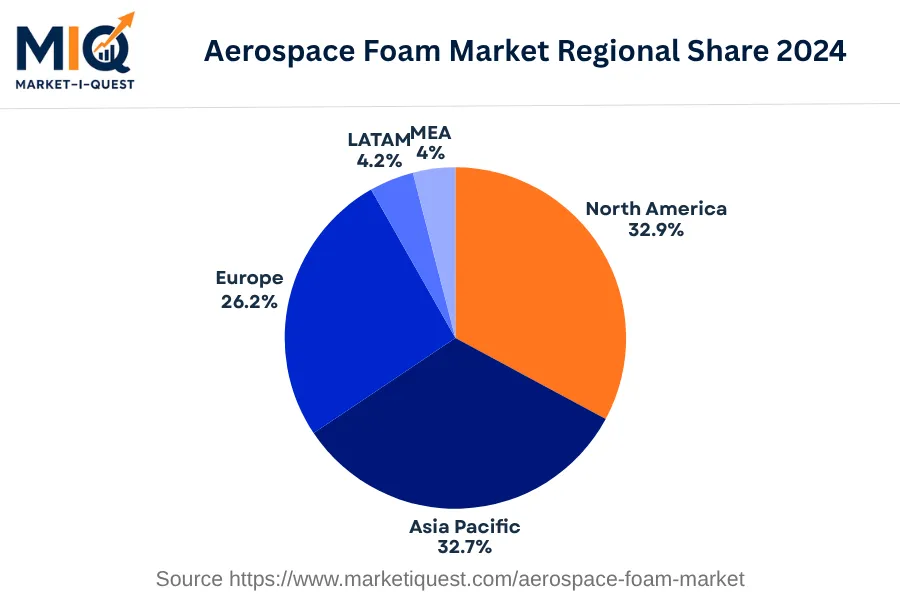
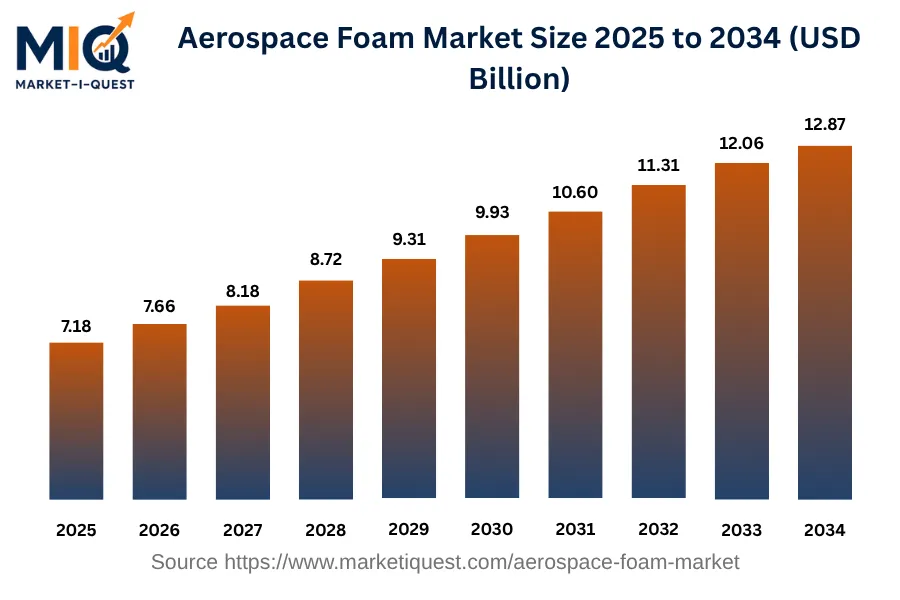
The Aerospace Foam Market is projected to grow from a value of USD 7.18 billion in 2025 to USD 12.87 billion in 2034, representing a CAGR of 6.7%. This market witnessed a rise from USD 6.73 billion in 2024 to USD 7.18 billion in 2025. The increase in value over these years indicates a steady growth trajectory towards the projected value in 2034. The expansion of the market is underpinned by the growing demand for lightweight materials for aerospace applications. Technological advancements also contribute to the market's growth, facilitating the production of durable and high-performance aerospace foams. As for the regional market shares in 2024, North America accounted for 32.9%, closely followed by Asia Pacific with a share of 32.7%. Europe held a substantial portion of 26.2%. Meanwhile, Latin America and the Middle East & Africa (MEA) had lesser shares amounting to 4.2% and 4.0% respectively.

Key Takeaways

  • By Type - Polyurethane foam led the market accounting for the highest market share in base year.
  • By Application - Aircraft seats held a significant position leading the Aerospace Foam Market in terms of usage.
aerospace-foam-market market size

Key Driving Factors

Implementation of Stringent Fuel Efficiency Regulations

The aerospace industry globally is witnessing the implementation of stringent regulations surrounding fuel efficiency. Regulatory bodies like the Federal Aviation Administration (FAA) and the European Union Aviation Safety Agency (EASA) mandate specific standards for aircraft fuel efficiency to reduce GHG emissions. To comply, manufacturers are increasingly turning to lightweight materials, such as aerospace foam, to optimize aircraft weight without compromising on safety or comfort. Aerospace foam, with its high strength-to-weight ratio, is a natural fit for these initiatives, reducing aircraft weight and thus fuel consumption. The pressing need for conservation and emission reduction initiatives is pushing the aerospace foam market.

Shift towards Performing Maintenance & Overhaul Operations Internally

An increasing number of aerospace companies are shifting towards performing maintenance, repair, and overhaul (MRO) operations in-house. This trend is driven in part by companies' desire to exert greater control over quality assurance and to reap cost and time savings by reducing reliance on third-party providers. As part of these MRO activities, companies require specific, reliable materials such as aerospace foam for tasks such as insulation, seat cushion replacements, or refurbishing interiors. The need for such materials is ongoing, as regular maintenance is a requisite part of aerospace operations, creating a consistent demand for aerospace foam.

Market Evolution by Timeline

2019-2023
Throughout this period, aerospace foam was primarily utilized in aircraft interiors by companies such as Boeing and Airbus, as markets in North America and Europe demanded more comfort and efficiency. The technology became more integrated, with aerospace foam widely recognized as reducing aircraft weight and improving fuel efficiency, however, supply was constrained by environmental factors. Regulations, such as the EU's 'End of Life Vehicles Directive', led to recycling initiatives being developed. The existing commercial model centered around long-term contracts with large aerospace manufacturers. One major risk experienced during this period, beyond supply constraints, was the fear of an economic downturn potentially affecting purchasing power for large-scale projects.
2024
In 2024, the market saw increased usage specifically in newer generation aircraft, with Asia being a new growth region. Advances with the recyclability of aerospace foam bridged some supply constraints observed before. Complementing the 'Circular Economy Action Plan', the EU directives promoted the recycling of aerospace foam, thus incentivizing usage. Flexible pricing models started to emerge, with the potential for shorter-term contracts. Regarding potential challenges, enforcement of stricter environmental regulations posed a risk for foam manufacturers, causing disruptions in the supply chain.
2025-2029
This period saw continued global expansion, with increased demand from emerging markets such as Latin America and Africa. Technology improvements led to even more effective foam while simultaneously lowering manufacturing emissions, a key constraint from previous years. Regulations such as the EU's 'Green Deal' started to impact material choices in aerospace manufacturing strongly. Contract models typically involved green terms, requiring information about carbon footprints to be shared between supplier and buyer. The potential shortening of global supply chains threatened disruption, as companies grew increasingly localized.
2030-2034
Predicted for this period is increasing demand from global airlines seeking improved cabin environments and weight reductions. Technological advancements provide for high-performance aerospace foams with enhanced recyclability despite constraints of higher production costs. Policy-wise, attention is paid to the tighter emissions regulations of the Paris Agreement, affecting material selections. Additionally, commercial models may shift towards partnerships between foam providers and recycling enterprises to secure future supplies. Expected risk factors cover global political instability and economic slow downs that might affect aerospace manufacturing stakeholders' procurement strategies.

Future Market Outlook

Future Opportunities

The current landscape of the aerospace foam market reveals numerous future opportunities fueled by increasing regulatory demands and advancing technologies. Boeing's recent partnership with a biocomposite manufacturer underscores a growing interest in developing environmentally friendly materials, addressing sustainability concerns highlighted in the 2023 report by the International Air Transport Association. As air travel continues to expand, the need for efficient, lightweight materials is paramount and presents an opportunity for manufacturers to innovate. The adoption of the latest ISO 24014:2019 standard in aerospace materials could incentivize firms to explore more robust foam solutions that incorporate recycled materials, aligning with sustainability goals. Additionally, the rising focus on noise reduction in cabins offers another avenue for the development of specialized foams that enhance passenger comfort, as showcased in the quieter cabins of the Airbus A350. Furthermore, as countries like Canada and Germany push for stricter emissions regulations in the aerospace sector, there is potential for the proliferation of high-performance foams meeting these criteria. Collaboration between academia and industry players is likely to accelerate, as seen in the ongoing research initiatives at institutions like MIT in 2023. Establishing partnerships will be crucial for companies looking to leverage cutting-edge technologies, like 3D printing, which can create complex foam structures that were previously unattainable. As a result, the aerospace foam market is poised for expansion driven by innovation and compliance with evolving regulations.

Segmentation Analysis

By Type

The market is divided into subsegments including Polyurethane foam, Polyethylene foam, Polyimide foam, Melamine foam, Metal foam, Polyvinyl chloride foam, Polyethylene terephthalate foam, Specialty high-performance foam, and others. Polyurethane foam accounted for the largest revenue share while Polyethylene terephthalate foam is expected to grow at the fastest CAGR during the forecast period.

Largest Revenue Share

Polyurethane foam

Market Share Leader

Polyurethane foam leads in revenue generation due to its diverse applications and superior properties compared to alternative foam types. It is commonly used in areas like construction, furniture, and automotive industries, which are major demand drivers for this subsegment. The construction sector's growth, driven by urbanization and increasing infrastructure investment, particularly in developing regions, is a significant contributor to polyurethane’s dominance. Polyurethane foam is preferred for its excellent insulation properties, enhancing energy efficiency in buildings, and meeting increasingly stringent regulation standards. Given its suitability for various climate conditions, this foam type enjoys a broad geographical market. It also benefits from a relatively mature and diversified distribution network, spanning both direct channels and third-party distributors, enabling easier access to various customer segments. Its relatively inelastic demand forms a high switching cost for customers, further reinforcing its market stance.

Fastest CAGR

Polyethylene terephthalate foam

Forecast Period Growth Leader

Polyethylene terephthalate (PET) foam is anticipated to exhibit the fastest growth, owing to its increasing acceptance due to its unique features and potential applications. More environment-friendly than traditional foam types, PET foam aligns better with global sustainability trends and evolving regulations favouring greener materials. It provides promising opportunities in sectors like wind energy, marine, and packaging, primarily due to its excellent strength-to-weight ratio, impressive thermal stability, and recyclability. Advancement in technology and increasing R&D are anticipated to further enhance its features and expand its applications, propelling its growth. However, its penetration might be obstructed by higher cost and limited awareness in some markets. Strategic partnerships across the supply chain and targeted promotional efforts could smooth its adoption, while a reduction in its production cost would serve as an important growth catalyst.

By Application

The application-based segment of the market is broadly categorized into flight deck pads, aircraft floor, carbon walls and ceilings, aircraft seats, and others. In 2024, the aircraft seats subsegment dominated the market in terms of revenue, while carbon walls and ceilings is expected to record the highest growth rate during the forecast period.

Largest Revenue Share

Aircraft seats

Market Share Leader

The aircraft seats subsegment represents the largest source of revenue in the aviation industry. This is primarily due to the high ticket prices associated with premium seating, such as business and first-class cabins. The demand for these premium seats has remained high despite economic fluctuations, driven by the growing number of high net worth individuals globally, increased business travel, and the rising middle class in emerging markets. Additionally, the trend towards experiencing luxury while flying and the increased emphasis on passenger comfort and experience have also contributed to the growth of this subsegment. Airlines invest heavily in enhancing seat comfort to differentiate themselves in a competitively charged market, which has also contributed to revenue through increased seat price premiums. Furthermore, regulations that mandate minimum passenger comfort standards also drive demand for upgraded aircraft seats.

Fastest CAGR

Carbon walls and ceilings

Forecast Period Growth Leader

The carbon walls and ceilings subsegment is expected to grow at the fastest CAGR during the forecast period. The driving factors for this rapid growth include the increasing popularity of carbon fiber composites in aircraft construction for their lightweight, high strength and wear resistance properties, which can help increase fuel efficiency and cut down on maintenance costs. There is a newfound focus on improving aircraft performance and decreasing the environmental impact of aviation emissions, which has resulted in a greater adoption of these materials. Potential barriers could include the high cost of carbon fibers and the need for specialized skills for its application, however, increasing investments in R&D, improvements in manufacturing techniques, and strategic collaborations are expected to mitigate these issues. In the short term, fluctuation of raw material prices and supply chain related impacts of COVID-19 are immediate risks that might affect the growth trajectory.

Competitive Analysis

Key Market Players

Manufacturers / OEMs

BASF SE
Germany
Rogers Corporation
US
Evonik Industries
Germany

Key Suppliers & Raw Materials

Dow Inc.
US
Huntsman Corporation
US
Arkema
France

Distributors, Integrators & Channel Partners

Juno Composites Ltd
UK
Avient Corporation
US
Hexcel Corporation
US

Porter’s Five Forces Analysis

An analysis of the aerospace foam market, its competitive environment and key factors influencing it.

Supplier Bargaining Power

Medium

Exclusive partnerships with OEMs and high production cost limit supplier bargaining power.

Buyer Bargaining Power

High

Buyer bargaining power is high with numerous suppliers and a mature market.

Threat of Substitutes

Low

Limited substitutes due to stringent safety requirements and certification barriers in the aerospace industry.

Threat of New Entrants

Low

High capital expenditure, industry expertise, and regulatory challenges limit the threat of new entrants.

Competitive Rivalry

High

Market is highly competitive with major players involved in aggressive price wars.

Regional Analysis

Geographic market dynamics and growth opportunities across key regions

Global Market Outlook

aerospace-foam-market market regional share

North America

In 2024, the North American Aerospace Foam Market experienced substantial growth, driven by a combination of factors addressing supply and demand dynamics. The top driver was increased spending in defense and space exploration sectors, particularly in the United States. This augmented demand was backed by significant technological breakthroughs, enabling the production of high-performance polymer foams. Also, stringent safety regulations across North America, especially in Canada and Mexico, stimulated an increase in demand for lightweight and thermally-insulated materials.

The market trends observed in 2024 highlighted a shift towards eco-friendly and recyclable aerospace foams. With the US Federal Aviation Administration enforcing stricter environmental standards, companies were observed prioritizing the development and use of sustainable materials. Another trend noted was the rise in collaborative efforts, specifically M&A in the US sector aimed at expanding product ranges and driving innovation. The market further witnessed a digital shift in sales channels, with an increasing push towards online platforms for procurement, especially within the manufacturing sector.

In terms of sectors, the defense and commercial aviation industries remain the primary customers for the Aerospace Foam Market in North America. This demand is particularly high in the US owing to its vast military expenditure and growing commercial aviation sector; the latter, a consequence of an improving economy and increased travel demands post-pandemic. With these market drivers and trends, the Aerospace Foam Market maintained a robust position in North America in 2024.

Asia Pacific

In 2024, the Aerospace Foam Market in the Asia Pacific witnessed a substantial growth driven by various factors and shaped by pacific trends. Leading this expansion was an increased demand for lightweight materials in aircraft manufacturing, specifically in countries like China, India, and Japan, due to their robust aviation sectors. Regulatory changes promoting energy-efficient solutions further fostered this growth. Additionally, significant investments in aerospace technology in South Korea and Australia, stirred up advances in foam manufacturing, enhancing productivity and market size.

Market trends in 2024 revolved primarily around buyer preferences, technology integration, and policy enforcement. Buyers in the aviation sector across key ASEAN markets displayed a leaning towards polyurethane foams, for their durability and weight advantages, altering product dynamics. The advent of smarter production technologies involving IoT and AI revolutionized the supply chain across the region. Meanwhile, stricter safety and environmental policies prompted the Australian and Japanese aerospace industries to seek out cleaner, recyclable foam options, signaling a shift towards sustainability.

Engagement with the market was broad, including enterprises and the government sector, particularly defense departments, due to the applications of aerospace foams in military aircraft and equipment. Manufacturers in other industries also showed increased interest, given the foam’s acoustic insulation properties and potential. A year of significant expansion, 2024 marked noticeable shifts in Asia Pacific’s Aerospace Foam Market.

Europe

In 2024, the European Aerospace Foam Market, led by Germany, the United Kingdom, France, and Italy, has seen robust growth. Industry expansion is driven by an increased demand for lightweight materials in aircraft manufacturing and soaring investment in R&D for foam technology innovations. More stringent EU safety and performance regulations have also spurred the use of advanced-foam solutions in the aerospace sector. Moreover, a steady rise in environmental concerns has encouraged the adoption of energy-efficient technologies, which has indirectly impacted the market with more demand for improved insulation in aircraft.

Trends in 2024 indicate a shift in buying behavior favoring sustainable and energy-efficient foams, with manufacturers engaging in strategic partnerships to amplify their sustainability commitments. The airline sector's ongoing digital transformation has also reshaped the market, leading to new channels of supply and demand in aerospace foam. As a result, the market has seen a flurry of M&A activity among manufacturing giants. Simultaneously, higher policy enforcement on flame-retardancy standards for material used in spacecraft and aircraft has led to an increased demand for flame-retardant foam, particularly in the government and enterprise sectors. By example, government orders for defense and space exploration projects have directly boosted the Aerospace Foam Market, underpinning sectoral dynamics observed in 2024.

Latin America

In 2024, the Aerospace Foam Market in Latin America remained a vibrant part of the manufacturing industry, especially in countries like Brazil, Mexico, Argentina, Colombia, Chile, and Peru. Drivers of this market include rising demand for fuel-efficient aircraft, which has led to increased use of lightweight aerospace foam. Government initiatives in Brazil and Mexico promoting domestic aerospace manufacturing industries have boosted supply dynamics. Also, the vast investments in aircraft manufacturing sectors of Argentina and Colombia significantly spurred the demand for aerospace foams.

Trends observed in 2024 indicate that the Aerospace Foam Market in LATAM witnessed changes in buyer behavior, primarily driven by safety considerations and the demand for improved aircraft performance. Technological advancements in foam production methods also marked a significant shift, with manufacturers investing in sustainable and efficient foam production technologies. There were several notable partnerships between aerospace foam manufacturers and aircraft makers, with the purpose of ensuring steady foam supply. Policy enforcement around environmental conservation influenced the market, coaxing manufacturers into adopting cleaner processes of foam production.

Middle East & Africa

In 2024, the Aerospace Foam Market in the Middle East and Africa saw noteworthy developments, primarily driven by higher investments, growing demand, and the adoption of advanced technologies. Key market drivers included increased funding by governments, such as Saudi Arabia and UAE, in aerospace infrastructure development, and growing commercial air travel demand in countries like Egypt, South Africa, and Nigeria. Additionally, the adoption of innovative manufacturing technologies for lightweight and fuel-efficient aerospace foams also fueled market growth.

Changes in buyer behavior marked significant trends. For instance, there was a higher preference for premium quality and technologically advanced foam materials amongst the aircraft manufacturers. The robust growth in telecom sectors in countries like Kenya and Israel led to higher demand for aerospace foam in satellite applications. Moreover, mergers and acquisitions strengthened market dynamics, with prominent players enhancing their foothold. Regulatory bodies in these regions enforced stricter aircraft safety standards, triggering a demand shift towards flame-retardant aerospace foam. In terms of customers, government and manufacturing sectors dominated the aerospace foam market. Oil and gas entities also recorded substantial usage of these materials, given their application in offshore helicopter transport. Despite facing challenges related to cost and regional conflicts, the Aerospace Foam Market persevered, exhibiting significant prospects.

Recent Industry Developments

Latest market innovations, product launches, and strategic initiatives

April 2025

Insperial acquired MGR Foamtex, a manufacturer of advanced passenger upholstery systems. This acquisition allows Insperial to integrate specialized foam engineering capabilities directly into its broader global sales network for aircraft interiors.

March 2025

Muirhead officially opened a new 75,000-square-foot facility to scale the production of BioPRO. BioPRO is the aviation industry’s first naturally fire-resistant, protein-based bio-foam, offering airlines a sustainable alternative for cabin seating cushions without relying on traditional petrochemicals.

February 2025

Trelleborg Sealing Solutions finalized the acquisition of Aero-Plastics Inc., a manufacturer specializing in high-performance polymers. This explicitly expands Trelleborg's capacity to supply critical machined components used alongside foams in aircraft interiors, such as window frames and blind assemblies.

Frequently Asked Questions