Aerospace and Defense Materials Market Snapshot

Key Players

  • Lockheed Martin Corporation (United States)
  • Airbus S.A.S. (Netherlands)
  • The Boeing Company (United States)
  • BAE Systems plc (United Kingdom)
  • Northrop Grumman Corporation (United States)
  • Thales Group (France)
  • Leonardo S.p.A. (Italy)
  • Raytheon Technologies Corporation (United States)
  • General Dynamics Corporation (United States)
  • Saab AB (Sweden)

Market Size

Base Year 2024
$26.83 Bn
CAGR
3.6%
Forecast 2034
$38.21 Bn

Market Segments

By Material Type
  • Metals
  • Composites
  • Polymers
  • Ceramics
  • Alloys
By Application
  • Airframe
  • Engine Components
  • Propulsion Systems
  • Interior Furnishings
  • Structures
By End Use
  • Commercial Aviation
  • Military Aviation
  • Space Exploration
  • Defense
  • General Aviation

Market Dynamics

Drivers
  • Increasing military expenditure
  • Advanced technological developments
Restraints
  • Regulatory compliance challenges
  • High manufacturing cost
Opportunities
  • Advanced material innovations
  • Rising aerospace investments

Market Size

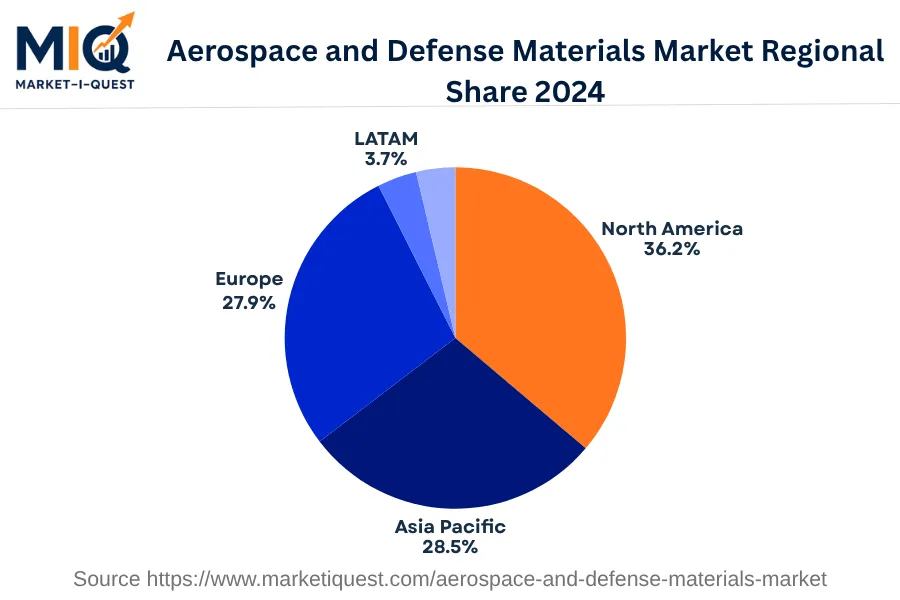
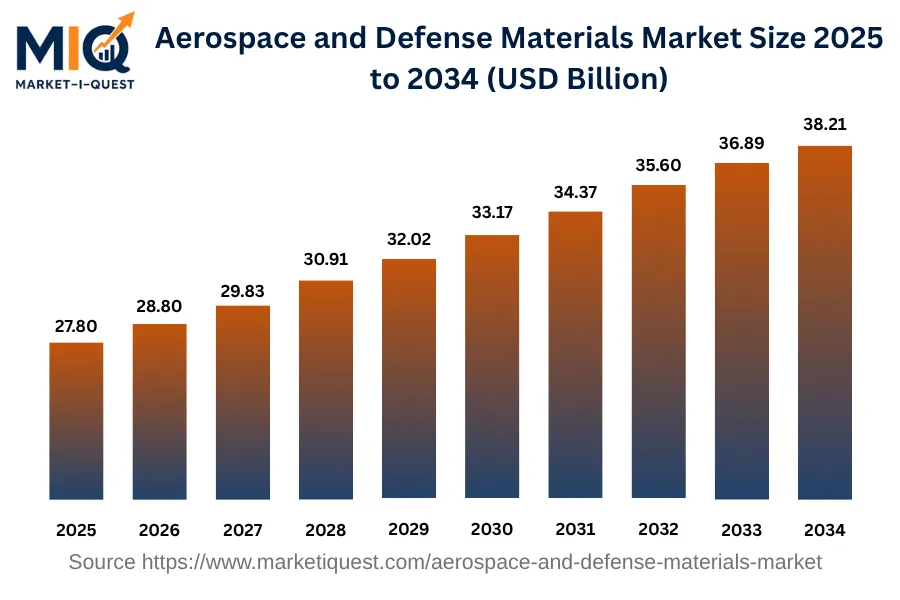
The Aerospace and Defense Materials Market valued at $27.80 billion in 2025 and is projected to grow to $38.21 billion by 2034, with a CAGR of 3.6%. This expansion path is characterized by a consistent increase in value year-on-year from its 2024 baseline of $26.83 billion. The growth is witnessed throughout the decade, culminating in the market's substantial worth by the end of the forecast period in 2034. However, the regional share distribution indicated North America holding the largest proportion with 3g6.2%, closely followed by Asia Pacific at 28.5%, and Europe at 27.9%. The remaining shares are minor with Latin America and Middle East and Africa each accounting for only 3.7% of the market.

Key Takeaways

  • By Material Type - Metals held the dominant position in the Aerospace and Defense Materials Market.
  • By Application - Engine Components led the demand accounting for a significant market share.
  • By End Use - Commercial Aviation accounted for the highest usage of aerospace and defense materials.
aerospace-and-defense-materials-market market size

Key Driving Factors

Implementation of Stringent International Aviation Safety Regulations

International aviation bodies such as the International Civil Aviation Organization (ICAO) and the European Union Aviation Safety Agency (EASA) constantly revise and enforce safety and efficiency regulations. These regulations stipulate the use of specific high standards of materials in the manufacturing and maintenance of aircraft. The aerospace and defense materials market is directly impacted by these new rules as aerospace and defense firms have to comply to these standards. As these firms accelerate to meet regulatory demands, they demand more quality materials that adhere to the new regulations.

The Increase in Demand for Lightweight and Energy-Efficient Aircraft

There's a mounting trend within the commercial aviation sector toward lighter and more energy-efficient aircraft. This urgency for improving fuel efficiency and reduce carbon emissions is driving a shift in demand within the aerospace and defense materials market. Suppliers now face increasing pressure from aerospace manufacturing companies to provide lightweight and durable materials to meet this need. The shift toward composite materials, i.e., materials made from two or more constituent materials with significantly different physical or chemical properties. As such, manufacturers' quest for sustainable aviation directly influences the kind of materials in demand in the aerospace and defense materials market.

Market Evolution by Timeline

2019-2023
Between 2019 and 2023, Asia-Pacific, especially China and India, emerged as key demand centres for Aerospace and Defense materials due to increased military spending. The supply side was dominated by Aluminum and Titanium due to their weight to strength ratio and resistance to corrosion. However, the rising cost of Titanium was a challenge. On the policy side, programs such as Make in India promoted local manufacturing. Commercially, price-fixing contracts were a common method to manage Titanium's price volatility. The main risks associated with this period were supply disruptions primarily due to geopolitical tensions.
2024
In 2024, the demand for Aerospace and Defense materials broadened to include Eastern Europe, driven by increased defense spending during rising security concerns. The use of Composite materials sizabley rose as a lighter alternative to Aluminum and Titanium. Due to the International Aerospace Quality Group's (IAQG) new standards, suppliers had to highlight their ability to consistently provide products that meet customer and regulatory requirements. Long-term supply agreements became the typical commercial arrangement.
2025-2029
Between 2025 and 2029, North America is expected to emerge as a major buyer of Aerospace and Defense materials will likely be driven by modernization programs of their military forces. Advanced material types such as Graphene and Alloys gained prominence for their superior physical properties. With the projected rising environmental concerns, the environmental impact of the supply chain might under scrutiny. Carbon pricing will likely become a significant element in determining prices. Decoupling of the supply chain from regions with geopolitical tensions may act as a trend for reducing risks.
2030-2034
From 2030 to 2034, global demand for Aerospace and Defense materials will likely arise from increasing space exploration missions and next-generation military programs. Supply-side focus might shift towards sustainability, with recyclable and green materials. Regulations would probably focus the sustainable production and disposal of Aerospace materials. It can be conjectured that companies might incorporate lifecycle pricing into contracts to cover costs associated with the disposal and recycling of materials. Dependence on rare earth elements and geopolitics would continue to be a significant risk factor.

Future Market Outlook

Future Opportunities

As the aerospace and defense materials market evolves, opportunities for growth are emerging, particularly in sustainability and advanced manufacturing technologies. The increasing focus on eco-friendly practices aligns with the goals set out in the United Nations’ Sustainable Development Goals, urging companies to reconsider their material sources. The recent collaboration between Airbus and the Massachusetts Institute of Technology (MIT) on sustainable aerospace materials exemplifies this shift, as both entities work towards reducing carbon footprints in aircraft manufacturing. Moreover, the expansion of unmanned aerial vehicles (UAVs) shows a demand for lightweight yet durable materials adapted for varying operational environments, which presents a chance for material innovation. Current collaborations, such as Lockheed Martin's partnership with Carbon to develop 3D printed parts from advanced polymers, are opening pathways for smaller defense contractors to enter the market with novel solutions. Furthermore, upcoming regulatory frameworks, such as the International Traffic in Arms Regulations (ITAR) reforms anticipated, are expected to streamline defense material development, potentially lowering barriers for new entrants. Continuous adaptations in material sourcing will be prompted by heightened scrutiny from regulators and consumers alike, especially in light of increased military spending by countries such as China and the United States.

Segmentation Analysis

By Material Type

The market is segmented by material type into Metals, Composites, Polymers, Ceramics, and Alloys. Among these, Metals registered the largest revenue share, while Polymers are projected to grow at the fastest CAGR during the forecast period.

Largest Revenue Share

Metals

Market Share Leader

The Metals subsegment has led the market in terms of revenue, largely driven by significant demand across wide-ranging applications including construction, automotive, industrial manufacturing, and electronics among others. Its popularity can be attributed to factors such as superior mechanical properties, ductility, and longevity offered by various types of metals. In addition to this, the recyclability aspect of metals also contributes to its high revenue share, promoting sustainability and cost-effectiveness. Furthermore, consistent advancements in metalworking technologies also drive the sales of metals. Geographically, the Asia-Pacific region, with its massive industrial base and rapid urbanization, contributes a significant share to the Metal segment's revenue. The regulatory environment favoring industries such as automotive and construction, which extensively use metals, further amplifies the metal subsegment's revenue. Important purchasing criteria for consumers within this market include cost-effectiveness, quality, and strength of the metal. Proven distribution channels and a certain degree of switching costs due to lack of performance guarantees with other material types also help maintain the dominance of this subsegment.

Fastest CAGR

Polymers

Forecast Period Growth Leader

Polymers are expected to register the fastest growth rate. As a growth driver, an increasing shift towards lightweight and energy-efficient materials, primarily in sectors like automotive, aerospace, and packaging, catalyzes the subsegment's growth. Technological advancements enhancing polymer characteristics and expanding their application range further boost their adoption. However, there are certain adoption barriers, high production costs being one of them. On the bright side, capital investments in polymer research, and partnership between manufacturers and end-user industries are fostering innovation and reducing these barriers. In terms of risks, regulatory changes concerning environmental impact and disposal of polymers are the most significant. It's assumed that such risks will be managed with an increased focus on sustainable and biodegradable polymers.

By Application

The market subdivides into Airframe, Engine Components, Propulsion Systems, Interior Furnishings, and Structures, with Engine Components leading in terms of revenue while Propulsion Systems represent the fastest growing segment.

Largest Revenue Share

Engine Components

Market Share Leader

Engine Components has emerged as the largest revenue generating segment in the base year 2024 due to various factors. The need for efficient and high-performance engines in both commercial and military aircraft is a key driver. Due to their criticality in flight operations, these components often require high-precision manufacturing standards and strict quality control, leading to high costs and thus significant revenues. Furthermore, advancements in engine technologies and introduction of more fuel-efficient engines have necessitated the replacement of older engine components in the large existing fleet of aircrafts, creating demand. Geographically, thriving markets like North America and Europe, due to their advanced aerospace industries, contribute significantly to this segment's revenue. Regulatory mandates for periodic component replacement for safety also contribute towards market dominance.

Fastest CAGR

Propulsion Systems

Forecast Period Growth Leader

The Propulsion Systems segment is showing the highest Compound Annual Growth Rate. The drive towards more efficient and green propulsion systems, backed by regulatory and environmental pressures, are acting as prominent growth catalysts. Investments in research and development are leading to groundbreaking technologies such as electric propulsion and hybrid systems. Meanwhile, the growing trend of space exploration is opening up new avenues for growth. Adoption is being fueled by industry moves towards fleet modernization and new aircraft orders, especially in emerging regions like Asia-Pacific. In the near term, disruptions in supply chains or delays caused by economic factors could affect the speed of growth, but the long-term positive outlook remains intact.

By End Use

The market is divided into subsegments including Commercial Aviation, Military Aviation, Space Exploration, Defense, and General Aviation. In 2024, Commercial Aviation accounted for the largest revenue share while General Aviation is projected to grow at the fastest CAGR during the forecast period.

Largest Revenue Share

Commercial Aviation

Market Share Leader

Commercial aviation is the major revenue-generating subsegment within this market given its extensive and growing demand globally. This can be attributed to multiple factors. First, the globalization of businesses has fueled the demand for air travel as companies expand their operations overseas. Furthermore, the rise in disposable incomes, along with lower airfares due to strong competition, has made air travel affordable for a larger populace, thereby driving the commercial aviation market growth. Commercial aviation is also highly regulated to ensure safety, with compliance often leading to significant investments; further increasing the revenue of the subsegment. Geography also plays a role as developed economies have sophisticated aviation infrastructures, which significantly contributes to their revenue. Substantial investments in new technologies like fuel-efficient engines and automation also augment the commercial aviation market, propelling it to command the largest revenue share.

Fastest CAGR

General Aviation

Forecast Period Growth Leader

As per industry trends, General Aviation has a strong outlook for growth. Factors driving this potential include its adaptability and flexibility. General aviation primarily consists of private aircraft, offering distinct customization opportunities. As the demand for personalized travel increases, so does the growth potential of this subsegment. Technology advancements have also been essential growth catalysts. For instance, increased tech like advanced navigation systems has made personal aviation safer and more efficient, thereby attracting new customers. Partnerships between technology firms and aircraft manufacturers could also fuel growth. However, there are adoption barriers like the high cost of ownership and stringent regulatory standards. Overcoming these barriers could provide significant growth opportunities, as trends in high net-worth individuals purchasing personal aircraft could signify untapped markets. Therefore, despite its current smaller revenue share, General Aviation is expected to experience a high CAGR in the future.

Competitive Analysis

Key Market Players

Manufacturers / OEMs

Boeing
US
Airbus
France
Lockheed Martin
US

Key Suppliers & Raw Materials

Alcoa Corporation
US
Precision Castparts Corp
US
Constellium N.V.
Netherlands

Distributors, Integrators & Channel Partners

BE Aerospace, Inc.
US
Wesco Aircraft
US
Parker Hannifin
US

Porter’s Five Forces Analysis

This analysis evaluates the competitiveness and attractiveness of the Aerospace and Defense Materials Market.

Supplier Bargaining Power

High

Limited suppliers of materials and high switching costs make supplier power high.

Buyer Bargaining Power

Low

Buyers, typically large defense agencies and firms, have limited choices and high switching costs.

Threat of Substitutes

Low

Substitutes are limited due to regulatory, performance and safety requirements in the sector.

Threat of New Entrants

Low

High capital expenditure, expertise, and regulatory barriers prevent new entrants.

Competitive Rivalry

Medium

Existing competitors compete on cost, quality, and technological advancements.

Regional Analysis

Geographic market dynamics and growth opportunities across key regions

Global Market Outlook

aerospace-and-defense-materials-market market regional share

North America

In 2024, the Aerospace and Defense Materials Market in North America represented a dynamic interface between high-tech solutions and stringent industry-specific requirements. Key drivers included rigorous governmental regulations in countries like U.S., Canada, and Mexico that mandated the utilization of advanced materials to enhance aircraft safety and efficiency. Investments and technology adoption accelerated, as aerospace manufacturers like Boeing and Lockheed Martin incorporated composites and lightweight alloys into their designs, impacting supply dynamics and pricing.

Despite high production expenses, industry players saw considerable demand due to the escalating need for high-performance materials in aerospace manufacturing. More so, the growing use of drones for enterprise-level applications and government surveillance initiatives catalyzed this growth. Trends revealed a shift towards sustainability, with increased demand for eco-friendly and recyclable materials in aerospace manufacturing. Digital transformation strategies, including automation and integration of Industrial Internet of Things (IIoT) in production lines, reshaped standard manufacturing practices. Aerospace firms fostered alliances, such as the Boeing-Spirit Aerosystems partnership, aimed at innovative materials research and development. Policy enforcement was steered towards promoting domestic manufacturing units, limiting foreign-dependency in the defense sector. This was particularly evident in the U.S with the strict imposition of the Buy American Act, thereby reinforcing self-reliance in critical defense infrastructure.

Asia Pacific

In 2024, the Aerospace and Defense Materials market in the Asia Pacific was an arena of robust growth and dynamic change. Drivers of this expansion included increased military spending by countries such as China and India, fuelling demand for sophisticated defense materials. Forecasted regulations for industries to adopt more sustainable and lightweight materials, particularly in China and Japan, underpinned the market development. Investment in Research & Development by leading enterprises, such as Hindustan Aeronautics and Mitsubishi Heavy Industries, boosted progress in advanced technology adoption. Further, supply dynamics were shaped by South Korea's thriving production capability for raw materials.

On the trends front, buyer preference shifted towards more durable and lightweight aerospace materials, spearheaded by Indian and ASEAN airlines' procurement strategies. The consistent emergence of new material technologies encouraged M&A activities, with notable examples like the partnership between Australia's Quickstep Holdings and South Korea's Hanwha Solutions. Dynamics around commercial space flights, particularly in China's private sector, resulted in increased demand for advanced materials and components. Lastly, the enhanced enforcement of aerospace standards stimulated a shift towards high-quality materials in manufacturing companies across the region, with government entities keenly observing adherence to these improved standards. As such, the Aerospace and Defense Materials market in Asia Pacific for 2024 was powered by technological advancements, regulatory adherence, and an increasing demand for high-quality, lightweight materials.

Europe

In 2024, the European Aerospace and Defense Materials Market fluctuated significantly due to varying geopolitical circumstances and pandemic recovery efforts.

Driving factors included growing defense spending by influential economies like Germany, the UK, and France, responding to deepening security concerns. Additionally, regulatory measures across the EU, particularly the European Defence Fund's initiatives, incentivized innovation and R&D investment in advanced materials. Technological adoption also played a crucial role, with countries like Italy and Spain integrating AI and machine learning to improve production and supply chain efficiency.

Trends affecting the industry included heightened buyer focus on sustainability, with market players increasingly seeking environmentally responsible materials. A significant shift was also observed towards strategic partnerships and M&A, particularly between leading manufacturers and emerging European startups. For instance, the Nordic countries had seen substantial growth in collaboration between established industry giants and local tech enterprises. Policy enforcement efforts aimed at promoting transparency and fair trade also influenced the dynamics, especially within Central and Eastern Europe.

The key sectors impacted by these drivers and trends in 2024 encompassed government departments commissioning defense vehicles and equipment, enterprises operating in the commercial aerospace sector, manufacturers for military and aerospace technologies, and retail entities selling defense and aerospace equipment.

Latin America

In 2024, the Aerospace and Defense Materials Market in Latin America was strongly defined by changes in regional regulations, growing demand, and technological shifts. Increased investment in aerospace industries, particularly in Brazil and Mexico, drove higher consumption of defense materials. In Colombia and Peru, strengthening military capabilities created heightened demand for advanced aerospace materials. In Argentina, the adoption of 5G technology in defense operations led to an influx in demand for specialized materials.

Several key trends were apparent in 2024. The increasing digitization of defense systems, especially in Chile, led to a change in buyer behavior, with a higher preference for materials that support advanced technology. The shifting dynamics of supply channels, primarily due to policy enforcement in Brazil, impacted the cost and availability of certain materials. Furthermore, there was a significant rise in partnerships and mergers between local and international aerospace companies in Mexico, altering the ecosystem of the market.

The main sectors driving these changes included the government, particularly in defense procurement, manufacturing industries involved in the production of aerospace technology, and retail sectors in Mexico and Brazil where demand for commercial aerospace materials was substantial. Generally, such factors shaped the landscape of the Aerospace and Defense Materials Market in LATAM during 2024.

Middle East & Africa

In 2024, the aerospace and defense materials market in the Middle East and Africa experienced substantial developments. Key drivers include governments' intensified defense budgets, particularly in Saudi Arabia, UAE, and Israel, fueling demand for advanced materials. The adoption of new technologies in manufacturing processes, especially in regions like UAE and Qatar, also led to increased dependency on high-performance materials. Regulatory changes in Egypt and South Africa promoted domestic production of aerospace materials, escalating local supply dynamics.

Noteworthy trends incorporated aerospace corporations' escalating preference for lightweight, energy-efficient materials. In Nigeria and Kenya, the rapid shift towards substituting traditional materials with composites was conspicuous to meet increased fuel efficiency standards. Channel dynamics revealed a growing reliance on e-procurement platforms to streamline the acquisition process, with Saudi Arabia leading the course. Mergers and acquisitions became commonplace, with Israel's defense sector as a prime example, facilitating access to advanced material technologies. Enforcement of stricter environmental policies led to a surge in demand for eco-friendly aerospace materials, most notably in South Africa. These market movements predominantly affected sectors such as government defense contracts, manufacturing, and oil and gas, where the application of these materials is critical. The market landscape's evolution reflected in the heightened demand for sophisticated defense equipment and aircraft, and pursuit of technological advancements in material science.

Recent Industry Developments

Latest market innovations, product launches, and strategic initiatives

October 2025

PTC Industries officially inaugurated its new Titanium and Superalloy Materials Plant to domestically produce aviation-grade metals for defense and aerospace applications.

August 2025

ATI Inc. officially expanded and extended its long-term contract to supply Boeing with titanium products used to build commercial airplanes.

April 2026

Syensqo signed a long-term supply agreement to provide advanced composite materials for Avio's space launch vehicles.

Frequently Asked Questions