Aerospace Adhesives and Sealants Market Snapshot

Key Players

  • Henkel AG & Co. KGaA (Germany)
  • 3M Company (United States)
  • Dow Inc. (United States)
  • Huntsman International LLC (United States)
  • PPG Industries Inc. (United States)
  • Cytec Solvay Group (Belgium)
  • H.B. Fuller Company (United States)
  • Master Bond Inc. (United States)
  • Hexcel Corporation (United States)
  • Royal Adhesives & Sealants (United States)

Market Size

Base Year 2024
$1.62 Bn
CAGR
5.1%
Forecast 2034
$2.66 Bn

Market Segments

By Resin Type
  • Polysulfide
  • Silicone
  • Fluorosilicone
  • Polyacrylate
  • Polyurethane
  • Polythioether
  • and Others
By Application
  • Fuel Tank
  • Airframe
  • Flight Line Repair
  • Aircraft Windshield & Canopy
  • Fuselage
  • and Others

Market Dynamics

Drivers
  • Increased aerospace production
  • Rising maintenance requirements
Restraints
  • Stringent Environmental Regulations
  • High Product Development Costs
Opportunities
  • Increasing aerospace production
  • Advanced adhesive technologies development

Market Size

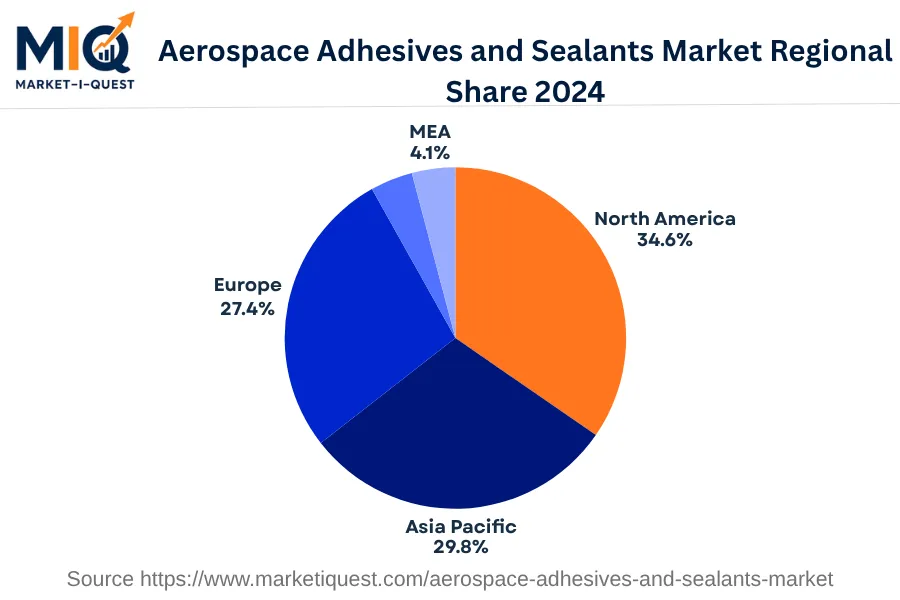
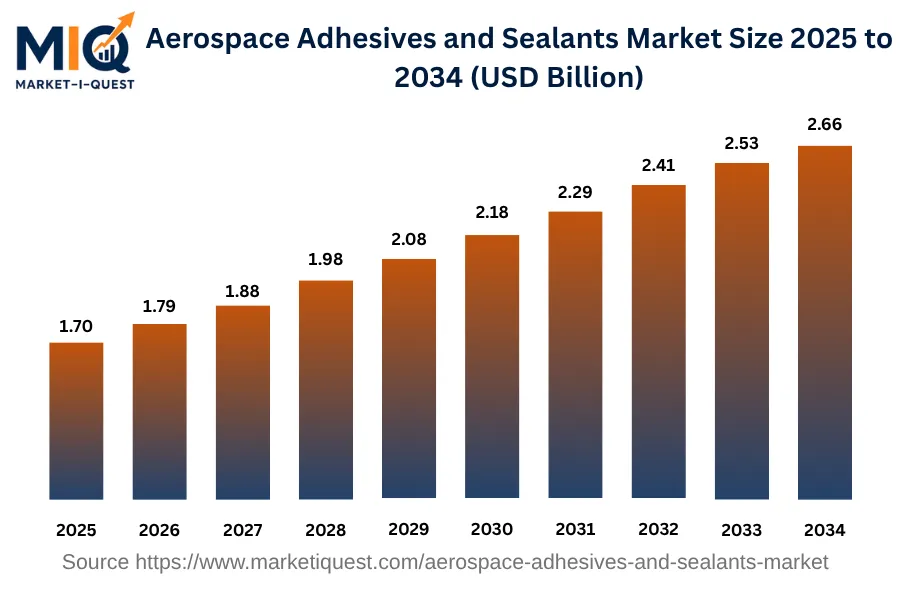
The Aerospace Adhesives and Sealants Market is projected to grow from USD 1.70 billion in 2025 to USD 2.66 billion in 2034, advancing at a CAGR of 5.1%. The path of growth will build on the base figure of USD 1.62 billion in 2024. The increase is supported by the rising applications within the aerospace industry, including aircraft maintenance, repair and overhaul operations, as well as manufacture of new aircraft. In terms of regional market share in 2024, North America will hold the highest share at 34.62%, followed closely by Asia Pacific at 29.84%. Europe will represent 27.41% of the market, with MEA and LATAM accounting for smaller shares at 4.11% and 4.02%, respectively.

Key Takeaways

  • By Resin Type - Polyurethane subsegment led the market accounting for the largest market share in the base year.
  • By Application - Fuselage held the dominant position accounting for the highest usage of Aerospace Adhesives and Sealants in the base year.
aerospace-adhesives-and-sealants-market market size

Key Driving Factors

Implementation of Stricter Environmental Regulations

Environmental policies, such as the European REACH (Registration, Evaluation, Authorisation and Restriction of Chemicals), are compelling the aerospace industry to switch to eco-friendlier adhesives and sealants. These policies aim to manage chemical risks and are becoming increasingly stringent, pushing aerospace manufacturers to alter their material choices. For instance, many traditional solvent-based or volatile organic compounds (VOCs) heavy adhesives and sealants are now gradually being replaced by water-borne or high solid adhesives, which results in escalating the demand in the aerospace adhesives and sealants market.

Surge in Lightweight and Fuel-efficient Aircraft Production

Airline companies are boosting their focus on fuel efficiency for economic and environmental reasons. They seek to reduce the weight of aircraft by implementing lightweight materials like composites which need specialized adhesives and sealants for bonding. Additionally, the increasing production rate of more fuel-efficient aircraft models like the Airbus A320neo and the Boeing 737 MAX to meet the growing global air travel demand directly influences the need for adhesives and sealants. Such adhesives paired with lightweight composites help eliminate the need for mechanical fasteners, reducing the aircraft mass and eventually leading to improved fuel efficiency. This surge in lightweight and fuel-efficient aircraft production is actively driving the aerospace adhesives and sealants market.

Market Evolution by Timeline

2019-2023
In this period, the demand for aerospace adhesives and sealants significantly increased mostly in regions like North America and Europe. The primary reasons for the surge in demand were the use of these adhesives in aircraft manufacturing and maintenance. The majority of the supply of these adhesives was led by companies like 3M and Henkel, with their products becoming widely accepted due to their high-level of integration and reliability. However, there was a constraint in the supply chain due to volatile raw material prices. No specific regulatory policies greatly affected the market during these years. This period saw a competitive pricing model, with contracts mostly being long-term supply agreements. The primary risk encountered was the dependence on raw material prices.
2024
By 2024, established economies continued to lead the demand for aerospace adhesives and sealants. Asia, especially China and India, started to emerge as potential markets. Technological advancements allowed more efficient and high-performing adhesives to be developed by companies like Huntsman Corp and Bostik, but high production costs limited widespread accessibility. Initiatives such as the European Union's strategic action plan for batteries played a role in boosting the market. A mix of competitive and value-based pricing was observed. Partnerships were formed between adhesive manufacturers and aircraft companies for customized solutions. Volatility in raw material prices remained a constant risk.
2025-2029
During these five years, demand from Asia-Pacific countries accelerated due to increasing aviation infrastructure and domestic manufacturing capacity in countries like China, India, and Japan. Leading suppliers, including H.B. Fuller and Illinois Tool Works, introduced adhesives with higher temperature resistance and easy application methods, improving overall product quality. The global trend towards green manufacturing led to the development of more eco-friendly aerospace adhesives in accordance with environmental regulations. Value-based pricing strategies were dominant with a rise in collaborative contract models. The prominent risk of this period was the challenge to maintain product quality while adhering to ecological standards.
2030-2034
By the early 2030s, increased defense spending and cargo transport boosted the demand in developing regions like Africa and Middle East. Tech-driven companies like Lockheed Martin introduced aerospace adhesives with enhanced durability and resilience. The penetration of digital transformation in manufacturing boosted the productivity level. Revised standards on VOC emissions, imposed by regulatory entities influenced the manufacturing process. Pricing strategies became customer-centric with personalized contract agreements emerging. The asymmetric impact of the digital revolution brought potential risks with the increased vulnerability of the supply chain to cyberattacks. These risks highlighted the need for stringent cyber resilience in the Aerospace Adhesives and Sealants Market.

Future Market Outlook

Future Opportunities

The future of the aerospace adhesives and sealants market is expected to be shaped by ongoing regulatory developments and evolving material science. As the potential for increased use of electric and hybrid aircraft becomes more apparent, driven by the 2020 Paris Agreement objectives on climate change, manufacturers are likely to seek adhesives that accommodate new technologies and materials. Companies like Arkema are already exploring thermoplastic elastomers designed to bond with composites prevalent in next-generation airframes. Furthermore, collaborations, such as that between Airbus and Solvay in 2021, may catalyze the development of next-gen adhesive solutions tailored for composite materials and lightweight designs. The rising demand for maintenance, repair, and overhaul (MRO) services in aviation, highlighted by the 2023 survey from the Aviation Suppliers Association, indicates a growing market for versatile adhesives that can be applied in various scenarios. Regulatory bodies such as the Federal Aviation Administration (FAA), which continues to evolve standards for maintenance practices, will influence the specifications for new products in the market. Additionally, the push for sustainable practices may foster investments in eco-friendly adhesive formulations, urging companies to adapt to circular economy principles that include recyclable or biodegradable options. The convergence of these factors can drive innovation in adhesive technologies specifically designed for long-term performance and minimal environmental impact.

Segmentation Analysis

By Resin Type

The market is divided into subsegments including Polysulfide, Silicone, Fluorosilicone, Polyacrylate, Polyurethane, Polythioether, and Others. Polyurethane accounted for the largest revenue share while Fluorosilicone is expected to grow at the fastest CAGR during the forecast period.

Largest Revenue Share

Polyurethane

Market Share Leader

In the resin market, Polyurethane holds a significant lead in terms of revenue generation. Polyurethane's popularity mainly stems from its versatile nature. Known for its elasticity, toughness, and durability, it is highly favored in multiple industries such as automotive, construction, and furniture. For instance, in the automotive industry, polyurethane serves as an excellent material for cushioning in seats, insulation, and as a robust adhesive that binds metals and plastics together. In the construction industry, it is broadly used for insulation and sealing due to its superb thermal resistance. Moreover, the regulatory push towards more energy-efficient homes, especially in developed markets like North America and Europe, has boosted the demand for polyurethane for insulation. The cost-effectiveness and easy availability also act as deciding factors for the purchasing choice leading to low switching costs. Regarding distribution channels, both direct and indirect channels including online sales have facilitated the wide-reaching access to polyurethane products across various geographies.

Fastest CAGR

Fluorosilicone

Forecast Period Growth Leader

Fluorosilicone, while having a comparatively lesser market share, is showing promise of rapid growth in the coming years. The robustness of the material and its superior resistance to weather, heat, and chemicals has boosted its demand. Technologies accelerating the adoption of Fluorosilicone include innovations in the aerospace sector where this resin plays an essential role due to its durability and resilience in extreme conditions. Government policies and increased capital expenditure towards aerospace technology development act as catalysts in several advanced economies. Despite its potential, the relatively higher price of Fluorosilicone is a barrier to its adoption in more cost-sensitive sectors, but this limitation is expected to be mitigated as economies of scale and production efficiencies improve over time. There may also be near-term risks involving supply chain disruptions and regulatory changes, but the long-term growth trajectory of the Fluorosilicone subsegment appears vigorous.

By Application

The market is divided into subsegments including Fuel Tank, Airframe, Flight Line Repair, Aircraft Windshield & Canopy, Fuselage, and Others. Among these, the Fuselage accounted for the largest revenue share while the Aircraft Windshield & Canopy segment is expected to grow at the fastest CAGR during the forecast period.

Largest Revenue Share

Fuselage

Market Share Leader

The Fuselage segment accounted for the largest revenue share in 2024. There are multiple drivers for this trend. Firstly, the fuselage acts as the central body of an aircraft and houses the pilots, passengers, and cargo. Therefore, the high cost associated with its production and maintenance makes it a significant portion of the aircraft manufacturing and repair budget. Furthermore, the growing demand for larger-capacity aircraft, propelled by increasing passenger traffic and cargo transportation, also stimulates the revenue growth of this segment. This is due to the fact that larger aircraft require larger fuselage units, hence impacting the costs substantially. Regulations requiring periodic maintenance and checks of the fuselage further augment this trend. From a geographic perspective, fast-growing economies with booming aviation sectors, such as those in Asia, contribute significantly to the fuselage revenue, where expansion of fleet size and upgrading of older aircraft are common.

Fastest CAGR

Aircraft Windshield & Canopy

Forecast Period Growth Leader

Despite not contributing the largest revenue, the Aircraft Windshield & Canopy sector projects the fastest growth rate. The primary driver for this growth is the increasing focus on aircraft safety and the advancement in material technology. Modern aircraft windshield and canopy systems are designed with innovative materials to improve visibility, durability, and resistance to environmental stress. Thus, as the industry continues to advance and regulatory standards get stricter, the demand for high-performance windshields and canopies is set to significantly increase. Technical collaborations and partnerships within industry players have also spurred advancements in product quality and efficiency. However, the high costs that these advanced materials entail pose an adoption barrier that may impact the predicted growth rate. Despite potential initial setbacks, the overarching trend towards safer and more efficient aircraft is likely to fuel the growth of this sector.

Competitive Analysis

Key Market Players

Manufacturers / OEMs

Henkel Corporation
Germany
3M Company
US
Huntsman Corporation
US

Key Suppliers & Raw Materials

Dow Chemical Company
US
Sika AG
Switzerland
Arkema Group
France

Distributors, Integrators & Channel Partners

Airbus Helicopters, Inc.
US
Aviall Services, Inc. (Boeing Company)
US
Zodiac Aerospace (Safran)
France

Porter’s Five Forces Analysis

This analysis explores the competitive dynamics in the Aerospace Adhesives and Sealants Market.

Supplier Bargaining Power

Low

Diverse supplier base reduces dependency and increases competition.

Buyer Bargaining Power

High

Major aerospace OEMs dominate purchases and can leverage volumes for price negotiation.

Threat of Substitutes

Low

Limited substitutes due to high-performance requirements and certification barriers.

Threat of New Entrants

Low

High capital costs, stringent regulations, and technology expertise limit market entry.

Competitive Rivalry

Medium

Players compete on quality, innovation and relationships with major aerospace manufacturers.

Regional Analysis

Geographic market dynamics and growth opportunities across key regions

Global Market Outlook

aerospace-adhesives-and-sealants-market market regional share

North America

In 2024, the North American aerospace adhesives and sealants market experienced steady growth, enriched by both natural and man-made factors. Driving this progress included the rise in aircraft production across the U.S., Canada, and Mexico, spurred by the surge in commercial air travel demand post-pandemic. On the regulatory and investment front, stringent safety and quality standards for aeronautical components fueled demand for high-performance adhesives and sealants. Concurrently, intensive investment in advanced materials R&D expanded the portfolio of viable, superior-quality adhesive solutions.

Significant trends shaping the market landscape involved buyer preferences shifting towards eco-friendly adhesives, driven by growing environmental consciousness within the aerospace industry. Mounting considerations on adhesive weight and curing time also initiated a technology shift towards lighter, faster-curing materials, enhancing aircraft fuel efficiency. Equally crucial was the surge in strategic partnerships among adhesive suppliers, aircraft manufacturers, and material science innovators aimed at integrated, cost-effective supply chain management. Regarding sectorial impacts, key consumer segments included both government (military aircraft, space vehicles) and private enterprise (commercial airlines, private jet manufacturers). While the U.S. and Canada gravitated towards high-performance, lighter adhesives, Mexico exhibited increased adoption of cost-effective, locally produced sealants, revealing variations in regional market dynamics.

Asia Pacific

In 2024, Asia Pacific's Aerospace Adhesives and Sealants market dynamics were strongly influenced by China, India, Japan, South Korea, Australia, and key ASEAN markets. Demand was driven by the cluster of thriving aviation industries in China and India, coupled with surging investment in aircraft manufacturing. Strict regulations endorsing eco-friendly products superseded conventional adhesives and sealants, favoring high-performance, low VOC variants. Meanwhile, technology adoption was swift as suppliers leveraged advanced technologies to enhance product performance and meet stringent aerospace standards.

Market trends revealed a growing preference among aircraft manufacturers for composite-based adhesives to reduce aircraft weight. There was also a significant shift towards online purchasing channels by enterprise customers, with numerous manufacturers partnering with eCommerce giants to ensure seamless supply. Policies like China's "Made in China 2025" further reinforced the adoption of advanced manufacturing techniques, resulting in stiff competition among market players for product innovation. Key clienteles included enterprises, government agencies and manufacturing units, particularly in the aviation sector. These sectors remained significantly invested in aftermarket services, instigating elevated demand for adhesives and sealants, specifically in China and Australia. As such, the Asia Pacific Aerospace Adhesives and Sealants Market in 2024 was marked by robust demand, technology adoption, policy adherence, and novel purchasing trends.

Europe

In 2024, the Aerospace Adhesives and Sealants Market in Europe represented a critical segment in the aviation industry. Key drivers included an increased demand for efficient, lightweight aircraft, which led to a surge in investment and adoption of advanced adhesive and sealant technologies. These technological advancements offered high strength and fire-resistant materials. Country specific regulations like the REACH regulations forced vendors to ensure their products' environmental safety, further defining the market in the region, especially in Germany, the United Kingdom, and France.

The market saw trends in innovative materials, such as non-toxic sealants, with key players actively involved in channel partnerships and M&A activities to stay competitive. Furthermore, there was an observable shift towards the application of these products in the maintenance, repair, and overhaul (MRO) sector due to an aging aircraft fleet in Italy, Spain, and the Nordics. Also, initiatives like the Clean Sky 2 in Europe were part of the policy enforcement favoring the market.

Key customers in this sector spanned both government and private enterprises, especially in the manufacturing and retail industries. As an example, Benelux and Central and Eastern Europe saw increased use of aerospace adhesives and sealants in the production of composites for aircraft. By the end of the base year, these dynamics helped shape a diversified and competitive European Aerospace Adhesives and Sealants Market.

Latin America

In 2024, the Aerospace Adhesives and Sealants Market in Latin America witnessed significant growth, driven by diverse factors and marked by novel trends. Key drivers were increased investments in the aerospace sectors in countries like Brazil, Mexico, Argentina, Colombia, Chile, and Peru. The proliferation of cutting-edge technology in the production line led to the widespread adoption of high-quality, lightweight adhesives and sealants, impacting supply dynamics. Further, strict regulations pertinent to carbon emissions spurred the need for lightweight, fuel-efficient aircraft, thus bolstering demand for these materials.

Besides, evolving buyer behavior defined the market trends, examples being the preference for products with reduced volatile organic compound (VOC) emissions and increased thermal resistance. Technology shifts towards bio-based adhesives and sealants, owing to their environment-friendly nature, also nudged the market. There was a noticeable increase in partnerships and M&A activities among local and foreign players to leverage the lucrative LATAM market. A heightened emphasis on standards and policy enforcement on safety and sustainability by governments in the region, especially in the enterprise sector, was another major trend. These drivers and trends shaped the Aerospace Adhesives and Sealants Market in LATAM, with the effects seen heavily in enterprise sectors and government procurement of aircraft in 2024.

Middle East & Africa

In 2024, the aerospace adhesives and sealants market in the Middle East and Africa witnessed substantial growth, driven by specific regional factors. Increased investments in infrastructure development in Saudi Arabia and United Arab Emirates accentuated the demand for these products. Similarly, burgeoning aviation sectors in Qatar and Egypt fueled this market expansion. Advances in adhesives and sealants technology, particularly in Israel, propelled its adoption, while price-sensitive markets such as Nigeria and Kenya witnessed a shift towards inexpensive yet effective local brands.

Changing trends in the region also contributed to the market development. Stronger enforcement of aviation safety standards in South Africa led to a growing preference for high-quality, certified aerospace adhesives and sealants. Major airlines in the region prioritized partnerships with trusted suppliers to ensure consistent product quality. In Saudi Arabia, local manufacturing companies began to assemble aircraft components, thereby generating demand for high-performance adhesives and sealants. Meanwhile, Israel's robust tech industry significantly impacted the market, introducing innovative product variants that offered improved functionality and longevity.

Government, oil and gas, and manufacturing sectors were prominent consumers of aerospace adhesives and sealants. The UAE's transition to renewable energy sources required substantial investment in infrastructure, putting adhesives and sealants in high demand. A similar dynamic emerged in Nigeria and Kenya's manufacturing sectors where these materials were essential for the production and assembly of goods.

Recent Industry Developments

Latest market innovations, product launches, and strategic initiatives

February 2026

Henkel finalized the acquisition of Stahl for €2.1 billion to expand its overall control and production capabilities within the market for aerospace adhesives and surface treatments.

January 2026

3M completed a major update to its older lineup of aerospace sealants, altering the ingredients to comply with stricter environmental rules and prevent supply chain shortages for aircraft builders.

May 2025

PPG announced a $380 million investment to build a brand new manufacturing plant dedicated entirely to producing aerospace sealants and coatings to keep up with increasing aircraft production demands.

Frequently Asked Questions