Aerogel Market Snapshot

Key Players

  • Aspen Aerogels (United States)
  • Cabot Corporation (United States)
  • Aerogel Technologies (United States)
  • Nano High-Tech (China)
  • Jios Aerogel (South Korea)
  • Guangdong Alison Hi-Tech (China)
  • Active Space Technologies (Portugal)
  • BASF SE (Germany)
  • Enersens (France)
  • Svenska Aerogel (Sweden)

Market Size

Base Year 2024
$1.64 Bn
CAGR
16.85%
Forecast 2034
$7.78 Bn

Market Segments

By Type
  • Silica Aerogel
  • Polymer Aerogel
  • Carbon Aerogel
  • Metal Oxide Aerogel
By Form
  • Blanket
  • Rigid
  • Granular
  • Powder
By End-Use Industry
  • Building and Construction
  • Transport
  • Energy
  • Electronics
  • Healthcare
  • Others

Market Dynamics

Drivers
  • Increasing aerospace applications
  • Advanced insulation properties
Restraints
  • High production cost
  • Limited commercial viability
Opportunities
  • Rapid industrialization growth
  • Emergence in insulation applications

Market Size

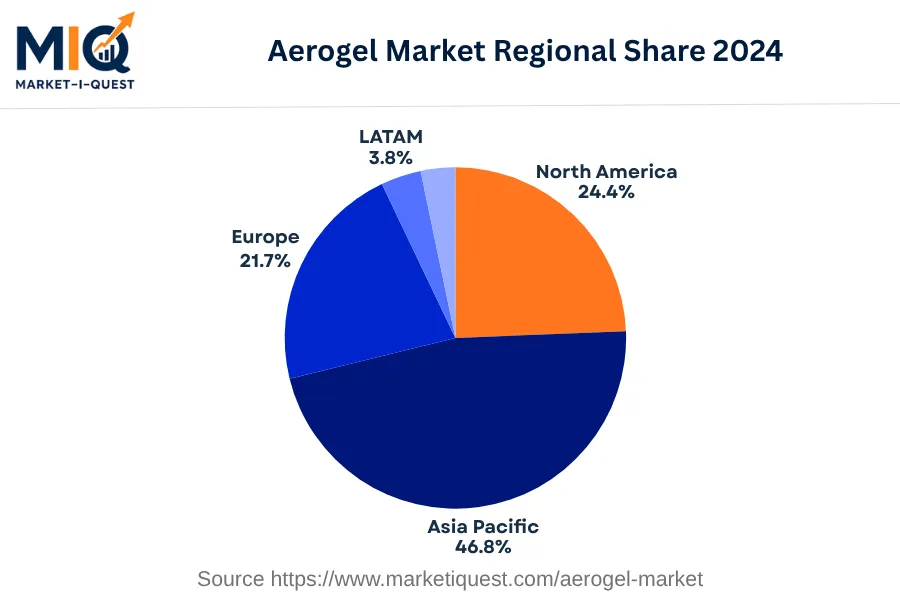
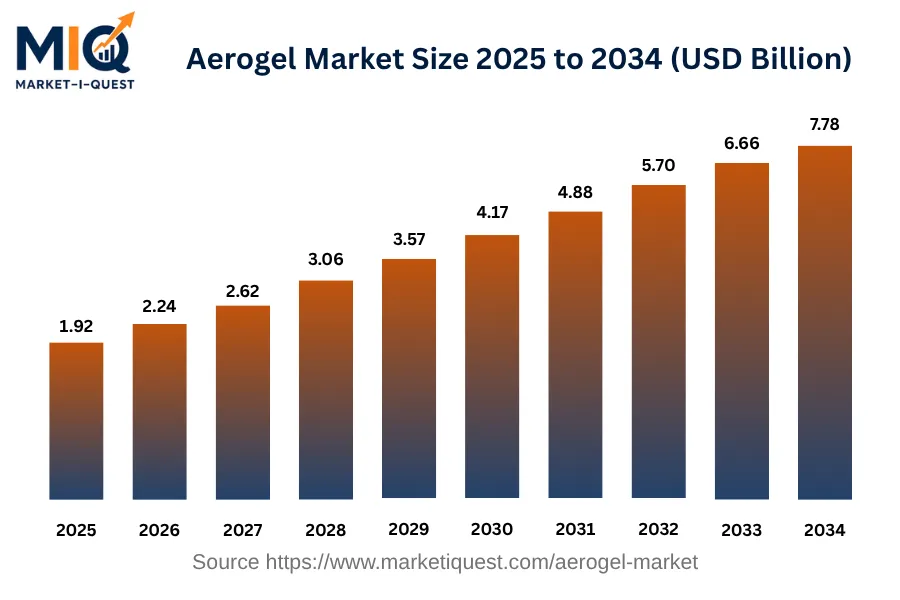
The Aerogel Market's size in 2025 is projected at 1.92 billion USD, escalating to 7.78 billion USD by the year 2034. This ascension signifies a CAGR of 16.85% within this period. Throughout the decade, market value starts by posting at 1.64 billion USD in the year 2024. A steady increase is then visualised with a distinctive leap from 2024 to 2025, followed by a consistent and acute upward trajectory till 2034. This influx predominantly springs from the heightened demand for Aerogel based on the features it encompasses and the extensive application cross verticals. Furthermore, the current regional share in 2024 demonstrates North America holding 24.36% of the market. Asia Pacific significantly leads with a 46.81% share, followed closely by Europe at 21.74%. There is a perceivable lag as LATAM and MEA contribute only 3.82% and 3.27% respectively to the global Aerogel market share.

Key Takeaways

  • By Type - Silica Aerogel held a leading position in the Aerogel Market.
  • By Form - Blanket form of Aerogel expanded extensively marking significant growth.
  • By End-Use Industry - Building and Construction segment was the top consumer of Aerogel market.
aerogel-market market size

Key Driving Factors

Implementation of Stricter Environmental Regulations

Increasingly rigorous environmental regulations, particularly in developed countries, are significantly driving the aerogel market. For example, the EU's Energy Efficiency Directive 2012/27/EU mandates energy-efficient building designs, pushing architects and builders to consider high-performance insulative materials like aerogels. Similarly, the U.S. Department of Energy's 'Better Building Initiative' emphasizes improving commercial and industrial buildings' energy efficiency, enhancing the demand for aerogels, known for superior thermal isolation properties. This regulatory push encourages adoption throughout the construction and architecture sectors.

Emerging Applications in the Aerospace and Defense Industries

The rise of aerogels in the aerospace and defense industries is another significant driving factor. These sectors' unique requirements, such as lightweight, durable materials capable of withstanding severe environmental conditions, make aerogels a prime choice. Lockheed Martin's Mars Rover, for example, utilizes aerogels for insulation from drastic Martian temperature swings. NASA also frequently uses aerogels due to their light weight and excellent thermal retention, ideal for insulating spacecraft. This growing application scope in aerospace and defense sectors hence promotes the market expansion of aerogels.

Market Evolution by Timeline

2019-2023
During these years, the shift in demand from oil and gas companies in North America led them to seek high-performance thermal insulations, enabling an increase in the adoption of aerogel. Solar energy projects, especially in China and India, leaned on aerogel for its superior insulation. On the supply side, companies like Aspen Aerogels and Cabot Corporation increased production rates to keep up. Yet, integration and scalability challenges restrained supply efficiencies. In policy matters, Europe's Green Energy Directive was instrumental in increasing aerogel usage in energy-efficient buildings. Aerogel became increasingly available on e-commerce platforms, with a tendency towards contract-based procurement. Risks included production volume constraints and prohibitive costs of advanced aerogels.
2024
In 2024, Aerogel's demand increased from aerospace and marine sectors globally due to its acoustic insulation capabilities. Key players in the supply chain, like Aerogel Technologies, launched advanced aerogels with enhanced properties. China, with its vast raw material reservoir, emerged as a significant contributor to the aerogel supply chain. Yet, the absence of stringent insulation standards in developing economies hindered the full-scale adoption of aerogels. The commercial model saw a rise in joint ventures and partnerships for aerogel production. The persistent risk remained linked to the high manufacturing cost and limited commercialization.
2025-2029
Throughout these years, aerogel adoption increased in the electronics sector especially in Japan and South Korea, due to its light-weight and thermal resistance. Supplier-side, aerogels with enhanced mechanical strengths emerged, yet production remained limited to small-scale operations. Policy-wise, stricter emission standards in Europe and North America promoted aerogel use in automotive and industrial spaces. Pricing remained relatively stable, favoring long-term contracts, but research grants and subsidies encouraged new market entrants. The risk remained inherent in supply chain disruptions, impacting raw material availability, and resultant aerogel production.
2030-2034
During these periods, healthcare and medicinal sectors from developed economies exhibited demand for aerogel for drug delivery systems. On the supply side, players like Aerogel Technologies and BASF made significant advancements in diversifying aerogel types, but encountered handling and storage-related challenges. In terms of policy, regulatory changes allowing more extensive use of aerogel in medicinal applications became apparent. The commercial model shifted towards lease-based contracts, particularly for large pharmaceutical companies. Risk factors included handling and storage-related challenges and patent disputes among manufacturers.

Future Market Outlook

Future Opportunities

The potential for growth in the aerogel market is largely driven by advancements in production technologies and evolving applications across numerous industries. In 2023, the International Energy Agency released a directive emphasizing the importance of energy-efficient materials in the quest to achieve net-zero emissions by 2050, underscoring the relevance of aerogels in insulation technologies. Companies like Aspen Aerogels are responding to this demand by expanding their production capabilities in regions such as North America and Europe. Similarly, the emerging market for wearable technology, highlighted at the Consumer Electronics Show in January 2023, has opened new avenues for the integration of aerogel materials due to their lightweight and thermal properties. Collaborations among industry leaders, such as the partnership between 3M and NASA established in 2022, aim to explore aerogel applications in aerospace, healthcare, and environmental applications. Moreover, countries like Germany are leading initiatives for lightweight materials in the construction industry, where sustainability in building practices is a growing priority. The potential for aerogel use in battery technologies, as evidenced by research at MIT in early 2023, suggests promising applications in energy storage systems. Such developments indicate a shift toward the utilization of aerogels in sectors that prioritize sustainability and performance, reflecting broader global trends toward greener innovations.

Segmentation Analysis

By Type

The market is divided into subsegments including Silica Aerogel, Polymer Aerogel, Carbon Aerogel, and Metal Oxide Aerogel. Silica Aerogel accounted for the largest revenue share while Polymer Aerogel is expected to grow at the fastest CAGR during the forecast period.

Largest Revenue Share

Silica Aerogel

Market Share Leader

Silica Aerogel leads in terms of revenue generation and this can be attributed to a number of factors. A prominent reason is its wide application across numerous industries such as oil and gas, construction, and automotive due to its superior thermal insulation properties compared to its counterparts. Additionally, Silica Aerogel is non-toxic and environmentally friendly, meeting an increasing demand for sustainable materials in several markets. Geographically, the use of Silica Aerogel is widespread; it is extensively utilized in North America and Europe due to stricter energy regulations and in Asia due to rapid industrialization. Another contributing factor is its established distribution channels; many heavyweight corporations have adopted this material, therefore ensuring its significant market presence. While switching costs remain relatively low, Silica Aerogel's pronounced benefits create a strong customer preference towards its use.

Fastest CAGR

Polymer Aerogel

Forecast Period Growth Leader

Though not the revenue leader, Polymer Aerogel is poised for substantial growth, holding the most promising outlook in terms of CAGR. This surge can be attributed to its novel properties, such as excellent insulation and lightweight nature, which make it ideal for emerging applications. A significant barrier to large-scale adoption of Polymer Aerogel is its higher production costs compared to traditional alternatives. However, advances in manufacturing techniques and increasing investment in R&D activities can serve as catalysts for its growth. Technological advancements, such as the development of more efficient synthesis processes, coupled with strategic partnerships between manufacturers and end-user industries, are expected to improve its market outlook. The considerable capital expenditure required for these developments does pose a near-term risk. Nevertheless, given its exceptional properties, the Polymer Aerogel subsegment is likely to witness increasing demand in industries such as construction and automotive, which are prioritizing weight reduction and energy efficiency.

By Form

The market is divided into subsegments including Blanket, Rigid, Granular, and Powder forms. According to the base year 2024, the Blanket form accounted for the largest revenue share while the Powder form is expected to grow at the fastest CAGR during the forecast period.

Largest Revenue Share

Blanket

Market Share Leader

The Blanket form of the product has been leading the revenue share due to its broad range of applications across various industries. Its easy usability and comparatively higher efficiency continue to drive its demand. Moreover, this form offers better coverage and insulation properties due to its wide surface area. It's not only used in industries but also finds application in homes for insulation purposes, thus expanding its customer base. Furthermore, in regions with cold climatic conditions, the blanket form has seen significant usage. Regulations imposed on energy conservation have also contributed to the raise in demand. Blanket forms often require lesser initial investment when compared to other forms, leading to a larger customer preference. The switching costs are also quite low due to the versatility and compatibility of this form, providing it a superior positioning in the market. Through multiple retail and online channels, blanket forms are being made easily accessible to the customers, promoting its growth.

Fastest CAGR

Powder

Forecast Period Growth Leader

The Powder form is expected to be the fastest growing segment due to the increasing trend towards efficient and sustainable industrial practices. This form's unique properties and functionalities enable it to cater to a wider variety of industrial applications, thus driving its demand. Moreover, advancements in processing technologies and capabilities have made it easier and more cost-effective to produce in large volumes, allowing industries to leverage its benefits at scale. As environmental regulations become more stringent, the powder form's lower emission profiles are expected to attract more adopters. There are certain barriers such as handling complexities and the need for precise measurements which might slow down the adoption rate. However, strategic partnerships with major distribution channels and targeted marketing efforts are expected to mitigate these challenges. Near-term risks include intense competition and fluctuating raw material costs, but overall the outlook for the powder form remains positive.

By End-Use Industry

The market is divided into subsegments including Building and Construction, Transport, Energy, Electronics, Healthcare, and Others. In 2024, the Building and Construction subsegment accounted for the largest revenue share while the Energy subsegment is expected to grow at the fastest CAGR during the forecast period.

Largest Revenue Share

Building and Construction

Market Share Leader

In 2024, the Building and Construction sector became the most profitable in our market segmentation analysis. This lucrative positioning could be attributed to several influencing factors. A rise in global population and rapid urbanization have led to an increase in the demand for infrastructure, driving growth in the sector. Moreover, technological advancements in construction materials and their increased application in the design and creation of structures further supplemented this demand. The industry also enjoys the benefit of steady public and private investment, fueling construction projects across various geographies. However, we must take note that the regulatory environment highly piloted industry growth. Strict building codes and regulations to ensure safety and sustainability have nudged the industry forward, pushing firms to adopt innovative, compliant solutions. Customer purchasing decisions were primarily driven by the quality, durability, and cost-effectiveness of these solutions.

Fastest CAGR

Energy

Forecast Period Growth Leader

Our analysis projects that the Energy subsegment will witness the fastest CAGR in the coming years. This prediction is underpinned by a number of key growth drivers. The global push towards renewable and clean energy sources to combat climate change is a significant catalyst. This shift has led to increased capital expenditure in renewable energy projects, including solar and wind, and technological advancements such as smart grids. Worldwide initiatives and policies that support green energy adoption and penalize carbon emissions also are creating a favorable environment for growth. However, the industry still faces potential barriers in the form of infrastructure challenges and high initial investment costs. Partnerships between governments, investors, and private companies might be a requisite solution to kick-start growth. On a cautionary note, shifts in policy or public sentiment towards renewable energy might pose near-term risk, proving detrimental to progress.

Competitive Analysis

Key Market Players

Manufacturers / OEMs

Aspen Aerogels, Inc.
US
Cabot Corporation
US
Aerogel Technologies, LLC
US

Key Suppliers & Raw Materials

BASF SE
Germany
Dow Inc.
US
W.R. Grace & Co.
US

Distributors, Integrators & Channel Partners

Marken Chemicals
UK
Nano High-Tech Co., Ltd.
China
Guangdong Alison Hi-Tech Co., Ltd.
China

Porter’s Five Forces Analysis

The analysis evaluates the competitive situation and profitability potential within the Aerogel market.

Supplier Bargaining Power

Medium

Limited number of raw material suppliers increases their bargaining power.

Buyer Bargaining Power

Low

Unique characteristics of aerogel lowers the bargaining power of buyers.

Threat of Substitutes

Low

Scarcity of viable and equally efficient alternatives reduces the threat of substitutes.

Threat of New Entrants

High

Low regulatory requirements increase the threat of new entrants.

Competitive Rivalry

Medium

The market has a moderate degree of competition, with key players holding significant market shares.

Regional Analysis

Geographic market dynamics and growth opportunities across key regions

Global Market Outlook

aerogel-market market regional share

North America

In 2024, the North American Aerogel Market was significantly influenced by dynamic drivers and trends shaping the industry. Increasing demand for superior insulation materials in construction and oil & gas sectors, along with stringent energy regulations set by the U.S. Department of Energy, drove the Aerogel Market. Adoption of advanced technologies improved production efficiency, while increased investment in green and sustainable products augmented market growth.

The trend towards energy efficiency and green construction significantly impacted buyer behavior. The shift to advanced nanotechnology, witnessed in the rapid adoption of Aerogel across automotive, aerospace, and construction industries, reoriented product and tech shifts. The emergence of online channels, predominantly in the US, streamlined supply-chain operations, and boosted the market. Strategic partnerships and M&As, especially in the US and Canada, fostered innovative growth trajectories in the Aerogel sector. Enforcement of stringent policies, such as the American Energy Independence and Security Act, provided impetus to the demand for aerogel insulation in North America.

In 2024, the booming HVAC industry became a prominent customer of Aerogel, alongside government entities, enterprises, oil & gas, and manufacturing sectors. The North American market for Aerogel in 2024 was indeed stimulated by dynamic drivers and evolving industry trends centered around energy efficiency, emissions reduction, and sustainable development.

Asia Pacific

In 2024, Asia Pacific's aerogel market witnessed significant growth, driven by escalating demand and favorable mechanisms. High energy efficiency standards in China, India, and Japan triggered demand for aerogels in construction, automotive, and oil & gas sectors. Investments in advanced material technologies by South Korea and Australia further stimulated aerogel production. Concurrently, lower production costs due to affordable raw materials positioned ASEAN markets as competitive suppliers in the aerogel network.

Emerging trends in 2024 embedded buyer preference for green and sustainable alternatives with aerogels being sought for their superior insulation properties. Technology evolution in aerogels lead to their increased usage in healthcare and retail segments in China and Japan. Mergers and acquisitions reinforced regional market presence, observed in the Chinese government's acquisition of a leading aerogel manufacturer, enhancing its domestic supply. Regulations, such as Minimum Energy Performance Standards (MEPS) in Australia, encouraged the adaptation of aerogel for thermal insulation.

Noteworthy is the swift enforcement of policy in India mandating the use of eco-friendly materials in public infrastructure projects, accentuating the aerogel demand. Manufacturing industries across the Asia Pacific, especially automotive in South Korea and Japan, sought aerogels for thermal management, fuelling the market. Thus, the Asia Pacific aerogel market in 2024 was dictated by regulatory dynamics, technological advancements and a shift towards energy-efficient materials.

Europe

In 2024, the Aerogel market in Europe witnessed significant growth due to various drivers and regional trends. It was primarily propelled by the increasing demand for effectual thermal insulation materials in major economies such as Germany, the United Kingdom and France. Stricter energy-efficiency regulations, especially in the Nordic region, compelled adopters to seek materials like Aerogel that lower energy consumption. Italy and Spain observed escalating investments in infrastructure development projects that favoured the usage of aerogel in construction.

A key trend in the market was replacing traditional insulation materials with aerogel in the manufacturing sector, driven by aerogel's superior thermal properties. Amid the ongoing digital transformation in Benelux, telecom companies majorly adopted aerogel for cable insulation. Central and Eastern Europe reported an uptick in collaborations between aerogel manufactures and local distributors, expediting product availability and escalating demand. Policy enforcement around environmental sustainability in the European Union pushed for the adoption of aerogel in enterprises, government projects, and utilities due to its green credentials.

Therefore, in 2024, the inherent characteristics of aerogel, coupled with regulatory and infrastructural drivers, influenced its growing market in Europe. Concurrently, trends around sustainability, digitalization, and supply chain collaborations furthered its industry foothold.

Latin America

The Aerogel market in Latin America (LATAM) showed considerable market activity in 2024. Strong drivers were increased demand for high-efficiency insulation materials, favorable regulatory policies advocating energy conservation, and the adoption of advanced materials technology in Brazil and Mexico. Government initiatives in these countries, along with Argentina, Colombia, Chile, and Peru, promoted energy-efficient infrastructure, contributing to the demand. Investment in advanced materials technology also increased, mainly in enterprise and manufacturing sectors, improving supply dynamics.

The mandate for energy-efficient buildings reshaped buyer behavior, shifting preference towards Aerogel insulation solutions. Technological advances in Aerogel production resulted in lower costs, further solidifying its competitive market stance. Omnichannel distribution became more prevalent, allowing wider access to Aerogel products, especially for retail buyers. M&A activities strengthened, with major participants aiming to control the supply chain and widen market reach. Regulatory enforcement was robust, with policies like Mexico's Official Mexican Standard NOM-020-ENER-2011 directing energy efficiency in non-residential buildings, strengthening the demand for Aerogel.

Significant customer segments for Aerogel included the construction industry, oil & gas, automotive, healthcare, and utilities. Their requirements for thermal insulation and resistance properties made Aerogel an apt choice, further expanding its market across LATAM during the base year.

Middle East & Africa

In 2024, the aerogel market in the Middle East and Africa displayed robust dynamics in response to various drivers and trends. Increased government spending on infrastructure and stringent energy efficiency regulations, especially in Saudi Arabia and UAE, drove demand for aerogels in construction and oil & gas sectors. Technological advancements, coupled with the abundant availability of raw materials in Nigeria, positively influenced supply dynamics. Fluctuations in raw material prices in South Africa and Kenya somewhat impacted the overall pricing in the market.

Emerging trends broadened the scope and reach of the aerogel market. Notably, we observed shifts in buyer preference towards environmentally friendly insulation materials. Expansion and innovation in aerogel applications were significant in Egypt's telecom and Israel's healthcare sector. Strategic partnerships promoting local manufacturing, like those in Saudi Arabia, emerged as a trend, reflecting the government's commitment to achieve self-reliance. In terms of enforcement, stricter adherence to energy efficiency standards across the region was noticeable. Lastly, the demand from utility services due to their increased interest in thermal insulation reinforced market growth.

Recent Industry Developments

Latest market innovations, product launches, and strategic initiatives

February 2026

Aspen Aerogels launched its Pyrogel XTE aerogel blankets. This updated product line is structurally engineered to offer enhanced thermal stability, specifically targeting high-temperature industrial piping applications and moisture protection.

August 2025

Outlast Technologies, in partnership with material supplier Svenska Aerogel, introduced Aersulate. This specialized aerogel-based fabric formulation is targeted at the consumer textile sector to enable thin, high-efficiency thermal insulation in outdoor footwear, bedding, and activewear.

Frequently Asked Questions