Active Calcium Silicate Market Snapshot

Key Players

  • Johns Manville (United States)
  • Promat International (Belgium)
  • American Elements (United States)
  • HIL Limited (India)
  • Weifang Hong Yuan Chemical Co. Ltd (China)
  • Rath Incorporated (United States)
  • Active Minerals (United States)
  • Anglitemp (United Kingdom)
  • Imerys Group (France)
  • Bee Chems (India)

Market Size

Base Year 2024
$0.378 Bn
CAGR
4.8%
Forecast 2034
$0.60 Bn

Market Segments

By Form
  • Blocks
  • Powder
  • Boards
By Application
  • Insulation
  • Paints & Coatings
  • Fire Protection
  • Cement
  • Ceramics
  • Others

Market Dynamics

Drivers
  • Rising construction activities
  • Growing industrial sector
Restraints
  • High production cost
  • Strict environmental regulations
Opportunities
  • Growing construction industry
  • Rising demand in fireproofing materials

Market Size

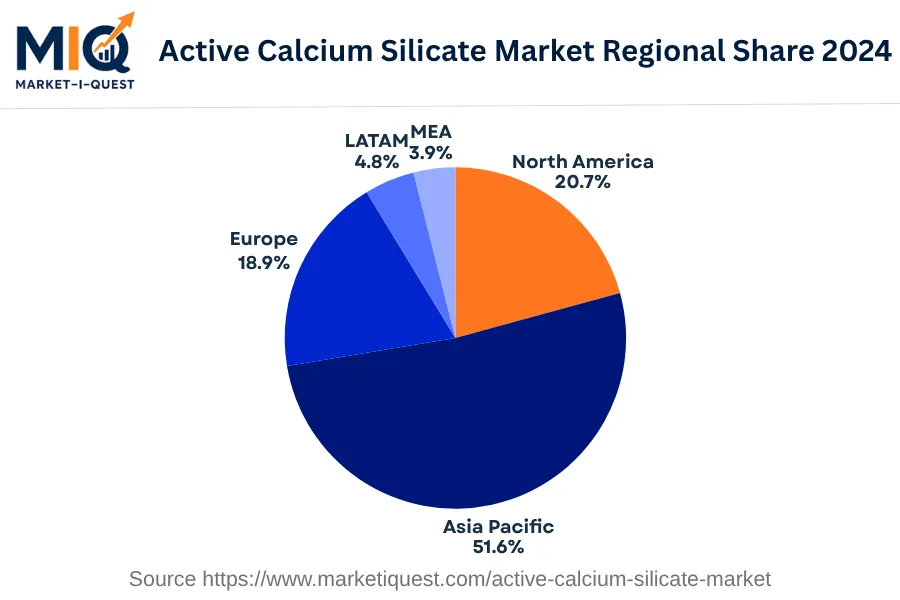
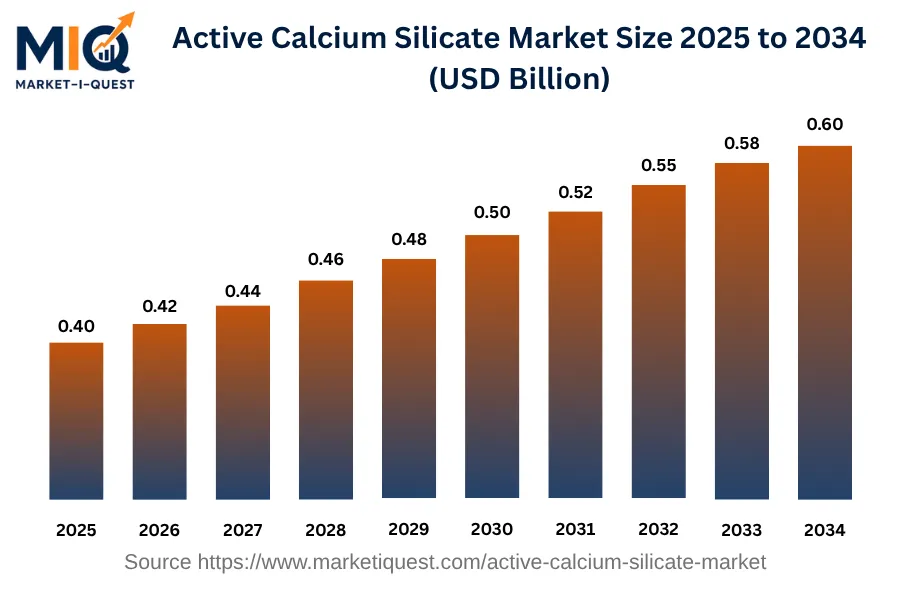
The Active Calcium Silicate market, valued at 0.40 billion USD in 2025, experiences a growth trajectory that will see it appreciating to 0.60 billion USD by 2034. This market expansion represents a Compound Annual Growth Rate (CAGR) of 4.8% over the nine-year period from 2025 to 2034. This increase in market size reflects an upswing from the market size of 0.38 billion USD in 2024, with 2025 experiencing a notable gain. Regional shares in the market as of 2024 were distributed with Asia Pacific holding the largest sector at 51.6%, trailed by North America at 20.7%, and Europe at 18.9%. The remaining shares of the Active Calcium Silicate market were held by LATAM at 4.8% and MEA at 4.0%. This regional share disposition elucidates the geography of the market in a significant way.

Key Takeaways

  • By Form - Blocks held the dominant position in the Active Calcium Silicate Market in 2024.
  • By Application - Paint & Coating led the market accounting for a significant market share in 2024.
active-calcium-silicate-market market size

Key Driving Factors

Implementation of Strict Fire Safety Regulations

Active Calcium Silicate is a key material in the production of fire-resistant building materials, such as wall boards and ceiling tiles. The significant shift towards the enforcement of strict fire safety regulations across numerous industries – especially construction – is a prominent factor driving the market. This trend is especially noticeable in developed countries, where regulatory bodies, like the Occupational Safety and Health Administration in the U.S., emphasize fire safety compliance, thereby encouraging the demand for fire-resistant materials. As Active Calcium Silicate products meet such fire safety requirements, the need for this compound is on the rise.

Expansion of the Construction Industry

The ongoing expansion of nations' infrastructural capacities, coupled with steady growth in the global construction industry, is a fundamental driving force for the Active Calcium Silicate market. The compound, renowned for its heat-resisting properties, strength, and durability scores high preference in the construction sector. As countries, like China and India, prioritize urban growth and infrastructural development, the demand for construction materials that use Active Calcium Silicate is increasing. This rapid growth and expansion of construction projects worldwide, therefore, is a concrete driving catalyst for this market.

Market Evolution by Timeline

2019-2023
The initial phase focused largely on industrial efficiency. Buyers, particularly from insulation, paint, and construction industries, were seeking improved thermal management and fire protection solutions, with Europe and North America being the leading regions. Meanwhile, suppliers dealt with the introduction of energy-efficient manufacturing processes. However, issues around inconsistent quality of raw materials limited optimal production. The Kyoto Protocol spurred governments' imposition of stricter construction standards, positively affecting demand. Fixed price contracts were a common commercial model, but quality issues necessitated contingency clauses. A notable risk included constant price fluctuations of raw materials.
2024
This was a period of global expansion, particularly into Asian markets. Rising construction activities in China, South Korea, and Japan led these countries to major buyer positions. In response, suppliers focused on tailoring their product for these markets via refining chemical compositions, expanding the usage possibilities. 'The Comprehensive Environment Improvement Plan' boosted the demand in South Korea. Commercial models saw partnerships form between suppliers and local distributors. However, the risk of patent infringement increased due to technological advancements.
2025-2029
This period saw increased use in the automobile industry. The adoption was driven by the need to make car components lighter yet strong and thermally stable. The US and Germany, being automotive hubs, witnessed a surge in demand. Suppliers invested in research and development, improving the strength of active calcium silicate. Legal standards like 'The Paris Agreement' motivated automakers to reduce the carbon footprint of their products. Contracts evolved into performance-based agreements. A prominent risk was the availability of alternatives that could potentially outperform active calcium silicate.
2030-2034
The period featured a significant growth in use by the aerospace industry. Countries with robust aerospace sectors like the USA, France, and the UK demonstrated strong demand. The supply side saw technological advancements in the form of nanotechnology to manipulate the physical properties of active calcium silicate. However, meeting the stringent aviation standards, such as the SOLAS regarding fire safety, remained a challenge for suppliers. Commercial models included long-term agreements with aerospace companies. In terms of risks, the global political situation directly impacted the aerospace industry and consequently the active calcium silicate market.

Future Market Outlook

Future Opportunities

The active calcium silicate market is ripe with future opportunities due to emerging trends in industrial applications and regulatory shifts. In 2024, the International Energy Agency indicated that stricter energy efficiency measures worldwide present avenues for growth, especially in the insulation market. As governments, particularly in North America and Europe, intensify efforts to reduce carbon footprints, demand for calcium silicate insulation materials is likely to rise. Companies like CertainTeed are pioneering sustainable insulation solutions, reflecting a broader industry shift towards environmentally friendly products. Moreover, the increasing focus on fire safety, notably highlighted by the adoption of the updated NFPA 5000 in the U.S. in 2021, acknowledges calcium silicate's non-combustibility and thermal stability as crucial attributes. This opens doors for manufacturers to position their products as staples in safety-conscious construction practices. Additionally, emerging markets in Asia-Pacific, particularly in India and Southeast Asia, are experiencing rapid urbanization and infrastructure development. This growth trend will drive the demand for effective insulation materials, providing a platform for companies to introduce advanced calcium silicate solutions tailored to regional needs. With these factors in play, manufacturers are well-positioned to exploit new market segments and leverage regulatory frameworks to enhance their product offerings.

Segmentation Analysis

By Form

The market by form consists of Blocks, Powder, and Boards with Blocks accounting for the largest revenue share, while Powder is expected to grow at the fastest CAGR during the forecast period.

Largest Revenue Share

Blocks

Market Share Leader

Market dominance in the Blocks subsegment can be attributed to multiple factors. Their relative ease of use, along with their versatility in numerous applications, contributes to their high demand in the market. Unlike Powder and Boards, Blocks can be readily used in construction and insulation projects without much need for conversion or treatment processes, implying a lower total usage cost and shorter project timelines. Regulation and supply favor Blocks due to their uncomplicated manufacturing process and lower environment impact compared to other form types. Additionally, purchasing decisions can be heavily affected by these factors as customers aim to balance affordability and eco-consciousness. In terms of geography, developed nations with established infrastructure investments tend to prefer Blocks owing to their efficiency and reliable supply chains. Switching costs from Powder or Boards to Blocks are also minimal, promoting their adoption.

Fastest CAGR

Powder

Forecast Period Growth Leader

The Powder subsegment is set to display the fastest growth, driven by a variety of factors. Its primary advantage lies in its form, which allows a higher degree of flexibility in applications. Its granulated state enables easy mixing and manipulation, making it ideal for precision-demanding tasks. The relatively low initial capital expenditure and the ability to scale the usage as per demand favor its adoption, thus becoming the catalyst for the growth of this segment. In addition, improvements in processing technology have allowed for better quality and cost-efficient Powder production, further driving growth. Partnering with construction companies or material retailers can also spur growth, although adoption barriers persist in the form of price comparison and inertia against shifting from traditional materials. The near-term risks include fluctuating raw material prices and standards compliance hurdles. In conclusion, while Powder is the fastest-growing subsegment, its future trajectory will depend largely on how effectively these risks are managed and adoption barriers breached.

By Application

The market is segmented by application into Insulation, Paints & Coatings, Fire Protection, Cement, Ceramics, and Others. The Paints & Coatings subsegment accounted for the largest revenue share while Insulation is projected to exhibit the fastest growth during the forecast period.

Largest Revenue Share

Paints & Coatings

Market Share Leader

The Paints & Coatings subsegment emerged as a dominant player, contributing to the majority of the revenue in the application market. This prominence can be attributed to the wide usage of coatings in a variety of sectors, from construction and automotive to aerospace and industrials. For instance, in the construction sector, paints and coatings are crucial for both aesthetic and protection purposes. Given that the construction industry is growing, especially in developing economies, the demand for paints and coatings is rising. Notably, these products provide protection against harsh weather, rust and corrosion, which lengthens the lifespan of structures and equipment. In addition, stringent regulations about VOC emissions have accelerated the demand for eco-friendly coatings, contributing to the revenue growth of this subsegment. Hence, a combination of rising demand in various industries coupled with evolving regulations leads to the high revenue generation in this subsegment.

Fastest CAGR

Insulation

Forecast Period Growth Leader

The growth of the Insulation subsegment is primarily driven by the increasing need for energy-efficient solutions in both residential and commercial buildings. The global emphasis on achieving sustainability goals has resulted in stricter building codes, mandating improved thermal insulation to minimize energy consumption. Adoption barriers in this subsegment could include the high initial investment required for insulation materials and the lack of skilled labor for installation. However, increasing partnerships between insulation manufacturers and construction companies are helping to overcome these challenges. Furthermore, technological advancements in insulation materials, coupled with government initiatives to promote energy conservation, are accelerating the market growth. The energy crisis remains a critical influence, spurring innovation and expansion in insulation solutions. Yet, fluctuating raw material prices pose a near-term risk to this growth trajectory.

Competitive Analysis

Key Market Players

Manufacturers / OEMs

American Elements
US
Rath Incorporated
US
Promat UK Limited
UK

Key Suppliers & Raw Materials

PPG Industries, Inc.
US
Imerys SA
France
Evonik Industries AG
Germany

Distributors, Integrators & Channel Partners

Spectrum Chemical Mfg. Corp.
US
Mineral Products Inc.
US
Briochem Ltd
Canada

Porter’s Five Forces Analysis

A concise analysis of the competitive forces shaping the Active Calcium Silicate Market.

Supplier Bargaining Power

Medium

Availability of raw materials and specialized suppliers influence their bargaining power.

Buyer Bargaining Power

High

Buyers have high power due to availability of multiple suppliers and low switching cost.

Threat of Substitutes

Low

Low threat due to unique properties and applications of active calcium silicate.

Threat of New Entrants

Medium

Capital and technological requirements present moderate barriers to entry.

Competitive Rivalry

High

Intense competition exists between established industry leaders and emerging players.

Regional Analysis

Geographic market dynamics and growth opportunities across key regions

Global Market Outlook

active-calcium-silicate-market market regional share

North America

In 2024, the North American active calcium silicate market saw a noteworthy expansion due to various drivers and trends. Urbanization and industrial expansion, particularly in the construction industry of the U.S., Canada, and Mexico, led to a heightened demand for high-temperature insulation materials like active calcium silicate. Relatively lenient regulatory guidelines for manufacturing and use of active calcium silicate also contributed to the market growth. Technological advancements drove a shift toward the production and adoption of more efficient and cost-effective materials, further boosting demand. Stable pricing influenced by predictable supply dynamics played an essential role in supporting this demand.

Trends indicated a shift in buyer behavior towards more durable and fire-resistant materials. An ongoing movement towards eco-friendly construction materials reshaped the production methods and product standards. Crucial channel dynamics involved partnerships and mergers and acquisitions primarily focusing on consolidating resources and optimizing operational efficiency. The North American market saw significant demand from chief sectors, including industrial, manufacturing, and construction. The adoption of active calcium silicate in these key areas was propelled by its multi-functional properties such as sound absorption, high-temperature resistance, and increased durability, which catered to a wide range of applications. Regulatory enforcement towards safer building practices also spurred acceptance in these sectors. Overall, the North American market for active calcium silicate presented a prosperous picture in the base year 2024.

Asia Pacific

In 2024, the active calcium silicate market in Asia Pacific exhibited robust dynamicity fueled by diverse factors. Market expansion was mainly driven by increasing demand from the construction and ceramics industries in China and India. Rising government investments in infrastructure projects and increased adoption of modern construction materials in these nations stoked market growth. Technological advancements led to the creation of high-quality, durable active calcium silicate, which catalyzed its demand further.

Buyers exhibited a growing inclination towards eco-friendly building materials, steering trends in the market. Active calcium silicate’s heat resistivity and sound absorption qualities made it a popularly sought-after choice among constructors for fire-proof and acoustic insulation. The use of digital channels for the sale of products expanded significantly in markets such as Japan, South Korea, and Australia. Moreover, partnerships and Mergers and Acquisitions were noted, particularly in key ASEAN markets, to consolidate market presence and broaden the retail network.

Sector-wise, besides construction and ceramics, the demand for active calcium silicate arose from sectors such as manufacturing and retail. In spite of high demand, the pricing of the product stayed stable, signifying a sturdy supply chain maintained by producers. Regulatory frameworks such as China’s Green Building Standards guided the manufacturing and application of active calcium silicate, ensuring the product’s quality through stringent checks.

Europe

In the baseline year 2024, the Active Calcium Silicate Market in Europe emerged characterized by widespread commercial application. Notable drivers included increasing demand from construction and industrial insulation sectors, particularly within Germany and the United Kingdom, and regulations incentivizing energy-efficient materials. Growing investments in research & development, seen most notably in France's technology adoption which led to heightened supply dynamics, also played a key role. Furthermore, manufacturers’ strategic pricing adjustments increased the market’s affordability and accessibility.

Trends were shaped markedly by consumer behavior with a focus on high-quality, durable products, a shift underscored by the growing popularity of active calcium silicate in the manufacturing sectors of Italy and Spain. Additionally, transformative product developments, epitomized by Central and Eastern Europe’s increased adoption of bio-sourced silicate products, fueled market changes. Channel dynamics played a considerable role too, with an increase in direct-to-consumer platforms facilitating vendor-client relationships. This year witnessed a consolidation phase in the market, with several mergers and acquisitions in the Nordics and Benelux strengthening the market's robustness. Standards came under closer inspection, evidenced by policy enforcement celebrating green initiatives, propelling growth in the enterprise, healthcare, and utilities sectors, further driving this European market.

Latin America

In 2024, the Active Calcium Silicate market in Latin America (LATAM) demonstrated a heightened demand driven primarily by construction, ceramics, and fire protection industries. An inflow of foreign investments, particularly in Brazil and Mexico's infrastructure development, created robust demand. In Argentina and Chile, stricter enforcement of fire safety norms compelled construction and manufacturing sectors to incorporate fire-resistant materials like Active Calcium Silicate. Technological adoption in Colombia and Peru's ceramics industry further propelled the market, with Active Calcium Silicate being favored for its thermal insulation properties.

Market trends predominantly revolve around ecological considerations and stringent regulatory compliance. In Brazil, Chile, and Argentina, end-users increasingly prefer Active Calcium Silicate for its non-toxic and bio-degradable attributes, aligning with their sustainability goals. LATAM's ongoing digitalization wave, particularly in Mexico and Peru, led to partnerships between local manufacturers and tech firms to develop advanced manufacturing processes, thereby optimizing supply. Compliance with the ‘Reglamento Técnico Centroamericano’ emerged as a notable trend, as companies navigated the regulatory landscape. The retail and e-commerce channels further witnessed accelerated sales due to the ease of product comparison and consumer awareness. The LATAM Active Calcium Silicate market, in 2024, was fueled by a blend of investment, regulatory compulsions, technological advances, and changes in consumer behavior.
Middle East & Africa

In 2024, the Active Calcium Silicate Market in the Middle East and Africa witnessed significant dynamism. The market was primarily driven by increasing demand in the construction and manufacturing industries, with key players in Saudi Arabia, UAE, and South Africa investing heavily in infrastructure development. Moreover, governmental regulations aimed at boosting local industries in major economies such as Nigeria and Kenya stimulated market growth. Additionally, advances in technology adoption in countries like Israel further accelerated the market, enhancing production efficiency and quality.

Trending in 2024 was a shift toward eco-friendly products, with manufacturers in Egypt and Qatar pivoting towards sustainable production methods in response to consumer demand and policy enforcement. There was also an evident change in buyer behavior as end-users, such as utilities and telecom sectors, started prioritizing products with longer lifespans and higher resistance to heat and sound. Furthermore, the market saw increased partnerships and M&As, particularly in the UAE and Saudi Arabia, aiming to consolidate market presence and leverage joint capabilities. Lastly, the standardization of active calcium silicate products was more rigorously instituted across regions, following an uptick in quality-consciousness among industries like oil and gas, healthcare, and retail.

Recent Industry Developments

Latest market innovations, product launches, and strategic initiatives

June 2026

Holcim acquired Xella to integrate the Silka calcium silicate brand into its portfolio and expand its building materials business.

July 2025

Promat International published updated testing data proving their calcium silicate boards perform better in fire protection than alternative systems.

January 2025

PQ Corporation acquired the specialty silicate division of Sibelco to increase its production capacity and distribution network across Europe.

Frequently Asked Questions