Actinic Keratosis Treatment Market Snapshot

Key Players

  • Sun Pharmaceutical Industries Ltd. (India)
  • Galderma Laboratories (Switzerland)
  • Tolmar Pharmaceuticals Inc. (US)
  • Biofrontera AG (Germany)
  • Novartis AG (Switzerland)
  • Perrigo Company plc (Ireland)
  • Leo Pharma A/S (Denmark)
  • DUSA Pharmaceuticals Inc. (US)

Market Size

Base Year 2024
$7.15 Bn
CAGR
6.92%
Forecast 2034
$13.96 Bn

Market Segments

By Treatment Type
  • Procedural Modality
  • Topical Treatment
  • Photodynamic Therapy
  • Others
By Drug Class
  • Nucleoside Metabolic Inhibitor
  • Immune Response Modifiers
By End User
  • Hospitals & Oncology Centers
  • Dermatology Clinics
  • Ambulatory Surgical Center

Market Dynamics

Drivers
  • Increasing geriatric population
  • Rising skin cancer awareness
Restraints
  • High treatment costs
  • Lack of awareness
Opportunities
  • Emerging Therapeutics
  • Increased Patient Awareness

Market Size

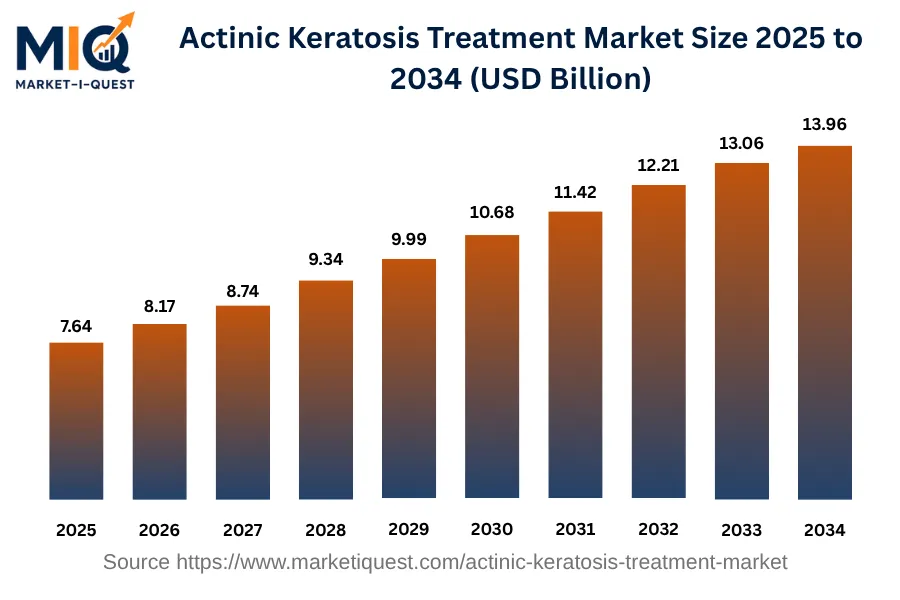
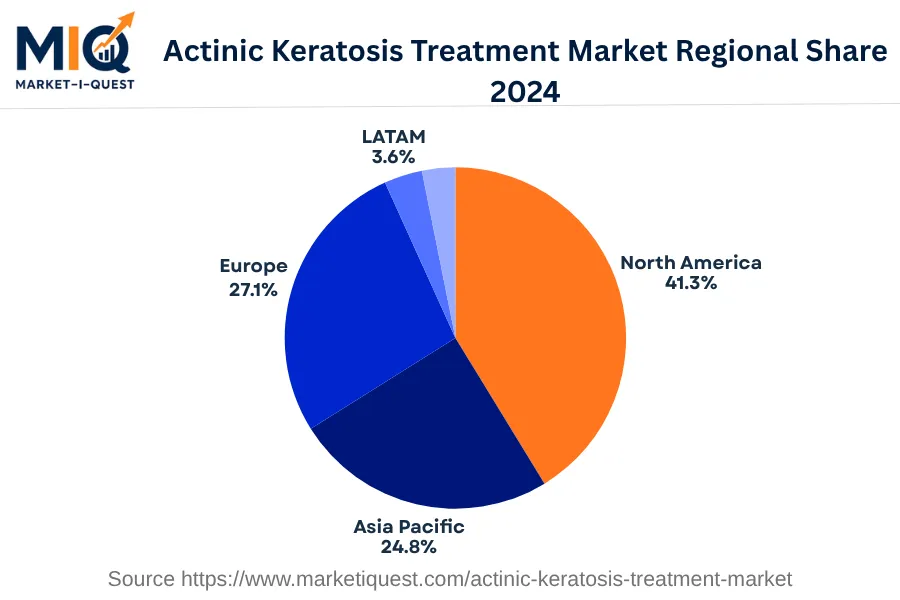
The Actinic Keratosis Treatment Market was valued at USD 7.15 billion in 2024. By 2025, it slightly rose to USD 7.64 billion. Over the subsequent nine years, the market showed a consistent increase and by 2034 reached a value of USD 13.96 billion. This represents a CAGR of 6.92% during the 2025 to 2034 period. This solid growth was largely propelled by the increasing demand for effective therapies for Actinic Keratosis and advancements in treatment methods. Furthermore, the rising awareness of Actinic Keratosis' potentially severe health implications also contributed to the market's expansion. The regional distribution of the market in 2024 demonstrated North America had the largest share at 41.3%, followed by Europe at 27.1%, and the Asia Pacific at 24.8%. Less significant shares were held by Latin America and the Middle East & Africa, with respective shares of 3.6% and 3.2%.

Key Takeaways

  • By Treatment Type- Procedural Modality holds a significant share in the market.
  • By Drug Class - Nucleoside Metabolic Inhibitor emerged as a major share holding subsegment of the market.
  • By End User - Hospitals & Oncology Centers held the largest share of the segment.
actinic-keratosis-treatment-market market size

Key Driving Factors

Implementation of Skin Cancer Awareness Programs

A driving factor in the Actinic Keratosis Treatment Market is the increasing implementation of skin cancer awareness programs by health bodies such as the Skin Cancer Foundation and the World Health Organization. These programs aim to improve the awareness about the need for early detection and treatment of skin conditions, including actinic keratosis, which could turn into cancers if not treated early. They employ several measures such as organizing free check-ups at public places, running ad campaigns about the impact of sun exposure, and collaborating with governments to reach a broader population. This has heightened consumers' understanding of actinic keratosis, leading to increased usage of treatments that could ultimately prevent the development of skin cancers.
Introduction of Novel Actinic Keratosis Treatment Drugs

Innovation in treatment drugs is another significant driving factor for the Actinic Keratosis Treatment Market. Pharmaceutical companies, supported by extensive research & development resources, are producing novel medicines and therapies that offer improved effectiveness and reduced side effects to treat actinic keratosis. These products are then backed up by rigorous promotional activities that seek approval and preference from healthcare providers. High-efficacy drugs like Picato and Klisyri have gained approval from the Food and Drug Administration and recommendation by dermatologists. The innovation and subsequent marketing of these superior outcomes, safer, and faster treatment drugs significantly sway the market growth of actinic keratosis treatment.

Market Evolution by Timeline

2019-2023
During this period, North America was the largest consumer of Actinic Keratosis Treatment due to the high prevalence of fair-skinned individuals and exposure to UV radiation. Therapeutic strategies available included topical chemotherapy and photodynamic therapy, both showing therapeutic efficacy despite integration challenges. An important regulatory environment has been the United States Food and Drug Administration's position, approving several topical treatments such as fluorouracil and imiquimod. Commercially, partnering with dermatologists and hospitals was a common model to enhance accessibility, and pricing was largely a factor of the treatment approach adopted. A challenge in this period was poor patient adherence due to prolonged treatment courses and adverse side-effects.
2024
In 2024, there was a likely inclination towards photoprotective treatments as the best preventive measure for actinic keratosis. Countries with high UV exposure such as Australia, the U.K., and states like Florida and California in U.S. showed a high demand for these treatments. The commercial models shifted towards e-commerce platforms to reach a larger demographic and provided transparent pricing models. Manufacturers were under the scanner of regulatory bodies for adhering to strict regulations for over-the-counter topical creams, posing a challenge that year.
2025-2029
During 2025–2029, Asia-Pacific likely saw an increased demand for AK Treatment due to rising awarenss and increased exposure to sun. The introduction of innovative, less harmful treatments showed promise for improving patient adherence. Regulations became stringent in European regions like Germany and France, making it mandatory for manufacturers to disclose full list of ingredients. Major partnerships arose among pharmaceutical manufacturers, dermatologists, and retail chains for product availability. The rise in counterfeit products emerged as a significant risk, resulting in manufacturers being held accountable for delivering genuine products.
2030-2034
By 2030–2034, it's likely that digitization played a significant role with telemedicine consultations being preferred for actinic keratosis treatments. The majority demand originated from regions with substantial elderly populations like Japan and parts of Europe, owing to the correlation between age and actinic keratosis. While technology aided in processing and delivery of medication, regulations were designed to ensure data privacy. The commercial model evolved with fast prescription-to-delivery models, emphasizing on quick and secure treatment delivery. A practical risk involved handling complex cyber-secure systems and ensuring patient data privacy.

Future Market Outlook

Future Opportunities

With the rise of differentiated treatment methodologies, future opportunities in the actinic keratosis treatment market are becoming more pronounced. As of 2023, the FDA's approval of new topical therapies, including Ingenol Mebutate, signifies regulatory support for more varied treatment modalities. This approval opens avenues for pharmaceutical companies to investigate additional indications and formulations for actinic keratosis treatment. Furthermore, the increasing prevalence of skin cancers—including a noteworthy rise in non-melanoma skin cancers reported by the Centers for Disease Control and Prevention in 2022—highlight an urgent demand for effective preventive measures and treatments. Coupled with this, there is a notable emphasis on patient education and awareness campaigns led by dermatology associations, providing an excellent groundwork for market penetration. Additionally, collaborative efforts involving leading dermatological research institutions such as the American Academy of Dermatology and biopharmaceutical companies could facilitate the development of new medications and delivery systems. Partnerships also provide the grounds for innovative research in less invasive treatment alternatives, such as cryotherapy and topical chemotherapy formulations. As education and awareness around actinic keratosis continue to grow, companies that can provide efficient, patient-focused treatments will likely find substantial opportunities for market expansion in the coming years.

Segmentation Analysis

By Treatment Type

The market is divided into subsegments including Procedural Modality, Topical Treatment, Photodynamic Therapy, and Others. Procedural Modality accounted for the largest revenue share while Photodynamic Therapy is expected to grow at the fastest CAGR during the forecast period.

Largest Revenue Share

Procedural Modality

Market Share Leader

Procedural Modality in the context of treatment types dominates the market share in revenue due to its wide scope of application across an array of medical conditions. The subsegment involves various treatments that are procedural, such as surgeries, which are often the first line of action for severe conditions. Its universality among medical practitioners and its built-in adaptability to handle a wide range of diseases make procedural modality the industry standard, consequently driving its high revenue. Furthermore, the introduction of technologically advanced tools and equipment used in procedural treatments has made it possible to perform complex procedures efficiently, leading to more successful outcome rates, thus indirectly boosting their adoption rate. Besides, regions with high healthcare funding, such as North America and Europe, significantly contribute to this subsegment's larger revenue share due to higher rates of usage and institutional support.

Fastest CAGR

Photodynamic Therapy

Forecast Period Growth Leader

Photodynamic Therapy is projected to grow at the fastest CAGR. This is largely attributable to the broadening utilization of this therapy in the treatment of various types of cancer and other skin conditions. The therapy involves using photosensitizing agents, often activated by a specific wavelength of light, to kill cancerous cells. The technique's non-invasive nature and its potential in precisely targeting the cells make it a lucrative option for patients, fostering its rapid growth. Moreover, as medical technology progresses, Photodynamic Therapy's adoption barriers are gradually coming down. The collaborative research efforts and growing investment inflows towards innovative drug discoveries are set to augment this growth further. However, risks such as regulatory changes and competitive technologies persist in the near-term but they may get mitigated with strategic alliances and constant research advancements.

By Drug Class

The market is subdivided into two key segments including Nucleoside Metabolic Inhibitors and Immune Response Modifiers. For the base year of 2024, Nucleoside Metabolic Inhibitors hold the largest share of the market revenue, whereas Immune Response Modifiers are on a trajectory to expand at a robust CAGR.

Largest Revenue Share

Nucleoside Metabolic Inhibitor

Market Share Leader

Nucleoside Metabolic Inhibitors lead today due to their superior efficacy in dealing with a broad spectrum of infectious diseases and certain types of cancers. This drug class often serves as a cornerstone in treatment protocols, offering limited competition and hence, strong pricing power. Dynamic pharmaceutical advancements have increased the range of indications being treated by these drugs, contributing to their growing market share. The patient pool is continually expanding in response to the global rise in these conditions, driving up the demand, and hence revenue growth. Their widespread acceptance among providers has been further supported by the regulatory bodies favoring their market approval. High-investment R&D projects are further cementing the sector’s growth by developing drugs with increased efficacy, lower toxicity, and fewer side effects. Geographically, developed Western markets contribute the largest share owing to their established healthcare infrastructure and patient affordability.

Fastest CAGR

Immune Response Modifiers

Forecast Period Growth Leader

The Immune Response Modifiers present a promising growth avenue, forecasted to expand rapidly due to a confluence of factors. These drugs are becoming increasingly attractive for their potential to treat autoimmune diseases and certain types of cancers. The global increase in the prevalence of such conditions is likely to stimulate the high demand for these drugs. Pharmaceutical companies, buoyed by supportive regulatory policies, are investing intensively in R&D activities to discover novel immune modifiers and expand their applications, creating further growth potential. However, this segment also faces adoption barriers, including high development costs and challenges related to adverse effects. Partnerships between pharmaceutical companies and biotechnology firms are emerging as a key strategy to accelerate development and bypass capital expenditure hurdles. However, this growth might be risked by potentially disruptive healthcare policies, and any setbacks in ongoing R&D trials.

By End User

The market is divided into subsegments including Hospitals & Oncology Centers, Dermatology Clinics, and Ambulatory Surgical Centers. Hospitals & Oncology Centers accounted for the largest revenue share while Dermatology Clinics are expected to grow at the fastest CAGR during the forecast period.

Largest Revenue Share

Hospitals & Oncology Centers

Market Share Leader

Hospitals and Oncology Centers hold the lion's share in this market segment based on their high-volume needs. Their broad scope of services spanning from medical outpatient consultation to intensive treatments such as surgery or chemotherapy makes them a crucial part of the healthcare ecosystem which drives their revenue generation. Furthermore, the rising cancer incidences globally and the consequent increase in demand for oncology services contribute considerably towards this subsegment. Also, considering their role as primary points of care, they often have greater purchasing power and can afford a range of specialized equipment and services, reinforcing their dominance in the market. Their substantial influence is further boosted by regulatory policies, mandating specialized centers for cancer treatments in specific geographies. Despite the challenges posed by high regulation and switching costs, this subsegment continues to dominate the market due to its size, breadth, and purchasing power.

Fastest CAGR

Dermatology Clinics

Forecast Period Growth Leader

While Dermatology Clinics may not currently hold the largest revenue share, they are on track to register the most rapid CAGR. Driving this growth are multiple factors, including an increasing awareness of skin health among the general population, and a corresponding rise in outpatient dermatological treatments. This uptick in demand has begun to draw significant investment into the subsegment, both in terms of capital expenditure on the latest dermatological equipment, and partnerships with technology providers to enhance service delivery and patient experience. However, expansion in this segment is not without its challenges. Barriers to entry could emerge in the form of strict regulatory guidelines governing the establishment and operation of clinics. Additionally, the substantial investment required for modern treatment facilities can be a risky proposition, particularly in geographies where health insurance penetration is low. Nevertheless, with an evolving healthcare landscape and growing public awareness driving increased demand, Dermatology Clinics are knocking on the door of accelerated growth.

Competitive Analysis

Key Market Players

Manufacturers/OEMs

3M
US
Galderma Laboratories
Switzerland
LEO Pharma
Denmark

Key Suppliers & Raw Materials

Johnson & Johnson
US
Fresenius Medical Care
Germany
Teva Pharmaceutical Industries
Israel

Distributors, Integrators & Channel Partners

Walgreens Boots Alliance
US
Cardinal Health
US
McKesson Corporation
US

Porter’s Five Forces Analysis

An analysis of the competitive dynamics in the Actinic Keratosis Treatment Market.

Supplier Bargaining Power

Medium

Diverse suppliers with restrained power because of generic pharmaceutical proliferation.

Buyer Bargaining Power

High

Patients and healthcare providers have strong bargaining power due to numerous treatment options.

Threat of Substitutes

High

Alternative non-pharmaceutical treatments like photodynamic therapy pose a significant threat.

Threat of New Entrants

Medium

Potential market entrants face hurdles such as clinical trials and strict regulation.

Competitive Rivalry

High

Intense rivalry driven by numerous prominent companies and ongoing treatment innovation.

Regional Analysis

Geographic market dynamics and growth opportunities across key regions

Global Market Outlook

actinic-keratosis-treatment-market market regional share

North America

In 2024, North America's Actinic Keratosis Treatment Market was primarily driven by a rise in the prevalence of skin disorders, particularly in the US, Canada, and Mexico. Increasing awareness and early detection of actinic keratosis fueled the demand for advanced treatments in the healthcare sector. Regulatory approvals of new treatments, like the FDA's endorsement of Picato, further spurred market growth. Technology adoption also played a significant role in the market's expansion, with advancements in photodynamic therapy gaining traction in dermatological practices. However, high treatment costs posed a barrier to market growth, underscoring the need for cost-effective solutions.

Trends included a noticeable shift towards non-invasive treatments such as topical creams and gels, reflecting a change in patient preference for minimally invasive procedures. Collaboration and merger activities, for example between Leo Pharma and Biofrontera, sought to expand product portfolios and boost market share. The enforcement of stringent regulatory policies by organizations like Health Canada regulated the quality control of treatments, fostering trust among consumers. The market largely catered to healthcare facilities, including hospitals and clinics, with a separate niche formed by home-care settings. The manufacturing sector contributed through the production of medications and therapy equipment, while the retail sector played a crucial role in the distribution and accessibility of products.

Asia Pacific

In 2024, the Actinic Keratosis Treatment Market in Asia Pacific witnessed remarkable dynamics. Key drivers encompassed rising awareness about skin cancer, increased healthcare investment by governments, and advanced technology adoption, particularly in countries like China, India, Japan, South Korea, and Australia. The prevalence of actinic keratosis due to extreme sun exposure influenced demand and supply chains in the healthcare sector. Regulatory advances, particularly in India and China, also incentivized market growth with the introduction of standards for actinic keratosis treatment.

Trends observed include a heightened patient preference towards less invasive procedures, with photodynamic therapy gaining momentum in Japan and South Korea due to its efficacy in treating actinic keratosis. The growth of online healthcare infrastructure is a pivotal trend, particularly in China and India, with digital platforms facilitating widespread access to dermatological care and treatments. Partnering with international pharmaceutical organizations also characterized the competitive landscape, enabling market players to expand their footprint across key ASEAN markets. A shift in policy enforcement prioritizing preventive healthcare became evident especially in Australia, encouraging robust screening procedures for earlier detection of actinic keratosis and comprehensive patient education. Thus, the Actinic Keratosis Treatment Market exhibited progressive growth in the Asia Pacific region in 2024.

Europe

In 2024, the Actinic Keratosis Treatment market in Europe experienced substantial dynamics. New introductions of topical therapies and increased adoption of combination therapies primarily drove the market. In the UK, France, and Germany, the ongoing trend of opting for less invasive treatments, such as cryotherapy and photodynamic therapy, provided impetus to the market growth. Moreover, an uptick in investments for research and development, especially in Spain and Italy, bolstered the supply aspect of the sector. Regulatory support, particularly in the Nordics, also facilitated the launch of improved and effective treatments, thereby enhancing market growth. However, despite the adequate pricing of these therapies, the market saw a slight dampening effect due to increased competition.

Market trends in 2024 indicated a shift towards customized patient care, with health care providers increasingly involving in patient education on the preventative measures for Actinic Keratosis. In the Central & Eastern Europe and Benelux regions, there was a substantial increase in strategic alliances and collaborations among key players, aiming at the expansion of treatment offerings. Moreover, an increase in policy enforcement related to telemedicine was also an evident trend in these regions. Patient preference for digital consultations for Actinic Keratosis diagnosis and follow-ups substantially altered the channel dynamics, leading to amplified reliance on online modes.

Latin America

In the base year 2024, the actinic keratosis treatment market in Latin America showed a potential growth trajectory. The surge in treatment demand was driven by several key factors, including escalating skin cancer prevalence in countries like Brazil and Argentina owing to excessive sun exposure, increased government and private investment in healthcare infrastructure, and heightened patient awareness regarding AK condition and the need for early treatment. Additionally, the adoption of innovative treatment technologies like photodynamic therapy in major LATAM markets like Mexico significantly contributed to this market growth. Price regulations in countries like Colombia, Chile, and Peru also stimulated increased accessibility to actinic keratosis treatment drugs.

Amidst prominent trends, an evolving buyer behavior leaned towards non-invasive procedures backed by high cure rates. A notable shift in treatment methods from traditional topical creams to advanced techniques like laser therapy and cryotherapy was recognized, led by countries like Brazil where healthcare players are adopting new, more effective treatments. Another dynamic trend was the rise in partnerships and M&A activities within the pharmaceutical and biotech sectors, particularly in Mexico and Argentina, aiming to enhance product portfolios and bolster the actinic keratosis treatment sector. The increased enforcement of health policies promoting skin cancer prevention campaigns further fortified the market in LATAM.

Middle East & Africa

The Actinic Keratosis Treatment market in the Middle East and Africa exhibited a steady growth in 2024. The surge was driven by multiple factors including increased sunlight exposure leading to more skin disease prevalence, growing awareness in healthcare, and advancement in diagnostic technology. Regulatory policies like Saudi Arabia's Vision 2030 emphasizing improved healthcare infrastructure also fuelled the market. The establishment of healthcare cities in the United Arab Emirates and massive government investments in healthcare in countries such as Qatar and Nigeria impacted the growth positively.

The main trends observed in the market include a rise in dermatology consultations, especially from sectors such as oil and gas utilities in Saudi Arabia where workers have significant exposure to harmful UV rays. The increased adoption of laser treatment technology across hospitals in South Africa and Israel was another key trend. Collaborative efforts for research and development, such as that between the Department of Health in the UAE and international dermatological organizations, further characterized the market.

There's also been an observed increase in purchases from healthcare providers in retail and manufacturing sectors, driven by employee health awareness programs. The increased enforcement of health protection and skin cancer prevention policies in Egypt and Kenya also shaped the market dynamics across the region.

Recent Industry Developments

Latest market innovations, product launches, and strategic initiatives

February 2026

Biofrontera announced successful final-phase trial results for its light-activated treatment. The data proved the therapy is highly effective at clearing precancerous spots on the neck, trunk, and limbs when paired with a specific red-light device.

June 2025

At the International Congress of Dermatology, Galderma presented new methods for customizing care specifically for patients with weakened immune systems. The organization also shared real-world data on using simulated daylight treatments to repair sun-damaged skin.

May 2025

The U.S. Food and Drug Administration approved the company's updated blue light therapy device. The redesign replaced older fluorescent tubes with LEDs to make the equipment smaller and the procedure much more comfortable for patients.

Frequently Asked Questions