Acrylonitrile Butadiene Styrene Market Snapshot

Key Players

  • LG Chem (South Korea)
  • INEOS Styrolution (Germany)
  • Trinseo (United States)
  • Chi Mei Corporation (Taiwan)
  • BASF SE (Germany)
  • Sinopec Group (China)
  • Toray Industries Inc. (Japan)
  • Emirates National Oil Company (United Arab Emirates)
  • SABIC (Saudi Arabia)
  • Dow Inc. (United States)

Market Size

Base Year 2024
$29.63 Bn
CAGR
4.6%
Forecast 2034
$46.46 Bn

Market Segments

By Type
  • Opaque
  • Transparent
  • Colored
By End Use Industry
  • Appliances
  • Electrical and Electronics
  • Automotive
  • Consumer Goods
  • Construction
  • Others

Market Dynamics

Drivers
  • Rising demand in automotive industry
  • Growing usage in consumer goods
Restraints
  • Environmental concerns
  • Stringent government regulations
Opportunities
  • Emerging economies demand
  • Innovations in automotive industries

Market Size

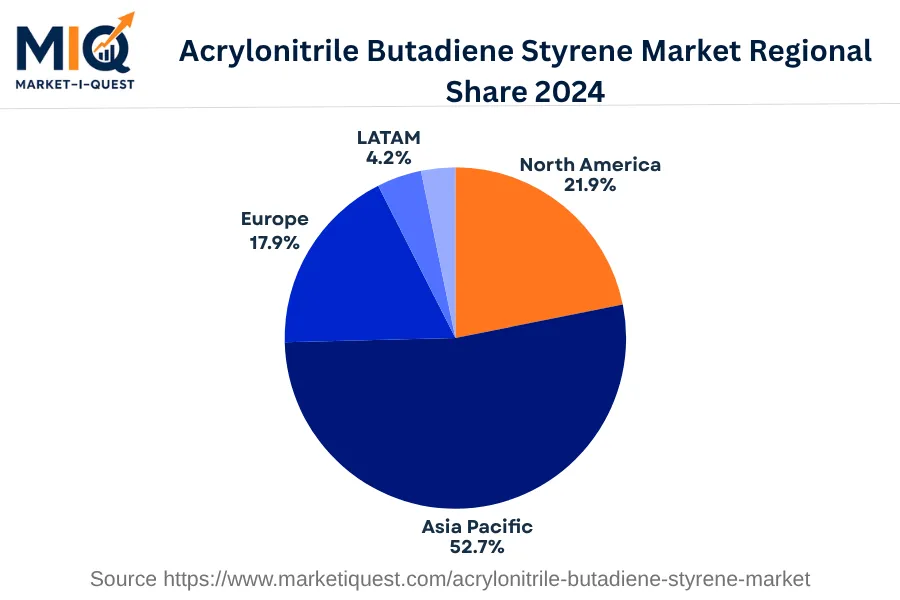
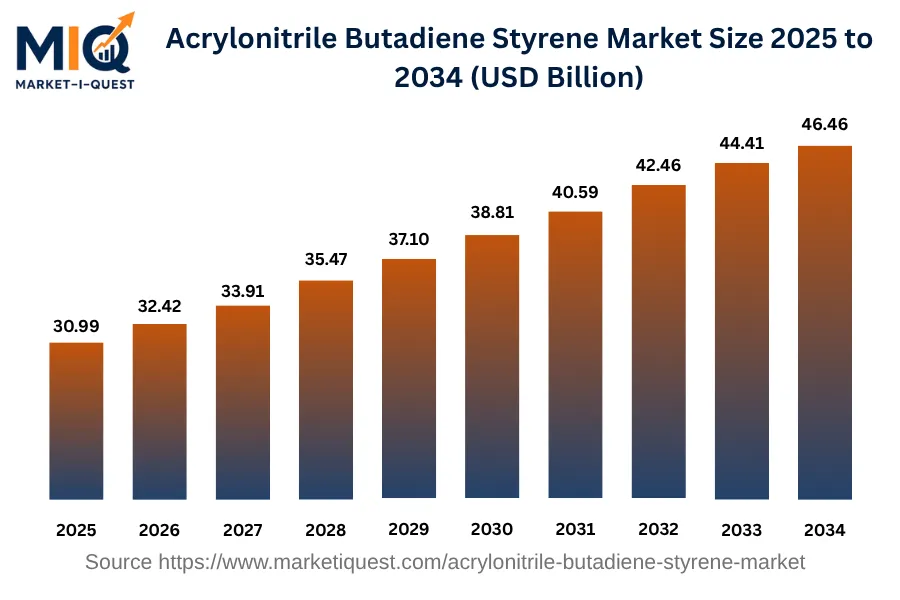
The Acrylonitrile Butadiene Styrene Market valued at $30.99 billion in 2025 and is projected to reach $46.46 billion by the year 2034, growing at a CAGR of 4.6%. Over the course of these years, the market is seen embarking on a steady growth path, a function of its intrinsic properties that serve a wide range of applications across industries. The significant rise from $29.63 billion in 2024 to nearly $31 billion merely a year later testifies the market's positive momentum. Even so, the most substantial growth is seen in the latter part of the forecast period - from 2025 to 2034. However, the regional share distribution indicates that a significant majority of the market share is held by Asia Pacific with 52.7%, followed by North America with 21.9%. Europe comes next with a relatively moderate share of 17.9%, while Latin America and Middle East & Africa carrying the smaller shares of 4.2% and 3.2% respectively.

Key Takeaways

  • By Type - Transparent dominated the market holding a significant share.
  • By End Use Industry - Automotive emerged as the leading subsegment highlighting a significant growth.
acrylonitrile-butadiene-styrene-market market size

Key Driving Factors

Adoption of ABS in Automotive Industry

The acrylonitrile butadiene styrene (ABS) market is being energized by its growing adoption within the automotive industry. ABS's properties of toughness, impact resistance and easy moldability are highly appreciated in this sector. Various automotive components, including dashboards, wheel covers, and body parts, are made from ABS, minimizing vehicle weight and thus improving fuel efficiency. With the increasing focus on reducing greenhouse gas emissions, automakers are progressively shifting towards lightweight materials such as ABS. Besides, ABS enables recyclability and promotes sustainability goals, aligning with the current automotive industry trends of circular economy adoption.

Enhanced 3D Printing Capabilities

As acrylonitrile butadiene styrene (ABS) is friendly to 3D printing processes due to its strength and heat resistance, the rise in 3D printing applications is playing a pivotal role in driving the ABS market. ABS is often the material of choice in 3D printing, used for creating robust and heat-resistant components and devices. From consumer goods to industrial machinery and healthcare equipment, 3D printing applications are varied and widespread. As manufacturers continuously explore ways for minimizing production time and cost, the use of ABS in 3D printing is expected to continue rising, driving ABS market expansion.

Market Evolution by Timeline

2019-2023
In this period, automotive and consumer goods industries were primary buyers of Acrylonitrile Butadiene Styrene (ABS), primarily due to ABS's strength and heat resistance. Asia-Pacific, particularly China and India, noted increased ABS demand due to expanding manufacturing sectors. ABS suppliers enhanced their production capacities, but faced sourcing issues for raw materials such as propylene. Regulations such as REACH in Europe and TSCA in the US influenced the ABS market, driving towards safer manufacturing processes and use of safer additives. Pricing was competitive due to several players in the market with contract manufacturing being the prevalent purchase model.
2024
In 2024, the electronics industry emerged as a significant buyer alongside ongoing demand from automotive and consumer goods sectors. A focus on light-weight and durable materials increased ABS's popularity. Production capabilities had improved, but ABS manufacturers still struggled with fluctuating raw material costs. ABS recycling became more regulated under initiatives such as China's 'Extended Producer Responsibility'. ABS prices remained competitive with contract manufacturing still being the primary purchase model. The rising costs of raw materials introduced potential risk in this year.
2025-2029
Buyers from the construction industry will likely begin using ABS extensively due to its durability and ease of shaping, while the electronics industry is expected to continue its demand. The need for ABS in Asia-Pacific might remain high during this period. ABS manufacturers will likely initiate significant investment in recycling technology, reducing the impact of raw material availability on supply. Stringent regulations around plastic waste under the EU Waste Framework Directive may affect ABS production. Costs would stay competitive, with growing preference for long-term contracts for reducing raw material price risks. Overall, procurement costs and the regulation of plastic waste will likely be the key challenges in this period.
2030-2034
The demand for ABS might continue to rise, leading by the electronics and construction sectors, in addition to new opportunities in the renewable energy sector, specifically in solar panel manufacturing. ABS demand in Africa and Latin America will likely increase notably, following a boom in their manufacturing sectors. Manufacturers might majorly shift towards using recycled ABS, may affect by strict environmental regulations and the EU Circular Economy Action Plan. Prices might stay competitive, with high-volume, long-term contracts being the common purchase model. Volatility in energy prices will likely impact manufacturing costs, making cost prediction a challenge for manufacturers.

Future Market Outlook

Future Opportunities

The opportunities for the acrylonitrile butadiene styrene industry are closely tied to ongoing innovations and increasing demand across various sectors. The shift towards electric vehicles has created a growing need for lightweight materials, and ABS manufacturers can expand their offerings to capture this segment effectively. Companies such as BASF have already begun collaborations with automotive manufacturers to develop ABS tailored to meet the specific requirements of electric vehicle components, indicating that demand for specialized materials will rise. Furthermore, regulatory developments worldwide, such as the Federal Trade Commission's focus on sustainability claims, offer opportunities for ABS producers to market more sustainable product lines. There is also an increasing trend toward customization in 3D printing, which correlates with the anticipated growth of ABS applications in this field. Organizations such as ASTM International are actively working on standards for 3D printing processes, which can prompt more manufacturers to integrate ABS into their production lines. As the packaging industry looks for materials that can provide durable yet lightweight solutions while adhering to new regulations, the role of ABS expands further. Environmental initiatives have started emphasizing the need for recyclable materials in packaging, making ABS adaptable to evolving consumer needs and compliance.

Segmentation Analysis

By Type

The market is divided into subsegments including Opaque, Transparent, and Colored. The Transparent subsegment accounted for the largest revenue share while the Colored subsegment is expected to grow at the fastest Compound Annual Growth Rate (CAGR) during the forecast period.

Largest Revenue Share

Transparent

Market Share Leader

The Transparent subsegment leads the market due to several factors. First, the straightforward nature of transparency appeals to consumers as it allows for easy visibility of products, which is highly demanded in packaging and electronics applications. Secondly, the regulations in several regions stress on the use of transparent materials in certain industries due to safety precautions and considerations, further driving its demand. Its ubiquitous use in a range of industries, from automotive to construction, ensures constant demand. Also, the availability and accessibility of raw materials for the production of transparent objects are quite vast, making it more affordable and thereby leading to higher purchase volumes. The preference for transparency in various sectors like electronics, where transparent screens for various display devices are highly sought after, comprehensively support our assertion that the Transparent subsegment accounts for the leading revenue share in the market.

Fastest CAGR

Colored

Forecast Period Growth Leader

The Colored subsegment is projected to show the fastest CAGR during the forecast period. This is majorly due to the recent surge in demand for customization and personalization in products across a diverse array of industries, including fashion, consumer electronics, and automotive. Users prefer colored products as it provides a sense of individuality and aesthetic appeal. Moreover, technological advancements have led to the availability of color variations at a decreasing cost. The trend of partnerships between manufacturers and color technology companies to create innovative and appealing color designs is also set to drive this subsegment's growth. However, there are adoption barriers, mainly the cost associated with changing the color schemes in established production lines. Furthermore, the question of color durability may pose near-term growth risks, but with improved manufacturing procedures and protective coatings techniques, these challenges can be managed.

By End Use Industry

The end use industry market is diversified and includes segments such as Appliances, Electrical and Electronics, Automotive, Consumer Goods, Construction, and Others. Among these, the Automotive sector takes the lion's share in terms of revenue while the Appliances subsegment is expected to see the fastest CAGR growth during the forecast period based on the trends in the base year, 2024.

Largest Revenue Share

Automotive

Market Share Leader

The Automotive segment commands the largest share in terms of revenue. This dominance can be attributed to several key factors. A burgeoning global population and increasing urbanization rates have led to a heightened demand for vehicles, particularly in emerging economies. Improvements in purchasing power and living standards across the globe have also significantly boosted vehicle sales. Further, the consumer shift towards electric and hybrid vehicles due to environmental consciousness heightens the demand within the automotive industry. Regulatory pressures, market competition, and consumer demands for better efficiency and performance are driving continuous innovation in this sector. The favorable policies and tax benefits offered by governments worldwide to encourage the production and sales of electric vehicles also add to the revenue of this segment.

Fastest CAGR

Appliances

Forecast Period Growth Leader

The Appliances sub-segment is expected to grow at the fastest rate. Factors driving its growth are multifaceted. Rapidly advancing technology and the ongoing development of smart homes and internet of things (IoT) technology have led to the evolution of traditional home appliances into smart appliances. This transformation is mainly driven by customer demands for greater convenience, more features, and energy savings. Moreover, the growth in per capita income and living standards globally has enabled consumers to spend more on these smart appliances. The increasing trend of nuclear families and the changing lifestyle and preferences of consumers have also positively impacted the sales of appliances. However, factors such as high initial cost and data security issues may pose challenges to the growth of this sub-segment.

Competitive Analysis

Key Market Players

Manufacturers / OEMs

LG Chem
South Korea
INEOS Styrolution Group
Germany
CHIMEI Corporation
Taiwan

Key Suppliers & Raw Materials

Shell
Netherlands
BASF
Germany
Dow
US

Distributors, Integrators & Channel Partners

SABIC
Saudi Arabia
Trinseo
US
Bharat Petroleum Corporation Ltd
India

Porter’s Five Forces Analysis

This analysis details the competition and influences within the Acrylonitrile Butadiene Styrene (ABS) market.

Supplier Bargaining Power

Medium

Dependence on petrochemical industry for raw materials gives moderate power to suppliers.

Buyer Bargaining Power

High

High demand in multiple industries like automotive, construction, and appliances gives buyers high bargaining power.

Threat of Substitutes

Medium

Availability of substitutes like polypropylene and PVC poses a medium substitute threat.

Threat of New Entrants

Low

High capital requirement, stringent regulations and technology barriers deter new entrants.

Competitive Rivalry

High

Presence of large incumbents with similar offerings results in high rivalry.

Regional Analysis

Geographic market dynamics and growth opportunities across key regions

Global Market Outlook

acrylonitrile-butadiene-styrene-market market regional share

North America

In 2024, the Acrylonitrile Butadiene Styrene (ABS) market in North America experienced a significant surge in demand due to advancements in various sectors and evolving industry practices. Key drivers included a surge in demand from automotive and consumer goods sectors owing to ABS's high impact resistance and toughness, which made it an ideal material choice. The shift to renewable energy increased the need for ABS-based components in wind turbines, enhancing market dynamics. Regulatory pushes for recycling and the increasing social awareness about sustainable practices amplified the demand for recycled ABS products. Lastly, technological adoption improved ABS production efficiency, making it economical and amplifying supply.

Trends observed involved a rise in e-commerce channels, increasing the accessibility of ABS products and catering to growing consumer demands. The consolidation in the ABS market through strategic partnerships and M&As aimed at raw material security and capacity expansion was noteworthy. The popularity of bio-based ABS, driven by stringent regulations on synthetic polymers usage, carved a new product path. Consumers oriented towards green applications fostered the demand for these bio-based solutions. The ABS market in Canada, Mexico, and particularly the U.S., was majorly driven by industries like healthcare, electronics, and automotive. The propensity of these sectors to adopt sustainable materials propelled the overall market performance. The North American ABS market in 2024 was a case study in how technological and regulatory trends can spur industrial material demand.

Asia Pacific

In 2024, the Acrylonitrile Butadiene Styrene (ABS) market in Asia Pacific showed robust characteristics, influenced by diverse factors. Demand for ABS, arising from increasing investment in the automotive and consumer electronics industries, particularly in China, India, and Japan, fueled expansion. Regulations regarding plastic waste management in India and China intensified the shift toward recyclable ABS products, echoing an investment toward environmentally-friendly technologies. Australia’s thriving 3D printing sector contributed to rising ABS consumption due to its excellent durability and ease of use. Conversely, supply dynamics experienced volatility due to price fluctuations in the crude oil market, indirectly affecting ABS pricing.

Changing purchasing behavior was evident in key markets such as South Korea and Australia, where consumers increasingly embraced ABS-based goods due to their durability and environmental credentials. Technological advancements precipitated ABS application scope expansion into new sectors, such as healthcare and utilities. Strategic partnerships were prevalent, for example, between ABS manufacturers in ASEAN markets and international tech firms to catalyze ABS innovation. China, meanwhile, reinforced its ABS quality standards to stimulate domestic output and ensure export competitiveness. Collectively, ABS adoption spans multiple sectors, from traditional manufacturing to retail, due to its versatile properties and broadening application range.
Europe

In the base year of 2024, the Acrylonitrile Butadiene Styrene (ABS) market in Europe exhibited robust growth dynamics driven by several notable factors. Increased demand from sectors like automotive, healthcare and manufacturing driven by ABS's versatility in various applications was a key growth driver. Stricter environmental regulations triggered greater investment in ABS, deemed a more sustainable alternative to traditional materials. Additionally, advanced technology adoption in production processes enhanced efficiency in the ABS supply chain while stabilizing pricing.

Trends molding the market landscape included a significant shift in buyer behavior; consumers sought more eco-friendly, durable materials, propelling ABS demand. Progressive product developments coupled with emerging technologies in manufacturing drove the market towards innovative ABS-based products. Noteworthy channel dynamics were marked by heightened e-commerce penetration, influencing the ways products and services were marketed and delivered. There was a marked increase in partnerships and M&A activities as companies aimed to consolidate their positions. Finally, stringent policy enforcement across key markets like Germany, the UK, France and Italy influenced the market dynamics, fostering a more competitive and regulated ABS market in Europe.

Latin America

In 2024, the Acrylonitrile Butadiene Styrene (ABS) market in Latin America has proven dynamic and expanding, significantly contributed by countries including Brazil, Mexico, Argentina, Columbia, Chile, and Peru. A surge in demand for durable and lightweight materials in automotive and electronics sectors has driven the ABS market. Regulatory policies favoring sustainability and recyclability have also encouraged the use of ABS materials, particularly in Mexico and Argentina where government focus on eco-friendly practices is evident. Moreover, companies in the region are adopting innovative manufacturing technologies, increasing the market's accessibility and further driving growth.

Trends transforming the market are largely centered around buyer behavior and channel dynamics. The heightened need for 'green' products in the manufacturing and retail sectors has led to increased preference for ABS as a sustainable solution. Additionally, the adoption of ABS in healthcare equipment, due to its resilience and safety features, reflects a shift in product application. The notable uptick of e-commerce in countries like Brazil and Chile, providing easy access to ABS-based products, further solidifies a shift in channel dynamics. Lastly, strategic partnerships and acquisitions have been widespread, highlighting consolidation trends, primarily in the enterprise sector.

Middle East & Africa

The Acrylonitrile Butadiene Styrene (ABS) market in the Middle East and Africa marked a significant position in 2024. Economic diversification efforts by Saudi Arabia, United Arab Emirates, and Qatar enhanced demand, fuelled by industrial expansion and infrastructural development. Technological adoption helped Nigeria and South Africa to streamline ABS manufacturing processes, leading to improved supply dynamics. However, high import duties in Egypt impacted trade dynamics negatively, causing a spike in regional ABS pricing.

Burgeoning technological advancements drove a shift towards high-impact ABS in automotive, electronic,g and telecommunication industries in Kenya and Israel. Strong alliances, such as the partnerships between manufacturers and governments of UAE and Saudi Arabia, buoyed ABS market development. In countries with stricter environmental standards like South Africa and Israel, sustainable routes to ABS production were gaining traction. Significant demand generated from sectors like automotive manufacturing in Nigeria, consumer electronics in South Africa with ABS featuring prominently in manufacturing automobile parts and electronic appliances. Healthcare industries in Israel and UAE showed an increased preference for ABS due to its high tensile strength. ABS use in 3D printing technology witnessed an upward trend, particularly in the education sectors of Qatar and Egypt. Despite adverse regulatory practices impacting pricing, the ABS market held its ground, driven by emerging trends and localized demand factors in 2024.

Recent Industry Developments

Latest market innovations, product launches, and strategic initiatives

September 2025

Supreme Petrochem Ltd officially opened its new ABS manufacturing plant, adding 90,000 tons of total production capacity to the market.

August 2025

INEOS Styrolution successfully processed recycled materials at its Antwerp facility to produce ABS plastic made of 60% recycled content.

February 2025

Trinseo launched a new ABS plastic grade containing up to 70% recycled content to reduce the need for brand-new raw materials.

Frequently Asked Questions