
5G V2X Communications Market Snapshot

Key Players

  • Qualcomm (United States)
  • Huawei Technologies (China)
  • Ericsson (Sweden)
  • Nokia (Finland)
  • Samsung Electronics (South Korea)
  • NXP Semiconductors (Netherlands)
  • Autotalks (Israel)
  • Intel Corporation (United States)
  • Continental AG (Germany)
  • ZTE Corporation (China)

Market Size

Base Year 2024
$ 1.4 Bn
CAGR
28.9%
Forecast 2034
$ 17.73 Bn

Market Segments

By Component
  • Hardware
  • Software
By Communication Type
  • Vehicle-to-Vehicle (V2V)
  • Vehicle-to-Infrastructure (V2I)
  • Vehicle-to-Pedestrian (V2P)
  • Vehicle-to-Network (V2N)
By Application
  • Intelligent Driving
  • Intelligent Transportation Systems
  • Communications and Entertainment
  • Emergency Vehicle Notification
  • Others

Market Dynamics

Drivers
  • Rising demand for connected vehicles
  • Government support for smart infrastructure
Restraints
  • High infrastructure deployment costs
  • Limited spectrum availability
Opportunities
  • Emergence of autonomous vehicle systems
  • Expansion of smart city infrastructure

Market Size

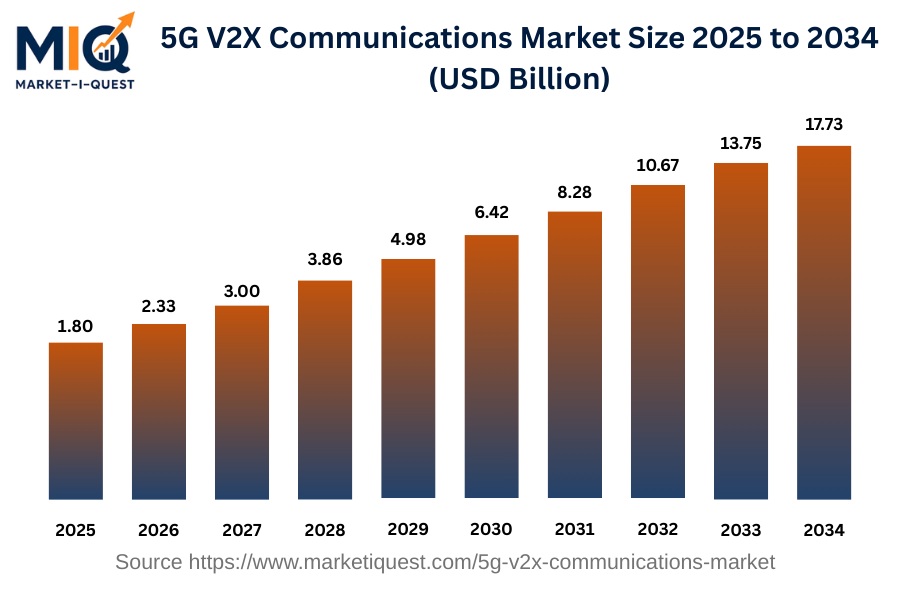
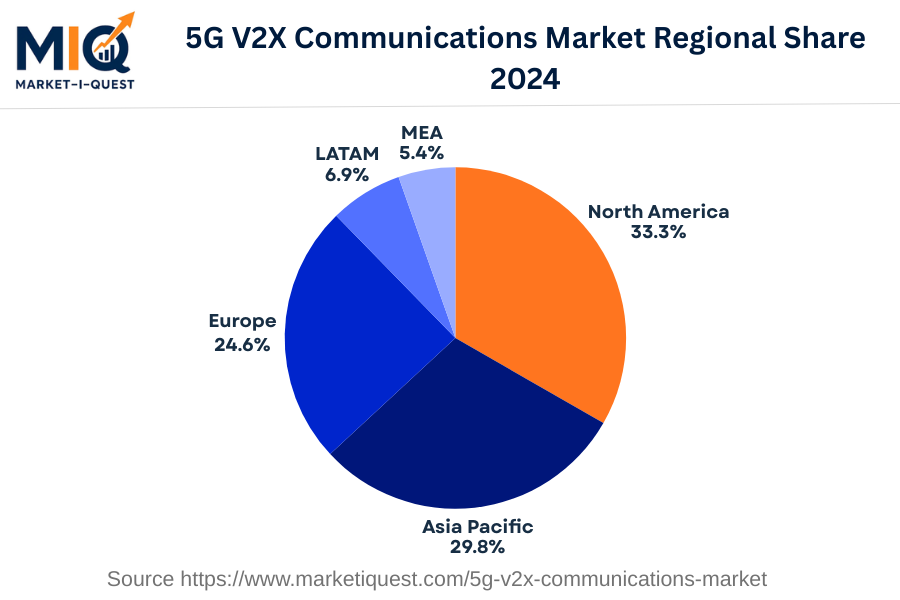
The 5G V2X communications market size is valued at USD 1.40 billion in 2024 and expands to USD 1.80 billion in 2025. By 2034, the market size reaches USD 17.73 billion, demonstrating a compound annual growth rate (CAGR) of 28.9%. The market shows a growth trajectory from USD 1.40 billion in 2024 to USD 1.80 billion in 2025, ultimately growing significantly by 2034. The adoption of 5G technology and increasing demand for connected vehicles are primary factors contributing to this growth. In 2024, the regional share mix includes North America at 23.8%, Asia Pacific at 21.3%, Europe at 17.5%, LATAM at 4.9%, and MEA at 3.9%.

Key Takeaways

  • By Component - Hardware held the leading position accounting for a significant share in 2024.
  • By Communication Type - Vehicle-to-Vehicle (V2V) emerged as the fastest-growing segment with robust expansion in market adoption.
  • By Application - Intelligent Driving captured the largest share establishing itself as a key driver in the 5G V2X Communications Market.
5g-v2x-communications-market market size

Key Driving Factors

Proliferation of Connected and Autonomous Vehicles

The ongoing trend toward autonomous and connected vehicles in the automotive industry has played a significant role in driving the 5G V2X communications market growth. The Vehicle-to-Everything (V2X) technology is critical in this context as it facilitates real-time information exchange between vehicles and their surrounding infrastructure, enhancing the safety and efficiency of transportation. This technology relies heavily on high-speed, low-latency communications, which can be fulfilled by the 5G network. As a key enabler of autonomous driving, the escalating integration of 5G V2X is therefore directly tethered to the progression of autonomous vehicles, predominantly amongst premium car manufacturers.
Smart City Initiatives and Infrastructure Development

The growing global emphasis on smart city initiatives also provides a significant growth for the 5G V2X communications market demand. Smart cities incorporate numerous technologies to enhance urban services, improve quality of life and ensure sustainable development. In this framework, 5G V2X plays a pivotal role, enabling a wide array of applications including intelligent traffic management, smart parking, and pedestrian safety. The increasing investment in smart city infrastructure, especially in technologically advanced regions like Europe and Asia Pacific, is pushing the demand for 5G V2X communication systems, leveraging the capacity of this technology to streamline urban congestion and boost overall city operations.

Market Evolution by Timeline

2019-2023
During this period, the 5G V2X communications market trend saw increasing interest primarily from automotive manufacturers. Companies like Ford and Audi began testing V2X technologies in U.S. cities such as Detroit and San Francisco. The deployment of initial use cases focused on safety applications, including Vehicle-to-Infrastructure (V2I) communications to improve traffic management. The European Union launched initiatives like the 'C-Roads' platform to enhance cooperation among nations on V2X standardization. Supply saw early deployments of 5G base stations, but challenges remained in terms of infrastructure cost and legacy system integration. Commercial models evolved, with manufacturers and mobile network operators exploring revenue-sharing agreements for V2X services. Concerns over cybersecurity and privacy became prominent, prompting industry stakeholders to advocate for stronger regulatory frameworks, including the European GDPR impacting data utilized in V2X applications. Overall, the market began laying foundational elements while navigating varied regional advances and regulatory landscapes.
2024
In 2024, a rise in 5G network rollouts worldwide boosted the 5G V2X communications market expansion. The United States and South Korea emerged as leaders in deployment, with cities like Los Angeles and Seoul implementing dedicated V2X pilot programs. Manufacturers like Tesla integrated advanced V2X features into their vehicles, focusing on autonomous driving and improved navigation systems. The introduction of the 3GPP Release 16 standards provided a clearer framework for V2X technology adoption. Partnerships grew among automotive companies, telecommunications firms, and local governments to co-develop smart city projects. Pricing strategies shifted towards subscription models for V2X services, allowing users to access real-time data feeds. However, challenges persisted with interoperability between different manufacturers' systems and delays in regulatory approvals for deployment in specific regions. Overall, these factors shaped a more connected landscape, while stakeholders worked to mitigate the risks associated with data sharing and system vulnerabilities.
2025-2029
From 2025 to 2029, the 5G V2X communications market matured as large-scale deployments became common. Countries such as China and Germany launched nationwide V2X programs, with major cities implementing smart traffic signals and connected vehicle infrastructures. Fleet operators, including logistics companies, began adopting V2X technology to enhance operational efficiency and reduce costs. Major automotive manufacturers collaborated to establish interoperability standards, which helped to alleviate some integration issues. The market saw consolidation as smaller firms faced difficulties in competition, leading to more strategic partnerships and acquisitions. Pricing adjusted to incorporate bundled services, blending connectivity, data analytics, and software solutions. Regulatory bodies issued clearer guidelines regarding cybersecurity for V2X communication, driven by rising public concerns. Despite progress, challenges, particularly in rural areas lacking adequate 5G coverage, threatened to widen the digital divide. Collaborative efforts emerged to provide mobile coverage solutions in underserved regions, balancing equity and development.
2030-2034
During the period from 2030 to 2034, the 5G V2X communications market became an integral part of urban mobility solutions. Global cities like Tokyo and Paris showcased fully integrated transportation ecosystems combining public transit, private vehicles, and autonomous systems communicating in real-time. Major automotive brands offered V2X capabilities as standard features in new models, and consumers increasingly demanded these functionalities for safety and convenience. Infrastructure investments from government bodies supported widespread rollout of smart traffic management systems. The establishment of international regulatory frameworks further standardized operations across regions, reducing barriers to adoption. Subscription-based models became the norm, allowing users to access enhanced V2X services based on tiered usage. However, challenges persisted, particularly in addressing privacy issues and ensuring data security in a hyper-connected environment. Concerns about technological equity remained, with ongoing dialogue on access to V2X technologies for all socioeconomic groups. Efforts to comprehensively address these risks continued, shaping the future of mobility.

Future Market Outlook

Future Opportunities

Looking ahead, numerous gaps in the 5G V2X communications market present notable opportunities for growth and development. As of early 2023, approximately 50% of global automakers have plans to adopt V2X technology in the next two years, suggesting a ripe environment for ancillary service providers. Regions like Europe are actively working on regulatory frameworks aimed at harmonizing the use of V2X technologies. For example, the European Union's connectivity strategy launched in early 2023 emphasizes the importance of V2X for enhancing urban mobility. In the United States, tests conducted in California since 2022 have revealed areas where V2X can significantly improve traffic efficiency, highlighting opportunities for technology suppliers to innovate solutions. Similarly, automakers seeking to enhance their competitive edge may invest in strategic partnerships, drawing on the ongoing collaboration between Honda and Verizon, which began in late 2022. Moreover, as security concerns arise with increased connectivity, opportunities in the cybersecurity sector are growing. As cybersecurity challenges have been documented in various public reports since 2021, tailored security solutions for V2X systems can create a significant niche market. Overall, the convergence of regulatory support, automotive interest, and technological advancements suggests a dynamic future landscape for 5G V2X communications, wherein various stakeholders can play critical roles in shaping effective solutions.

Segmentation Analysis

The 5G V2X communications market is segmented by Component (Hardware, Software), by Communication Type (Vehicle-to-Vehicle (V2V), Vehicle-to-Infrastructure (V2I), Vehicle-to-Pedestrian (V2P), Vehicle-to-Network (V2N)), and by Application (Intelligent Driving, Intelligent Transportation Systems, Communications and Entertainment, Emergency Vehicle Notification, Others).

By Component

Analysis of subsegments: Hardware and Software.

Largest Revenue Share

Hardware

Market Share Leader

The hardware subsegment leads in revenue primarily due to its foundational role in various technology ecosystems, providing the physical infrastructure necessary for software applications. This includes servers, networking equipment, and devices that form the backbone of both consumer and enterprise environments. The demand for high-performance and reliable hardware is driven by diverse customers across industries, from healthcare to finance, who require robust solutions to handle increasing data loads and processing demands. Geographically, regions with established technology industries, such as North America and Asia-Pacific, contribute to a large share of hardware sales. Regulatory pressures around security and data compliance also propel investments in advanced hardware solutions that comply with standards. Furthermore, businesses prioritize hardware that seamlessly integrates with their existing systems, resulting in lower switching costs and a reliance on established industry players. Distribution channels are well-defined, with many manufacturers leveraging both direct sales and partnerships with resellers and integrators to reach end-users efficiently. As these businesses continue to upgrade their infrastructure to support digital transformation initiatives, hardware remains a crucial aspect of their technology strategy and thus sustains its revenue lead.

Fastest CAGR

Software

Forecast Period Growth Leader

The software subsegment is projected to exhibit the fastest CAGR as organizations increasingly move toward cloud-based solutions and digital transformation initiatives. There is a significant shift in enterprise spending towards software that enables remote work, collaboration, and improved data analytics capabilities, driven by recent global disruptions. However, challenges such as navigating legacy systems and ensuring integration with existing workflows can slow adoption. Nevertheless, technological advancements, including artificial intelligence and machine learning, act as catalysts, creating new software capabilities that enhance business operations. Policies promoting digital innovation encourage companies to invest in these software solutions, while partnerships between tech firms often spur enhancements that meet evolving customer needs. Despite these growth drivers, near-term risks include potential cybersecurity vulnerabilities and the fast pace of technological change, which may leave some businesses behind. Organizations that effectively address these risks by investing in training and security measures are better positioned to reap the benefits of software advancements. While switching costs may vary, the overall trend toward SaaS models reduces barriers to entry, making it easier for new solutions to gain traction among adopters seeking agile and scalable software options.

By Communication Type

Analysis of subsegments: Vehicle-to-Vehicle (V2V), Vehicle-to-Infrastructure (V2I), Vehicle-to-Pedestrian (V2P), Vehicle-to-Network (V2N).

Largest Revenue Share

Vehicle-to-Infrastructure (V2I)

Market Share Leader

Vehicle-to-Infrastructure (V2I) is poised to generate the highest revenue in 2024 due to its essential role in enhancing traffic management and improving road safety. This subsegment benefits from growing regulatory support, as governments increasingly mandate the deployment of connected infrastructure to reduce accidents and congestion. Major cities worldwide are investing significantly in smart infrastructure, which includes traffic signals, road signs, and sensors, all designed to facilitate seamless communication with vehicles. With a growing number of automotive manufacturers incorporating V2I technology into their new models, the adoption rate is expected to surge among consumers who are increasingly prioritizing safety and efficiency in their vehicles. The large-scale deployment of 5G technology enhances the viability of V2I, enabling real-time data exchange between vehicles and infrastructure, which improves decision-making and response times. Additionally, the collaboration between private firms and public agencies to develop integrated transportation systems further bolsters the demand for V2I solutions. The ongoing push for smart city initiatives across several geographies, particularly in North America, Europe, and parts of Asia, indicates that V2I will remain a dominant revenue driver as the automotive and urban development industries continue to evolve.

Fastest CAGR

Vehicle-to-Pedestrian (V2P)

Forecast Period Growth Leader

Vehicle-to-Pedestrian (V2P) is projected to experience the fastest growth rate driven by the increasing emphasis on pedestrian safety and urban livability. As cities become more congested and pedestrian traffic increases, the need for effective communication between vehicles and pedestrians becomes critical. Technological advancements such as smartphone applications and wearable devices that allow pedestrians to communicate their presence to nearby vehicles are gaining traction, which supports the growth of V2P. Moreover, the rise of autonomous and semi-autonomous vehicles places a premium on technologies that enhance pedestrian safety, thereby propelling investments into V2P solutions. However, adoption barriers remain, such as the need for widespread infrastructure upgrades and the establishment of standardized protocols for interaction between vehicles and pedestrians. Catalysts for near-term growth include partnerships between tech companies and automotive manufacturers to develop integrated V2P systems, alongside supportive government policies promoting smart mobility initiatives. Despite these positive factors, risks such as data privacy concerns and the slow pace of regulatory approval could impact adoption rates. Overall, the momentum for V2P is strong as cities prioritize safety enhancements and embrace smart technology solutions.

By Application

Analysis of subsegments: Intelligent Driving, Intelligent Transportation Systems, Communications and Entertainment, Emergency Vehicle Notification, Others.

Largest Revenue Share

Intelligent Driving

Market Share Leader

Intelligent Driving leads in revenue generation as it reflects a transformative approach to vehicle operation, focusing on automation, safety, and enhanced consumer experiences. This segment benefits from substantial investment from automotive manufacturers and technology companies who prioritize sensor technologies, artificial intelligence, and machine learning to improve vehicle functionality. The demand is evident across major automotive markets, led by North America, Europe, and increasingly in Asia-Pacific regions. Conventional consumers and fleets prioritize autonomous features for safety, efficiency, and cost savings, thus driving adoption. Regulatory frameworks, especially in regions like Europe and North America, are increasingly supportive of innovative safety features, influencing purchasing decisions. Additionally, partnerships between tech firms and auto manufacturers facilitate a quicker rollout of smart features, establishing a competitive edge in the market. The high upfront investment in R&D and the potential for long-term cost reductions in operational expenses provide compelling reasons for stakeholders to invest heavily in this subsegment. Furthermore, consumers are willing to pay a premium for vehicles that offer advanced driving capabilities, contributing further to revenue growth within the Intelligent Driving sphere, which is expected to maintain its leadership position due to its alignment with consumer safety demands and technological advancements.

Fastest CAGR

Intelligent Transportation Systems

Forecast Period Growth Leader

The Intelligent Transportation Systems (ITS) subsegment is expected to experience the fastest growth due to rising urbanization and the pressing need for efficient traffic management solutions. As cities worldwide increasingly face congestion and infrastructure challenges, there is a growing emphasis on harnessing technology to improve transportation efficiency. Partnerships between government bodies and tech innovators drive the deployment of smart traffic signals, real-time data analytics, and connected vehicle technologies. Despite these opportunities, the ITS sector faces adoption barriers, including high initial capital expenditure and the complexity of integrating new systems with existing infrastructure. However, ongoing investments from government agencies and private sectors, alongside supportive policies promoting smarter cities, are paving the way for rapid advancements. Moreover, the push towards sustainability and reduced emissions further fuels the adoption of ITS, as these systems can significantly improve traffic flow and reduce vehicle idle times. In the near term, risks such as funding fluctuations and the need for comprehensive integration strategies may pose challenges, but notable trends indicate a robust shift towards smart city solutions, solidifying the ITS subsegment as a prominent growth area in the coming years.

Competitive Analysis

Key Market Players

The 5G V2X communications industry is competitive, with a mix of large established companies and smaller regional players. Most companies focus on improving their products/services, keeping prices attractive, and strengthening relationships with key customers. They also use partnerships, acquisitions, and new launches to expand their presence in existing and new markets. Overall, players compete on quality, reliability, and value, and competition is expected to remain strong over the forecast period.

Manufacturers / OEMs

Qualcomm
US
Nokia
Finland
Ericsson
Sweden

Key Suppliers & Raw Materials

Intel
US
Broadcom
US
Infineon Technologies
Germany

Distributors, Integrators & Channel Partners

Tech Data
US
Ingram Micro
US
Synnex
US

Porter’s Five Forces Analysis

This analysis evaluates the competitive dynamics in the 5G V2X communications market. It identifies the forces shaping the industry's structure.

Supplier Bargaining Power

Medium

Suppliers of key components face competition, but certification and technology limitations increase their bargaining power.

Buyer Bargaining Power

High

Customers have numerous options and low switching costs, increasing their leverage over suppliers.

Threat of Substitutes

Medium

Alternative communication technologies exist, but unique 5G benefits for V2X applications limit their viability.

Threat of New Entrants

Low

High capital investment and regulatory hurdles create significant barriers for new companies entering the market.

Competitive Rivalry

High

Intense competition among established players drives innovation and pricing pressures in the rapidly evolving market.

Regional Analysis

Geographic market dynamics and growth opportunities across key regions

Global Market Outlook

5g-v2x-communications-market market regional share

North America

In 2024, the 5G V2X communications market expansion in North America is characterized by the integration of advanced vehicular technologies aimed at enhancing road safety and improving traffic efficiency. Key drivers include increased investment from both private and public sectors, spurred by Federal Communications Commission initiatives promoting intelligent transportation systems. Regulatory frameworks, such as the National Highway Traffic Safety Administration’s policies, encourage adoption through safety standards requiring vehicle-to-everything communications in new vehicles. Furthermore, the rising demand for smart city initiatives in urban areas propels the development of infrastructure capable of supporting V2X technologies.

Trends indicate a shift toward collaborative partnerships among automotive manufacturers and telecom providers, aimed at developing comprehensive V2X solutions. The deployment of dedicated short-range communications (DSRC) and cellular V2X technologies is driving innovation in the automotive sector, resulting in rapid product upgrades. Enterprises in logistics and distribution increasingly leverage V2X capabilities to optimize fleet management and enhance operational efficiency. Additionally, local governments are exploring V2X solutions to improve public transportation and traffic management, signaling a shift in buyer behavior towards prioritizing safety and efficiency in transportation initiatives across the U.S., Canada, and Mexico.

Asia Pacific

In 2024, the 5G V2X communications market in Asia Pacific is characterized by significant advancements in vehicle-to-everything interactions, driven primarily by increasing demand for enhanced road safety and traffic management. Governments in China and India are implementing regulations to stimulate the adoption of intelligent transportation systems, promoting the integration of V2X technologies into urban planning. South Korea leads investments in 5G infrastructure, supporting partnerships between automotive manufacturers and telecom operators to facilitate seamless connectivity. Japan's focus on autonomous vehicles further accelerates technology adoption, enhancing the need for low-latency communication.

Trends indicate a shift toward collaborative ecosystems involving automotive, telecommunications, and tech firms framing the V2X landscape across Asia Pacific. In Australia, traditional automotive sales are adapting to include 5G-enabled vehicles, reflecting changing buyer behavior towards smart technologies. Key ASEAN markets are progressively establishing national standards to unify V2X protocols, enhancing operational consistency. Partnerships, such as between mobile network operators and smart city developers, are crucial in driving the deployment of V2X applications. Additionally, local governments are enforcing policy frameworks to regulate data security and privacy, essential to fostering consumer trust in V2X technology's capabilities across sectors including transportation, logistics, and public safety.

Europe

The 5G V2X communications market in Europe in 2024 is characterized by increasing investments and regulatory support aimed at enhancing connected mobility. The demand for safer and more efficient transportation systems drives the adoption of V2X technologies, particularly in key markets like Germany and the United Kingdom. Governments are investing in infrastructure upgrades and implementing policies such as the European Commission's Connected and Automated Mobility initiative, promoting V2X deployment. The growing adoption of advanced technologies, including AI and IoT, accelerates innovation in vehicle communication solutions.

Trends indicate a shift in buyer behavior, with automotive manufacturers investing in 5G capabilities for enhanced vehicle communication systems, while governments prioritize partnerships with telecom operators for infrastructure development. The integration of 5G enhances real-time data sharing between vehicles and infrastructure, fostering collaborations between automotive firms and tech companies. In addition, regulatory frameworks are evolving to standardize V2X technologies across member states, facilitating interoperability. Regions like the Nordics and Benelux are leading pilot programs, highlighting a focus on sustainable transport solutions. Overall, industry stakeholders adapt to a rapidly changing landscape with an emphasis on collaboration, technology integration, and regulatory compliance to realize the full potential of 5G V2X communications."

Latin America

In 2024, the 5G Vehicle-to-Everything (V2X) communications market in Latin America is characterized by increasing investments from both the public and private sectors aimed at enhancing transportation systems. The demand for improved connectivity is driven by urbanization trends, particularly in Brazil and Mexico, where smart city initiatives are gaining traction. Regulatory support, such as Brazil's National Broadband Plan and Mexico's ongoing reforms in telecommunications, encourages 5G adoption and infrastructure development.

Companies in sectors like automotive and logistics are adopting advanced technologies, including V2X communications, to enhance fleet management and improve safety. Partnerships between telecom providers and automotive manufacturers are becoming common, exemplified by collaborations aimed at deploying vehicle communication technologies in urban settings across Argentina and Colombia.

Buyer behavior is shifting toward integrated solutions that enhance traffic management and reduce accident rates. The growing emphasis on sustainability is influencing product development, with a focus on electric vehicles equipped with V2X capabilities. Additionally, governments are implementing policies that mandate 5G readiness in smart transportation projects, influencing standards and interoperability requirements. As a result, the V2X communications landscape in LATAM is evolving, reflecting both technological advancements and regulatory frameworks that facilitate market growth.

Middle East & Africa

In 2024, the 5G V2X communications market in the Middle East and Africa is characterized by growing demand for enhanced vehicular connectivity and automated transport solutions. In Saudi Arabia, Vision 2030 promotes smart city initiatives, driving investments in 5G infrastructure to support connected vehicles. The United Arab Emirates advanced its 5G rollout through the Telecom Regulatory Authority, enhancing V2X capabilities amid rising road safety concerns. Rising partnerships between telecom companies and automotive manufacturers in Egypt and South Africa further enable integration of 5G technology in vehicles, aiming to reduce traffic congestion and accidents.

Consumer behavior is shifting towards smart transportation as urban populations grow. In South Africa and Nigeria, increasing government support and policy enforcement for smart mobility solutions lead to expansion in the transport sector. In Kenya, mobile network operators are actively collaborating with local governments to implement 5G V2X applications in public transport systems. The regulatory frameworks surrounding transportation safety in Israel foster innovative V2X applications in government fleets. Furthermore, a shift towards standardization in V2X technologies is observed in Qatar, aiming to streamline development efforts across manufacturers and investors in the market. Such trends reflect a significant movement towards creating smarter, safer, and more efficient transportation ecosystems.

Recent Industry Developments

Latest market innovations, product launches, and strategic initiatives

Feb 2026

In Paris, the 5G Automotive Association (5GAA), BMW Group, and Viasat demonstrated 5G‑V2X Direct plus satellite (non‑terrestrial networks) connectivity for emergency messaging and hazard warnings, showing seamless switching between cellular and satellite and real‑traffic protection of vulnerable road users through shared sensor data between vehicles.

Aug 2025

Reliance Jio highlighted its 5G‑based V2X platform as part of its national 5G rollout, targeting intelligent transportation use cases such as smart traffic control, cooperative collision avoidance, and autonomous driving that leverage 5G’s ultra‑low latency and high bandwidth for real‑time V2X communication.

Dec 2024

5GAA released the third edition of its C‑V2X roadmap, projecting mass deployment of 5G‑V2X Direct‑enabled vehicles and services from 2026–2029, with an emphasis on direct vehicle‑to‑vehicle communications to enhance safety and efficiency in advanced driving use cases.

Frequently Asked Questions